Research

Oil Change International publishes upwards of 20 reports and briefings every year focused on supporting the movement for a just phase-out of fossil fuels.

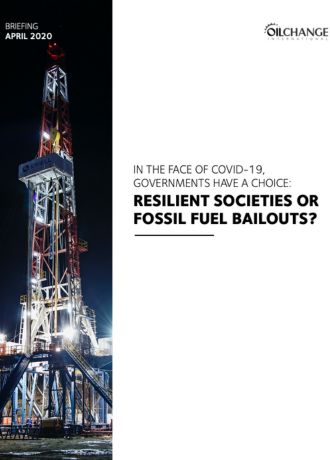
In the Face of COVID-19, Governments Have a Choice: Resilient Societies or Fossil Fuel Bailouts?

The COVID-19 crisis poses a threat to people's health, their jobs and their lives, and like all crises, exacerbates already existing inequalities. Trillions in public finance will be needed to get through the current pandemic. This briefing outlines why continuing to rely on fossil fuels, in particular oil and gas, is not compatible with long-term recovery. It does not make sense to use the COVID-19 stimulus packages to try to revive a sunsetting industry which will not deliver on economic recovery, only to shut it down a few years later to meet climate goals.
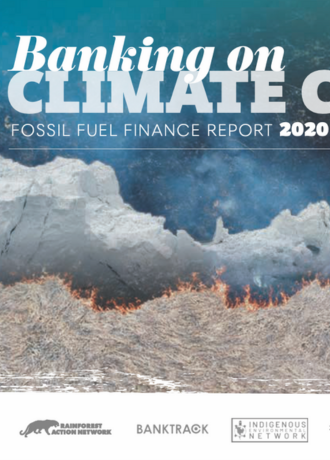
Banking on Climate Change 2020: Fossil Fuel Finance Report Card

A new report, Banking on Climate Change 2020, reveals that 35 private-sector banks across Canada, China, Europe, Japan, and the U.S. have financed fossil fuels with USD $2.7 trillion since the Paris Agreement was adopted (2016-2019), with financing on the rise each year. The report finds that fossil fuel financing continues to be dominated by the big U.S. banks – JPMorgan Chase, Wells Fargo, Citi, and Bank of America – together, these four banks account for a staggering 30% of all fossil fuel financing from the 35 major global banks since the Paris Agreement was adopted.

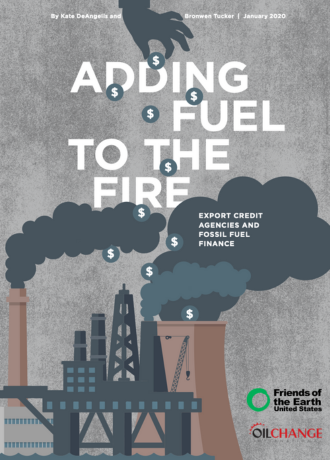
Adding Fuel to the Fire: Export Credit Agencies and Fossil Fuel Finance

This report from Oil Change International and Friends of the Earth U.S. shows that since the Paris Agreement was made, G20 countries have used their export credit agencies to provide nearly 12 times more finance to fossil fuels than to clean energy. 

Open Letter to EIB President: It’s time to stand firm and go Fossil Free

Over 70 organizations call on the European Investment Bank (EIB) leadership to stand firm behind a draft lending policy that, if adopted, would rule out future fossil fuel financing from the bank.

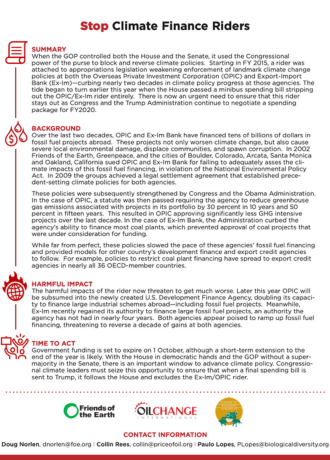
Briefing: Why Congress Must Stop Blocking Climate Progress on International Finance

There is an urgent need to ensure that anti-climate riders stay out of appropriations packages for Fiscal Year 2020 as Congress and the Trump Administration continue to negotiate a spending package.

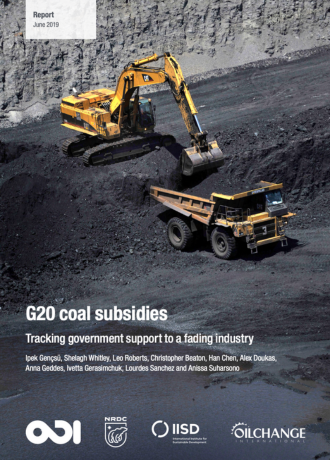
G20 Coal Subsidies: Tracking Government Support to a Fading Industry

G20 governments continue to provide billions of dollars for the production and consumption of fossil fuels. This report finds that they provide at least USD $63.9 billion per year in government support to the production and consumption of coal alone, with almost three-quarters of the support identified being directed to coal-fired power production.

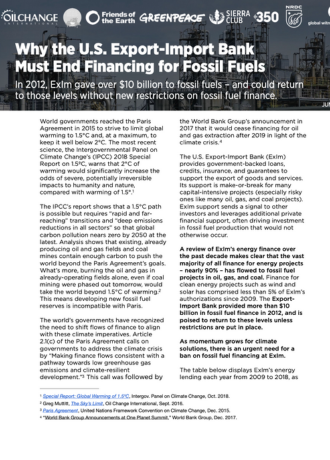
Briefing: Why the U.S. Export-Import Bank Must End Financing for Fossil Fuels

Over the past decade, nearly 90% of the U.S. Export-Import Bank's total finance for energy projects has flowed to projects in oil, gas, and coal. As momentum grows for climate solutions in the U.S. and abroad, there is an urgent need for a ban on fossil fuel financing at ExIm.

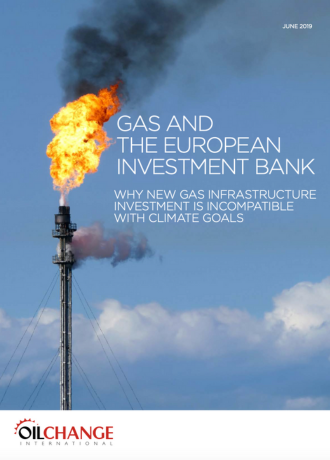
Gas and the European Investment Bank: Why New Gas Infrastructure Investment Is Incompatible with Climate Goals

There is no room for further financing of fossil gas or any other fossil fuel projects by the EIB. This briefing calls for the new Energy Lending Policy to reflect this reality. The EIB cannot claim to uphold its commitment to align its finance with the Paris Agreement if it continues to finance fossil gas projects.

Briefing: Carbon Pricing and the Multilateral Development Banks

To help inform the alignment of the MDBs with the Paris Agreement, this briefing explores the use of shadow carbon pricing by MDBs and considers some best practices and limitations in the application of shadow carbon prices.

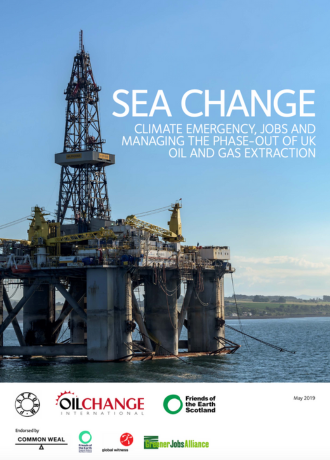
Sea Change: Climate Emergency, Jobs and Managing the Phase-Out of UK Oil and Gas Extraction

This new report reveals, for the first time, the climate impact of North Sea oil and gas extraction, and shows the way to a job-creating energy transition. To deal with the climate emergency, the UK needs to immediately stop approving new oil and gas drilling and redirect support to clean jobs and renewable energy.