
“Giant Leap Backwards” as Fossil Fuel Emissions Reach Record High
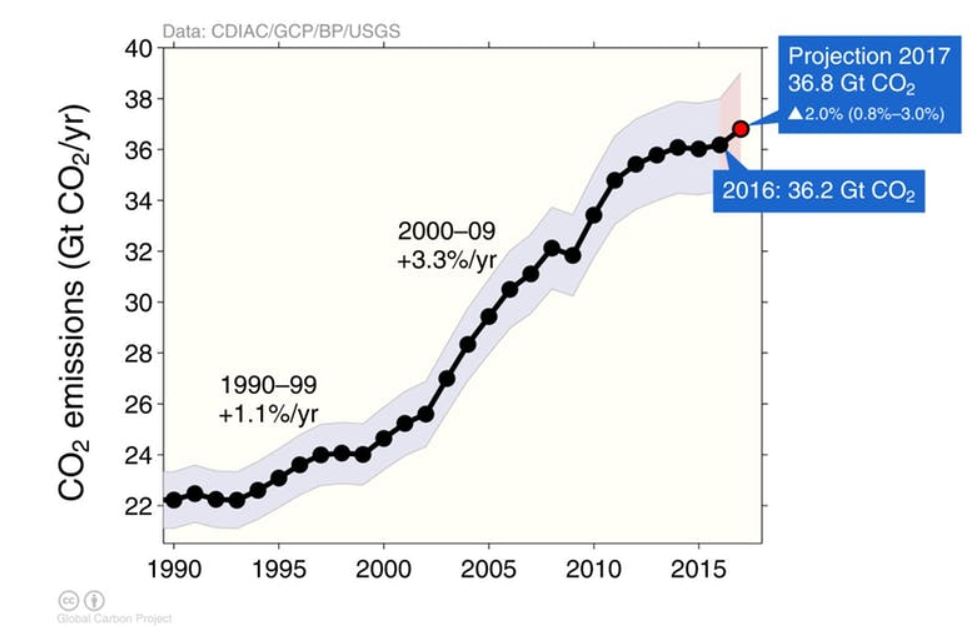
New research published today and presented at the UN climate talks in Bonn, predicts that following three years of almost no growth, the burning of fossil fuels will reach a record high this year.

C: Global Carbon Project
New research published today and presented at the UN climate talks in Bonn, predicts that following three years of almost no growth, the burning of fossil fuels will reach a record high this year.
The Global Carbon Project, an international research consortium of 57 academic institutions, has been examining fossil fuel emissions for over a decade.
Their latest research is published today simultaneously in Nature Climate Change, Earth System Science Data Discussions and Environmental Research Letters, and they reveal that global emissions of carbon dioxide will reach 37 billion tonnes in 2017, following a projected 2% rise in burning of fossil fuels. This comes after three years of “almost no growth”.
Total emissions, including from land clearing, increase the total to 41 billion tonnes.
The scientists are pointing to an increased use of coal in China, as well as a small increase in the US, as the main cause of the renewed growth in carbon dioxide emissions.
Emissions in China, which produces nearly 26% of the world’s output of CO2, are expected to surge by 3.5%, to 10.5 billion tonnes. China has used more coal this year, in part due to reduced rainfall meaning that its hydroelectric plants were not working to capacity.
Lead researcher, Professor Corinne Le Quéré, director of the Tyndall Centre for Climate Change Research at UEA, said: “Global CO2 emissions appear to be going up strongly once again after a three year stable period. This is very disappointing.”
She continued: “With global CO2 emissions from human activities estimated at 41 billion tonnes for 2017, time is running out on our ability to keep warming well below 2ºC let alone 1.5ºC. This year we have seen how climate change can amplify the impacts of hurricanes with more intense rainfall, higher sea levels and warmer ocean conditions favouring more powerful storms. This is a window into the future. We need to reach a peak in global emissions in the next few years and drive emissions down rapidly afterwards to address climate change and limit its impacts”.
Professor Le Quéré also said that the use of oil and gas has to decline too: “There have been lots of ups and downs in the use of coal but in the background there has been no weakening in the use of oil and gas. And that is quite worrisome.”
Others were equally critical. “The news that emissions are rising after the three-year hiatus is a giant leap backwards for humankind,” said Amy Luers, executive director of Future Earth, a global research initiative and sponsor of the report. “Pushing the Earth closer to tipping points is deeply concerning. Emissions need to peak soon and approach zero by 2050.”