Research

Oil Change International publishes upwards of 20 reports and briefings every year focused on supporting the movement for a just phase-out of fossil fuels.

Wasting Public Money: Germany’s Financial Support for Fossil Fuels Abroad

Research released today by Oil Change International and ClientEarth, Wasting Public Money, reveals how Germany is at risk of watering down a 2021 pledge to end taxpayer-backed financing of fossil fuel projects overseas. It outlines Germany’s long-term international role as a significant backer of fossil fuel projects overseas, sounds the alarm that the German coalition may soon seek to weaken their guidelines restricting international fossil fuel finance, and reveals that Germany is considering nearly EUR 1.2 billion in support for overseas fossil fuel projects.

Holding Course, Missing Speed: Protecting progress on ending fossil fuel finance and unlocking clean energy support

This report finds that CETP members cut fossil fuel finance by up to 78% but need to rapidly scale up finance for renewables and close loopholes that allow continued fossil finance.

Letter: Global North leaders must redirect trillions from fossils, debt, and the 1% to address global crises

150+ economists and policy experts including Yanis Varoufakis, Jason Hickel, and Olúfémi O. Táíwò are calling on Paris Summit leaders to ensure real global financial system transformation is on the agenda.

Briefing: G20 government finance enabled 82% of LNG export infrastructure expansion, breaking climate promises

This new briefing shows G20 government institutions were involved in financing 82% of new Liquefied Natural Gas (LNG) export terminal capacity built from 2012-2022, providing at least USD 78 billion in loans, guarantees, and equity investments for new LNG export terminal capacity projects.

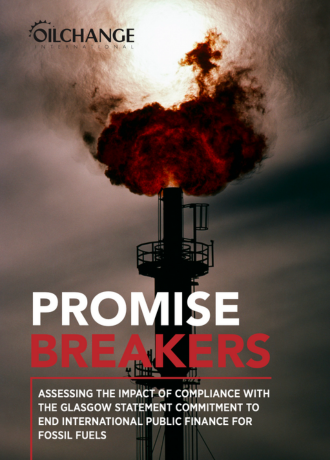
Promise Breakers: Assessing the impact of compliance with the Glasgow Statement commitment to end international public finance for fossil fuels

New research shows stop funding fossils commitment forged at the 2021 UN climate summit is already shifting an estimated USD 5.7 billion per year out of fossil fuels and into clean energy. If all signatories fulfill their commitments, then a further 13.7 billion per year will be shifted out of fossil fuels and into clean energy.

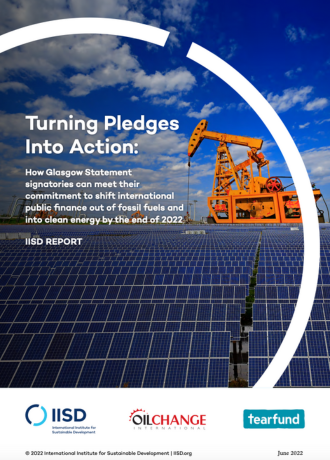
Report: Countries could shift almost USD 28 billion/year from fossil fuels to jump-start the energy transition—if they follow through on their pledges

The Glasgow Statement on public finance requires signatories to end new direct overseas support for fossil fuels by the end of 2022 and fully prioritize finance for a clean and just energy transition. But only a handful of signatories have begun to turn these pledges into action.

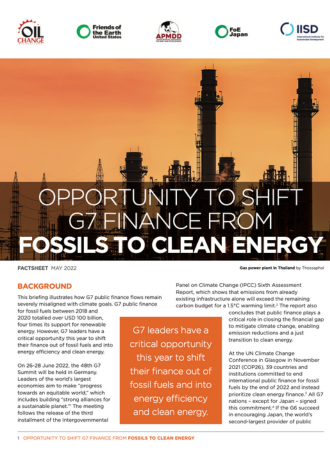
Opportunity to shift G7 finance from fossils to clean energy

This briefing illustrates how G7 public finance flows remain severely misaligned with climate goals. G7 public finance for fossil fuels between 2018 and 2020 totalled over USD 100 billion, four times its support for renewable energy.

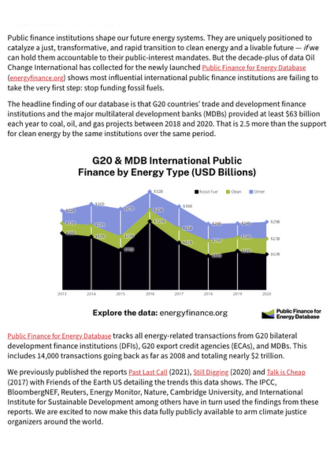
We just launched a database to expose the institutions using our money to fund fossils

Public Finance for Energy Database tracks all energy-related transactions from G20 bilateral development finance institutions (DFIs), G20 export credit agencies (ECAs), and the major multilateral development banks (MDBs). This includes 14,000 transactions going back as far as 2008 and totaling nearly $2 trillion.

Using international public finance to unlock a just transition: key trends and opportunities

This briefing explains why financial flows to fossil fuels matter and how to use the data provided by the Public Finance for Energy Database to help secure a just energy transition.

Distributed Funds for Distributed Renewable Energy: Ensuring African Energy Access Finance Reaches Local Actors

Communities in Africa have generally contributed the least to climate change, been undermined the most by international trade and finance policies, and have a right to better international support for distributed renewable energy. In order to reach universal energy access before the 2030 target set by the UN Sustainable Development Goals, international public finance institutions have an urgent responsibility to provide more funding and better financial transparency and tracking for distributed renewable energy. Additionally, they have a responsibility to foster local participation in and ownership of distributed renewable energy initiatives. This briefing provides recommendations for how international public finance institutions can fulfill this responsibility, while revealing that from 2016 to 2018, fossil fuels received more than 3.5 times the support than all kinds of renewable energy did during this period.