Research

Oil Change International publishes upwards of 20 reports and briefings every year focused on supporting the movement for a just phase-out of fossil fuels.

Sowing the Seeds of Climate Chaos: The Asian Development Bank’s Support for Gas

This new analysis finds the ADB has spent over $4.7 billion on gas since the adoption of the Paris Agreement. Plans to expand gas infrastructure in Asia pose one of the greatest threats to meeting the goals of the Paris Agreement and averting the most catastrophic impacts of the climate crisis.
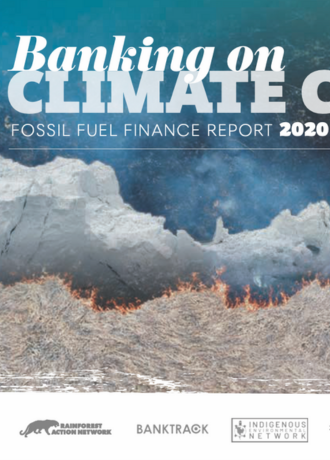
Banking on Climate Chaos 2021: Fossil Fuel Finance Report

This report analyzes fossil fuel financing from the world’s 60 largest commercial and investment banks — aggregating their leading roles in lending and underwriting of debt and equity issuances — and reveals that these banks poured a total of USD $3.8 trillion into fossil fuels from 2016–2020.

Fracking Fiasco: The Banks That Fueled the U.S. Shale Bust

A new report by Oil Change International and Rainforest Action Network (RAN) shows how major banks have continued pouring money into fracking companies in recent years despite numerous warnings that the sector was financially unsustainable — on top of the well-documented environmental, health and climate impacts of the industry.

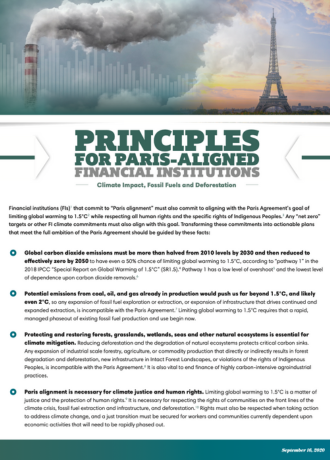
Principles for Paris-Aligned Financial Institutions: Climate Impact, Fossil Fuels, and Deforestation

Sixty climate and human rights groups from around the globe have issued a set of "Principles for Paris-Aligned Financial Institutions" to offer a roadmap for the decarbonization of the finance sector on a timetable aligned with the Paris Agreement.

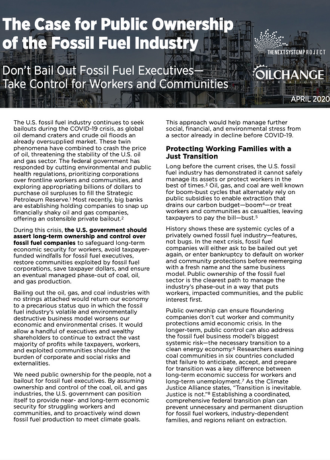
Discussion Paper: The Case for Public Ownership of the Fossil Fuel Industry

The U.S. government should acquire ownership and control over fossil fuel companies to safeguard workers, avoid taxpayer-funded bailouts, restore communities, save taxpayer dollars, and ensure an eventual managed phase-out of coal, oil, and gas production.

Banking on Climate Change 2020: Fossil Fuel Finance Report Card

A new report, Banking on Climate Change 2020, reveals that 35 private-sector banks across Canada, China, Europe, Japan, and the U.S. have financed fossil fuels with USD $2.7 trillion since the Paris Agreement was adopted (2016-2019), with financing on the rise each year. The report finds that fossil fuel financing continues to be dominated by the big U.S. banks – JPMorgan Chase, Wells Fargo, Citi, and Bank of America – together, these four banks account for a staggering 30% of all fossil fuel financing from the 35 major global banks since the Paris Agreement was adopted.

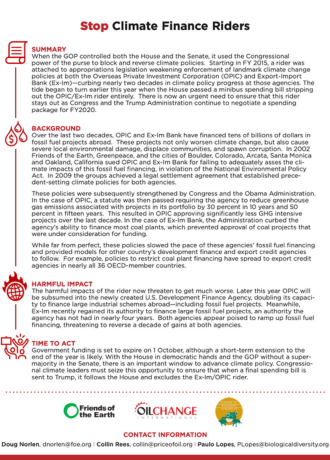
Briefing: Why Congress Must Stop Blocking Climate Progress on International Finance

There is an urgent need to ensure that anti-climate riders stay out of appropriations packages for Fiscal Year 2020 as Congress and the Trump Administration continue to negotiate a spending package.

Briefing: Why the U.S. Export-Import Bank Must End Financing for Fossil Fuels

Over the past decade, nearly 90% of the U.S. Export-Import Bank's total finance for energy projects has flowed to projects in oil, gas, and coal. As momentum grows for climate solutions in the U.S. and abroad, there is an urgent need for a ban on fossil fuel financing at ExIm.

The African Development Bank and Energy Access Finance in Sub-Saharan Africa

A new analysis of the energy finance provided by the African Development Bank (AfDB) shows that while financing for clean energy access has increased since the bank's landmark New Deal on Energy for Africa, support for off-grid and mini-grid solutions — often the fastest and most affordable energy access solutions — must accelerate if Africa is to realize universal energy access by 2030.

Shortchanging Energy Access: A Progress Report on Multilateral Development Bank Finance

Overall, the MDBs are not financing energy access at nearly a sufficient level to meet the needs of energy-poor communities. Much of the energy access finance that is being provided is being directed to many of the communities that need it most. But even so, energy access is not reflected as a priority for the MDBs.