Funding Failure: U.S. Carbon Capture and Fossil Hydrogen Subsidies Exposed
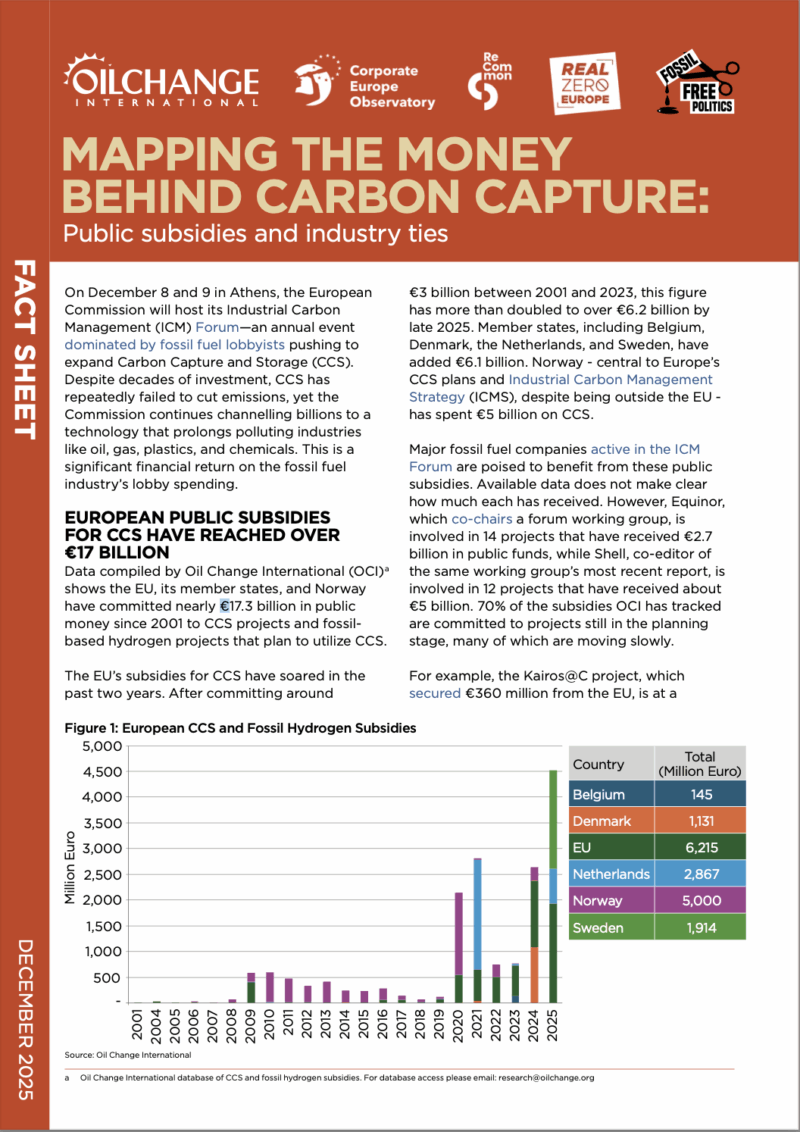
Despite the abundant evidence of carbon capture and fossil hydrogen's failures, the US subsidizes them to the tune of $12 billion - more than any other country.
Oil Change International publishes upwards of 20 reports and briefings every year focused on supporting the movement for a just phase-out of fossil fuels.
Despite the abundant evidence of carbon capture and fossil hydrogen's failures, the US subsidizes them to the tune of $12 billion - more than any other country.
For the first time, this comprehensive briefing brings together evidence to demonstrate that Norway's plans for blue hydrogen are unrealistic and economically unsound.
Our new briefing reveals how governments in North America and Europe are preparing to waste hundreds of billions of taxpayer dollars on these ineffective technologies, further benefiting the fossil fuel industry, despite their record profits.
Japan is promoting a dirty energy strategy across Asia that prioritizes fossil fuel production, putting corporate profits ahead of the people and the planet. This series of leaflets provides a wider audience with easy-to-understand information about Japan and its dangerous distractions.
The Big Oil Reality Check report finds that the climate pledges and plans of 8 international oil and gas companies fail to align with international agreements to phase out fossil fuels and to limit global temperature rise to 1.5ºC.
Governments have spent over $20 billion – and have approved up to $200 billion more – of public money on carbon capture and storage (CCS), providing a lifeline for the fossil fuel industry. Almost 80% of operating carbon capture capacity globally sends captured CO2 to produce more oil via Enhanced Oil Recovery, while many of the world's largest CCS projects overpromise and underdeliver.
Oil and gas companies, and some governments, are more interested in looking like they're acting on climate change than actually acting. They spend billions on smoke and mirrors such as “carbon capture and storage,” “certified gas,” ammonia co-firing, and hydrogen when in reality, they are trying to build escape hatches to continue their dirty business as usual.
These briefings reveal that Total, Eni, and Equinor are on the cusp of approving a surge of new oil and gas development. If they proceed with all the projects in their anticipated pipeline for 2023, Eni could rank as the world’s third worst oil and gas expander this year and Equinor as the world’s eighth worst by the total volume of new reserves approved for extraction.
A new report by Oil Change International and Earthworks examines the rapid growth in “certified gas” and exposes on-the-ground failures to detect oil & gas pollution by one of the largest certifiers of methane gas.
This briefing explains how Japan’s “Green Transformation (GX)” policy is a greenwashing exercise designed to benefit corporate interests and prolong the use of fossil fuels when renewable energy solutions are reliable, available, cleaner, and cheaper.