
Big Oil’s War Profiteering Must End
Fossil fuel dependence makes economies more volatile, puts communities in danger, and helps the wealthy few profit from wars. No corporation should make billions from war, suffering, and energy insecurity. Accelerating an equitable transition towards renewable energy is essential to a more stable and peaceful future.
As people lose their lives in Trump and Netanyahu’s illegal war on Iran, Big Oil is cashing in.
During the first month of the US-Israeli war on Iran, the world’s top 100 oil and gas producers banked an estimated more than $30 million every hour in excess profit.
Big Oil’s Bets Bring in Bank
Among the Big Oil majors, the three largest European companies – Shell, TotalEnergies, and BP – have seen the highest jump in profits on the back of the Iran war. This is tied to the companies’ large financial trading arms that bet on price changes from war-driven volatility.
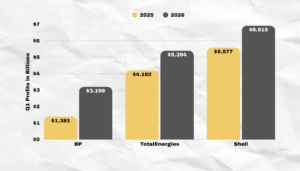
Combined, Shell, TotalEnergies, and BP’s first quarter profits ($15.5 billion) surged 39% higher compared to the same period last year. Shell leads profits with $6.9 billion, Total Energies with $5.4 billion, and BP with $3.2 billion over the first three months of 2026. BP’s profits grew by 132%, TotalEnergies by 29%, and Shell by 24%, compared to the first quarter of 2025.
TotalEnergies’ traders alone potentially made over $1bn in the month of March after dominating purchases of key Middle Eastern oil. The scale of TotalEnergies position raises serious questions about whether the French fossil fuel company used the crisis to exert outsize influence over oil prices while betting on them rising. That’s a recipe for market manipulation. The French government should investigate.
Big Oil’s Problematic Playbook
This is the same problematic playbook Big Oil used to profiteer from war when Russia invaded Ukraine.
In 2022, fossil fuel prices spiked and the five largest oil majors together reaped nearly $200 billion in profits, setting new company records. This windfall represented a 125% increase over oil majors’ profits from the year before. Oil and gas companies and commodity traders fueled record profits by engaging in speculative trading practices.
An analysis of the distribution of profits in 2022 among publicly listed oil and gas companies found that U.S.-based firms pocketed the largest share, and the richest Americans overwhelmingly benefitted from this windfall: 50% of U.S. firms’ profits went to the wealthiest 1% of individuals.
Take It Back Through Taxes!
That’s why people around the world are demanding action.
In the United States, 70+ organizations are calling on Congress to stop Big Oil’s war profiteering by implementing a windfall profits tax on the fossil fuel industry. With this tax, Big Oil would pay on extra profits while the price of oil is above last year’s average. The proposal is similar to what the US implemented in the 1980s. Revenue from that tax would go back to the public — not into the pockets of CEOs and shareholders — to cushion working families from fossil-fueled price shocks.
In France, campaigners have called for a permanent windfall tax on fossil fuel profits. The National Assembly has summoned TotalEnergies CEO Patrick Pouyanné to answer questions about the high profits.
In Australia, there is overwhelming support for a 25% tax on gas exports. This would require the gas industry and its financial backers to pay their fair share every time gas is exported, not just when companies report windfall profits. People and organisations in Australia argue that a flat 25% tax on gas exports could have a range of benefits, from generating revenue for essential services to funding a compensation fund for local and regional communities hit by climate impacts.
Break Free from Fossil Fuels to Fight Back
Geopolitical violence drives oil and gas price spikes. The history of the oil and gas industry is tied to war and violence. Fossil fuel executives and their wealthy shareholders reap the rewards when prices jump. No corporation should make billions from war, suffering, and energy insecurity.
Fossil fuel dependence makes economies more volatile, puts communities in danger, and helps the wealthy few profit from wars. Accelerating an equitable transition towards renewable energy is essential to a more stable and peaceful future.
Every step away from fossil fuels weakens the outsized power and wealth that allows countries like the US to wage illegal wars in the name of energy dominance.
Two years ago, at the United Nations Climate Change Conference in Dubai (COP28) all governments promised to transition away from fossil fuels. Last month, over 80 countries met in Santa Marta at the First International Conference on Transitioning Away from Fossil Fuels, showing momentum to move beyond oil, gas, and coal. Wealthy nations must step up and lead – including by taxing, regulating, and even seeking ways to break up and wind down Big Oil companies headquartered in their countries.