
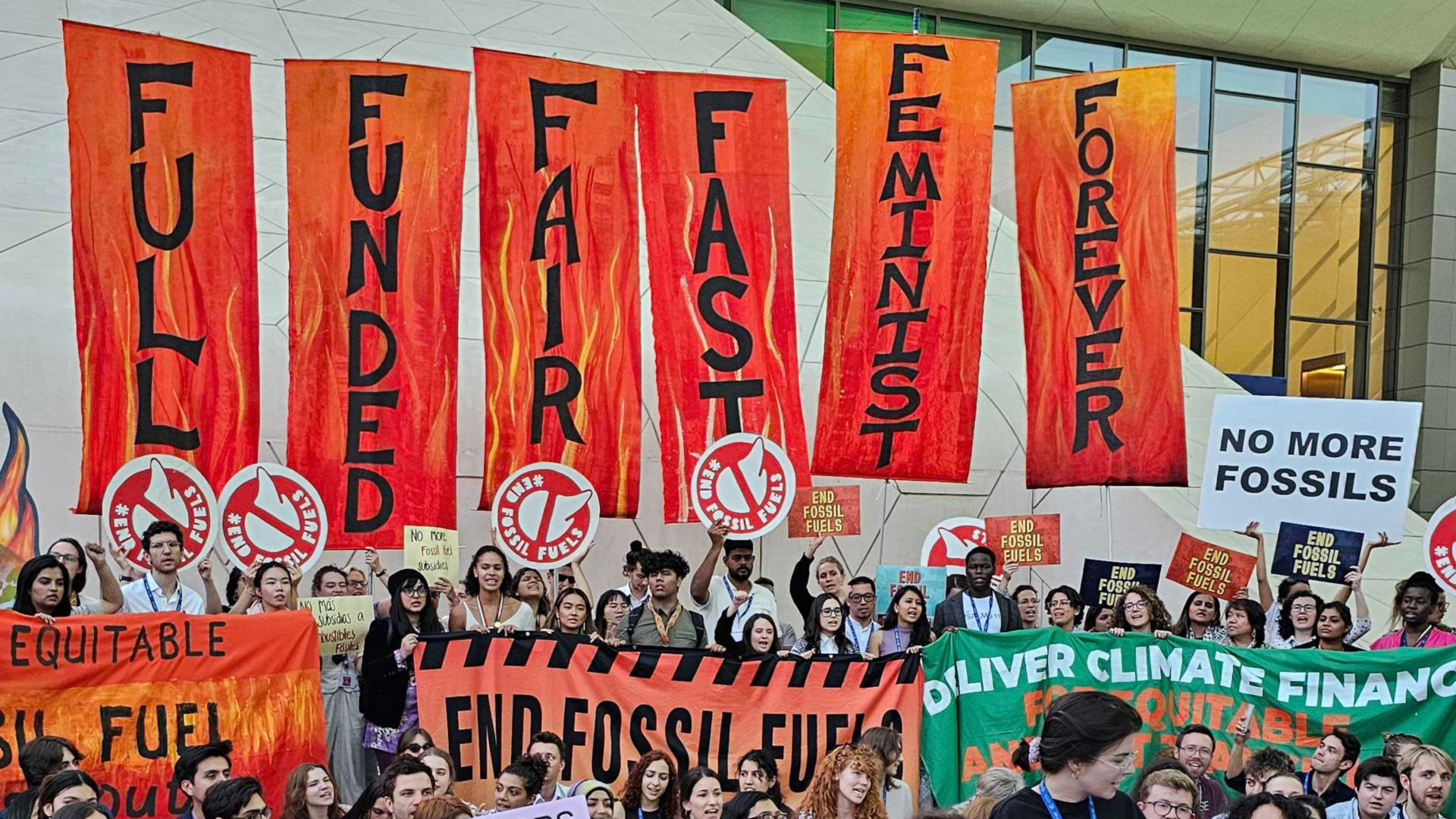
We know where fossil fuels are taking us. Now we need a roadmap out.
Fossil fuel dependence drives deadly climate impacts, higher energy costs, economic instability, and conflict. As the Trump administration doubles down on fossil fuel expansion in the United States and abroad, other governments must offer a different path. Publicly led national roadmaps can deliver a fair, fast, and funded fossil fuel phaseout to protect workers and communities, strengthen economies, and build energy sovereignty.
We know where fossil fuels are taking us. Deadly heatwaves, flooded homes, higher bills, and wars driven by the pursuit of control of oil and gas. Fossil fuel dependence leaves families, communities, and entire economies exposed to price shocks, while fossil fuel billionaires reap record profits. We know every rising fraction of a degree matters, and those least responsible for these crises pay the highest price. We know that a fair and funded transition to renewable energy is the only way countries can build lasting energy and economic security and sovereignty.
And yet, despite the brutal wake-up call of skyrocketing fossil fuel prices and out-of-control climate impacts, the global response is insufficient, chaotic, and unplanned.
Catastrophic glacial floods in Nepal have killed more than 1300 people. More than 5000 people are still missing. At least 35,000 more people died during Europe’s back-to-back summer heatwaves than is normally expected. Nearly 940,000 people across Southern Africa have been impacted by devastating floods that claimed hundreds of lives.
And the window is closing: the latest UNEP report warns that the world will cross the 1.5°C survival limit in the next few years.
That alone should compel the countries most responsible for the climate crisis to act. But even governments unwilling to meet that moral responsibility cannot ignore the immediate economic costs of continued fossil fuel dependence.
The U.S. and Israel’s attack on Iran showed just how vulnerable fossil fuel-dependent economies are to geopolitical shocks. Data from the Centre for Research on Energy and Clean Air show that in the six months following the US-Israel strikes on Iran, fossil fuel importers paid $330 billion more than they would have based on pre-war price forecasts. And this number keeps climbing. By contrast, clean power generation deployed since 2020 saved $36 billion, preventing bills from rising further. As families faced higher prices for fuel and basic goods, the five largest international oil companies and five largest U.S. independent refiners made more than $65 billion in profits in the second quarter of 2026.
The lesson should be obvious. Energy security does not come from drilling more oil and gas, whose flow can be interrupted by blocking a small number of chokepoints and a few cheap drones targeting pipelines or refineries. It comes from reducing dependence on fuels whose prices can be driven up by war, supply disruptions, and decisions made thousands of miles away.
The United States is pushing the world in the wrong direction
Already the world’s largest producer of oil and gas, the United States under President Donald Trump has accelerated fossil fuel development, expanded exports, gutted environmental protections, and obstructed renewable energy deployment.
This agenda is not confined within U.S. borders. The Trump administration has tied its foreign policy to the pursuit and control of oil, from its attacks on Iran to its assertion of control over Venezuelan oil reserves. At home, it has paired fossil fuel expansion with an anti-democratic assault on migrants and civil society. Abroad, it is using coercion to deepen other countries’ dependence on expensive fossil fuels. It is a strategy that concentrates power, exposes people to higher prices, and fuels conflict while fossil fuel companies profit.
The world cannot allow the Trump administration’s pro-war, pro-fossil fuel agenda to dictate our collective future. Other governments must show that there is a more democratic, stable, and affordable path forward.
Right now, the world is experiencing a textbook example of an unplanned, disruptive, market-led energy shock. An equitable and orderly transition to renewable energy offers something fundamentally different: an opportunity to generate energy domestically, reduce exposure to international price shocks, build local industries while decarbonizing economies and ensuring energy access for all within systems that are democratic and resilient.
The destination should be clear to all governments. Now the question is: how do we get there?
A just transition requires a plan
At the UN climate negotiations (COP 30) in Brazil in November of last year, a new initiative was launched to create a global roadmap for the transition away from fossil fuels. This initiative then led to calls for countries to develop their own national roadmaps, which are domestic plans that outline how they intend to reach a prosperous, fossil-free economy. These roadmaps are a key next step in the ‘how’ of a just transition, moving from broad objectives to concrete planning. At their core, these roadmaps must answer practical questions if they are to ensure the transition is fast and fair:
What happens to workers and communities whose livelihoods depend on fossil fuel industries? How will fossil fuel exporters diversify their economies to replace revenues? How can countries industrialize and move away from a raw material export model? How quickly can transport and industry be electrified and how much can be done with decentralised renewable energy systems? What investments are needed now to build a renewable energy system? And who pays for them?
These questions matter to both fossil fuel importers and producers. Importing countries that are dependent on coal, oil, and gas will continue to face volatile prices, supply disruptions, debt, geopolitical conflict, and worsening climate impacts. But producing countries also have much to lose if they fail to plan. As the global energy system shifts, declining fossil fuel revenues could leave governments struggling to maintain public services, creating profound economic, social, and political risks.
Markets will not deliver a just transition
The current crises make clear that leaving the transition to renewable energy to the markets is bound to fail. We need much stronger government intervention and planning not only to promote the uptake of renewable energy, but also to actively plan and implement the closure of fossil fuel infrastructure. Only governments can coordinate an economic project as complex as the transition away from fossil fuels, whether by guiding finance toward the right sectors, decommissioning infrastructure that needs to be removed, supporting communities and workers, and collaborating on the global stage to create the right conditions for the phase-out. The hands off, market-led approach has not delivered the money needed for the transition and has socialized costs and privatized profits.
And there is enough public money to make the transition happen on fair terms for everyone. Rich country leaders can unlock $6.6 trillion per year in public funding to pay their fair share for climate action at home and abroad by making polluters pay and changing unfair global financial rules.
From commitments to roadmaps
As country leaders meet in New York at the United Nations Secretary-General Summit on the road to COP31, they must translate the building blocks adopted at COP30 in Belém from frameworks into publicly led roadmaps and policies that can deliver the fair, fast, and funded fossil fuel phaseout we need to secure a stable and secure future for all.
Countries have already agreed to transition away from fossil fuels. Now they must show how through publicly led roadmaps that protect workers and communities, strengthen energy sovereignty, and mobilize the necessary public funding. The message from Climate Week must be clear: the Trump administration’s fossil fuel expansion will not dictate the world’s future.