Early shut down of extraction sites is key to limiting overshoot, keeping 1.5°C in reach
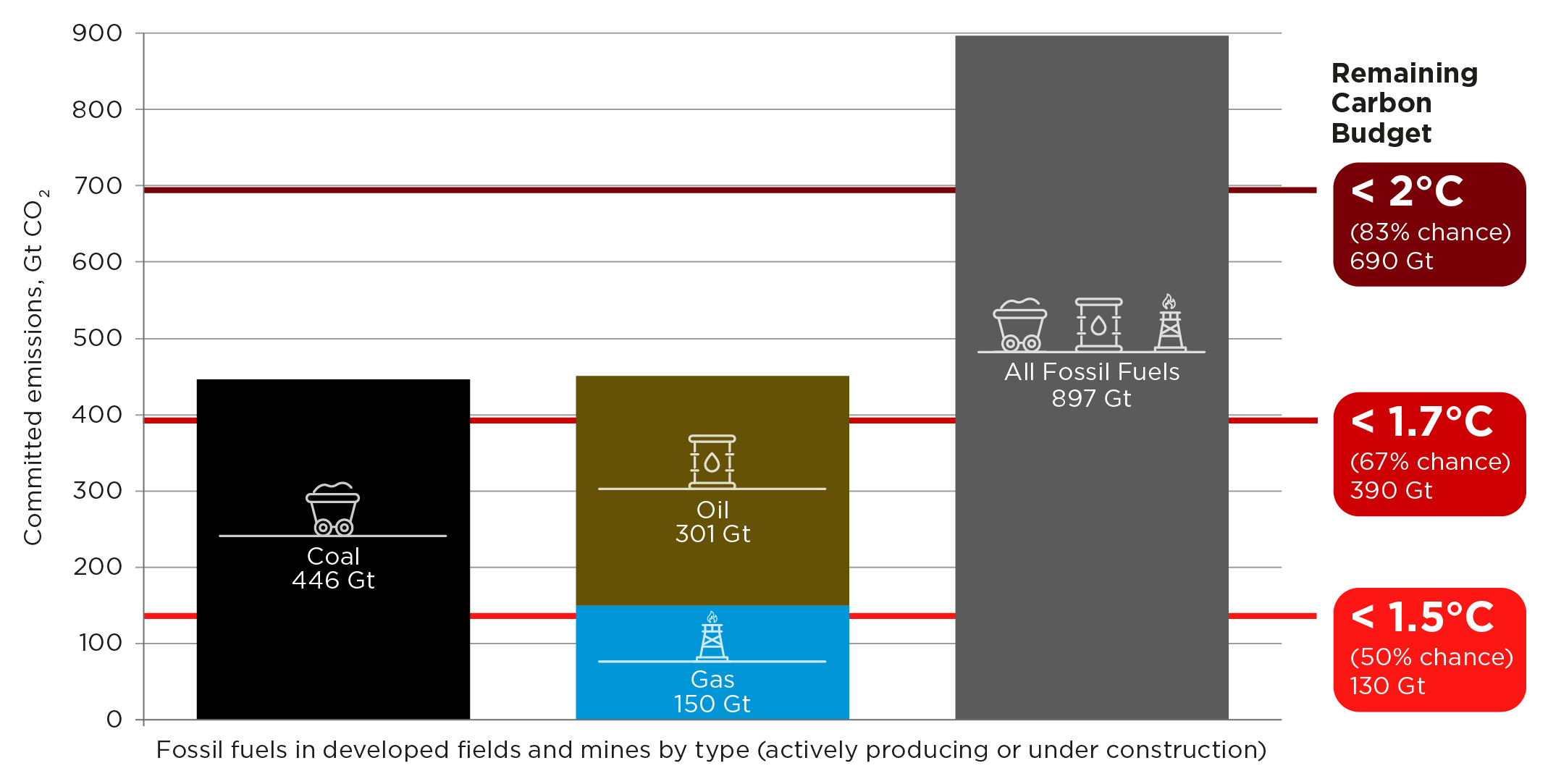
When adding our updated oil and gas estimate (451 Gt CO₂) to our previous coal estimate (446 Gt CO₂) (see Box 2), we find:
- Developed fossil fuel reserves combined would cause emissions of 897 Gt CO₂, if fully extracted.
- This is nearly seven times the size of the remaining 1.5°C budget.
- The proportion of total fossil fuel reserves – including oil, gas, and coal – that would have to remain unextracted to stay within the 1.5°C budget now exceeds 85%, up from 60% as of 2023.
Delayed action and continued investment in new fossil fuel infrastructure in the decade since the Paris Agreement, most egregiously by wealthy countries with the legal and moral responsibility to shoulder the greatest effort,30 has locked in high pollution and sentenced the world to some degree of overshoot. No amount of further warming is “safe.” Any level or duration of 1.5°C overshoot will cause irreversible harm, worsening extreme heat, flooding, food and water insecurity, disease, and other impacts, while risking the submersion of Small Island Developing States and collapse of entire ecosystems.31 Every fraction of a degree of warming avoided can reduce the severity and scale of human suffering and decrease the likelihood of passing irreversible tipping points.
This only heightens the urgency of action on fossil fuels. Our analysis finds that existing fossil fuel extraction projects – unless a portion are shut down early – could push warming as high as 2°C, a threshold governments must stay “well below” according to the Paris Agreement:
- Committed emissions from developed fossil fuels now exceed by 30% the remaining carbon budget for a high probability (83%) of holding warming below 2°C.e Holding warming “well below 2°C” has been widely interpreted in relation to pathways or budgets that give high certainty (eg, more than 66% probability) of avoiding 2°C of temperature rise. The remaining budget for a 83% probability of avoiding 2°C of warming is 690 Gt CO₂, which is commensurate with the budget for a 50% chance of avoiding 1.8°C of warming (680 Gt CO₂), per estimates by Forster et al. (2026). As affirmed by the ICJ, 1.5°C is the primary limit governments are legally bound to uphold under the Paris Agreement.
- Nearly one-quarter (23%) of developed reserves must remain unextracted to avoid risking 2°C of warming.
Planning for the early shut down of a significant portion of existing fields and mines is thus required to minimise the degree and duration of any overshoot of 1.5°C, and preserve the world’s chances of returning temperatures to less dangerous levels.
The world’s ability to return temperatures to 1.5°C from a period of overshoot is deeply uncertain and cannot reverse damage done to people and ecosystems in the meantime.32 Lowering temperatures from a peak level of warming depends on going beyond zero carbon pollution and achieving “net negative” emissions through carbon removal. CDR includes conventional land-based forms like reforestation and engineered, unproven forms that depend on combining bioenergy or direct air removal with carbon capture and storage (CCS).f Almost all operational CCS, which remains limited, is used to capture a portion of CO₂ emissions from fossil fuel combustion or processing. This may slow the rate of fossil fuel pollution but does not contribute towards negative emissions, which requires storing carbon removed directly from the atmosphere. All forms face severe feasibility constraints and their potential scale-up poses major risks to biodiversity, food security, and human rights and safety.33 Engineered CDR, such as bioenergy or direct air capture with CCS (BECCS or DACCS), does not yet exist on a material scale34, gOxford’s State of CDR Report for 2026 shows that novel CDR technologies, including DACCS and BECCS, have a removal capacity of just 1.07 Mt CO₂ per year, making up just 0.05% of all CDR (with 99.95% coming from conventional approaches of afforestation/reforestation and durable wood products). and ecosystem-based CDR is impermanent and further constrained by the impacts of global warming on forests.35
Just as every fraction of a degree of warming above 1.5°C is dangerous, so is every tonne of reliance on CDR to stabilise or lower temperatures. The fossil fuel industry has locked in this risk as a self-engineered scenario. For decades, the industry used promises of future carbon capture and removal to justify fossil fuel expansion,36 delivering very little operational CCS while creating the large excess of developed fossil fuels that makes breaching 1.5°C of temperature rise unavoidable.
Phasing out fossil fuels rapidly is the only way to minimise the risks and hazards of CDR reliance. Holding peak warming as low as possible to 1.5°C hinges on achieving deep and sustained reductions in carbon pollution within the next five to ten years.37 Neither CCS nor engineered CDR can make a meaningful contribution to this effort given their deployment status. After five decades of investment, CCS captured just 0.1% of annual fossil fuel CO₂ emissions in 2024.38 The world’s existing pipeline of CCS projects, including for BECCS and DACCS, amounts to just 0.43 Gt CO₂ of annual capture capacity by 2035, or only 1% of current fossil fuel CO₂ emissions, if it fully materialises.39, hThis is the maximum amount that could be captured if all projects worked at full capacity. The actual utilisation of CCS capacity is nearer 50%, per DNV (2025). In recent 1.5°C pathways that recognise some limits to CDR feasibility, fossil fuel production and use decline rapidly as an essential prerequisite to hold open the possibility of returning from dangerous periods of overshoot, falling at rates that eliminate any need for new fields and mines and imply early closure of existing fossil fuel infrastructure.40 This is true of the IEA’s 2025 Net Zero Emissions Scenario, which still relies on unproven forms of CDR to remove close to 200 Gt CO₂ cumulatively by 2100 to help return from 1.65°C of warming.41 This remains a highly optimistic and resource-intensive scale of novel CDR: achieving the rate of removal assumed by 2100 would require land area greater than the size of Peru and more energy per year than all buildings in the European Union consume today.42