
A World Without Oil
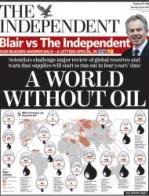 The day after being attacked by Tony Blair for its reporting, the Independent newspaper once again leads on a story of huge importance.
The paper looks at how leading scientists have criticized BP’s Annual Review of the world’s remaining oil reserves, warning that the end of oil is coming sooner than governments and oil companies are prepared to admit.
BP’s Statistical Review of World Energy, was published yesterday. It appears to show that the world still has enough “proven” reserves to provide 40 years of consumption at current rates. The assessment, based on officially reported figures, has once again pushed back the estimate of when the world will run dry.
However, scientists led by the London-based Oil Depletion Analysis Centre, say that global production of oil is set to peak in the next four years before entering a steepening decline which will have massive consequences for the world economy and the way that we live our lives.
According to “peak oil” theory our consumption of oil will catch, then outstrip our discovery of new reserves and we will begin to deplete known reserves.
Colin Campbell, the head of the depletion centre, said: “It’s quite a simple theory and one that any beer drinker understands. The glass starts full and ends empty and the faster you drink it the quicker it’s gone.”
Dr Campbell, is a former chief geologist and vice-president at a string of oil majors including BP, Shell, Fina, Exxon and ChevronTexaco. He explains that the peak of regular oil – the cheap and easy to extract stuff – has already come and gone in 2005. Even when you factor in the more difficult to extract heavy oil, deep sea reserves, polar regions and liquid taken from gas, the peak will come as soon as 2011, he says.
This scenario is flatly denied by BP, whose chief economist Peter Davies has dismissed the arguments of “peak oil” theorists.
“We don’t believe there is an absolute resource constraint. When peak oil comes, it is just as likely to come from consumption peaking, perhaps because of climate change policies as from production peaking.”