
Canada’s “Pipeline Through Paradise”
 One of the biggest problems for proponents of the tar sands (apart from frying the climate and polluting the local rivers and ripping up ancient boreal forests) is getting the dirty oil to hungry markets.
The route south from Alberta to America and the refineries of the Gulf coast hinges on the controversial Keystone XL pipeline securing approval, which could happen sometime later this year. But nothing is certain anymore and the pipeline could get blocked by the Obama Administration.
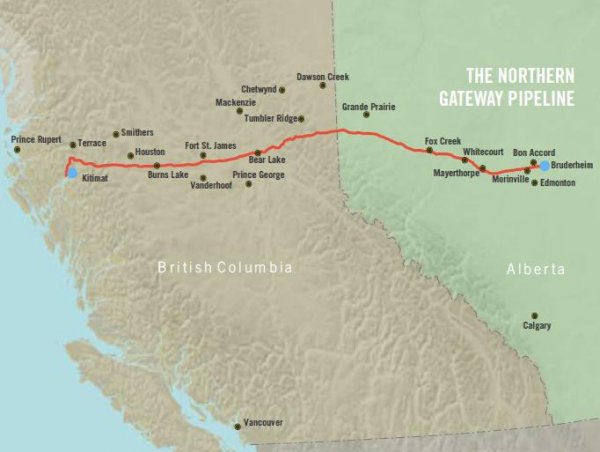
What about the route west from Alberta to British Colombia so the oil could get shipped to Asia? This gives Canada a back-up to Keystone. The route west is yet another highly controversial pipeline called the Northern Gateway pipeline.
A Canadian company, Enbridge, is planning to build a $5.8 billion pipeline to transport the oil 731 miles from Alberta to Kitimat on the west coast of British Colombia. The coast line here is dotted with numerous islands and super tankers would have to chart a potentially treacherous path.
As the pipeline would open the tar sands to Asia, Sinopec, China’s state-owned oil company, is among the companies that have invested over $100 million on the planning and permitting stage of the Northern Gateway pipeline.
“We think it is hugely in Canada’s national best interest to have a second outlet for our crude oil,” Enbridge CEO Patrick Daniel argues.
But the pipeline is opposed by First Nations, environmental groups, fishermen and local communities who are concerned about all the problems that pipelines bring or from a tanker spill along the rugged, but beautiful coastline
So good on the National Geographic for raising these concerns in an article, entitled “Pipeline Through Paradise.”
The article highlights the case of the ferry, the Queen of the North, which sank in March 2006, causing local pollution that still continues. “We had to learn a new language,” Helen Clifton, a matriarch of the Gitga’at, one of the First Nations tells the magazine. “’Sheen,’ ‘shine,’ ‘burbling,’ ‘boom.’ It opened our eyes to what happens in a disaster.”
The Gitga’at people worry that one of the 220 tankers a year that would pass their waters would end up like the Queen of the North.
It’s not just the coast that is threatened. The issue is no less critical for the wild and fragile Great Bear Rainforest that is home to wolves and bears. “We don’t want another Exxon Valdez on our shores,” Doug Neasloss, a Kitasoo/Xai’xais wildlife guide tells National Geographic.
“This is one of the biggest environmental threats we’ve ever seen,” said Ian McAllister, co-founder of Pacific Wild, a wilderness protection organization that focuses on Canada’s Pacific coast said. “And it will become one of the biggest environmental battles Canada has ever witnessed. It’s going to be a bare-knuckle fight.”
A decision is not expected for 18 months.