
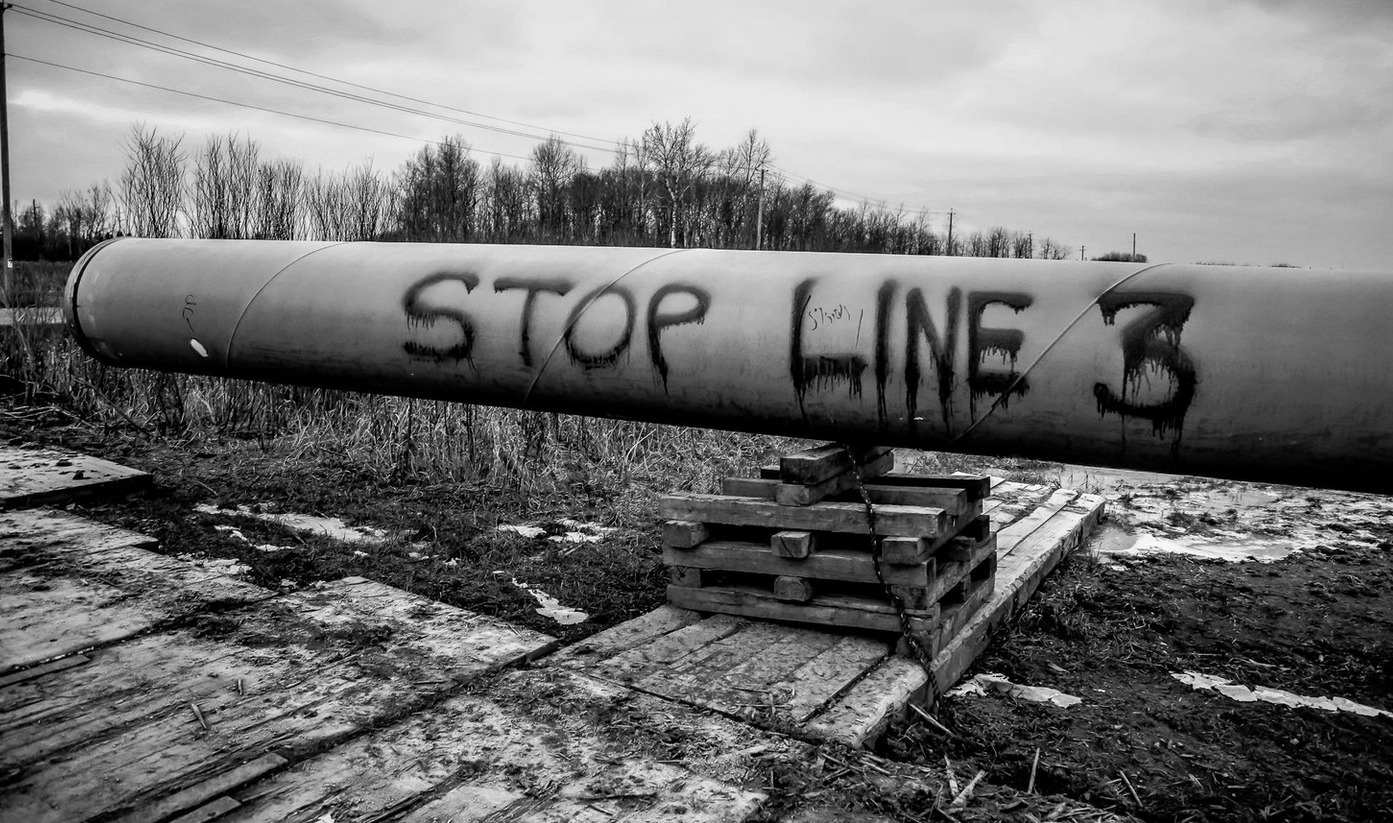
“Major Blow” to Tar Sands Industry As Enbridge Line 3 Pipeline Delayed
The Canadian tar sands industry has suffered another significant setback trying to get is carbon intensive product to market in the US.

C: StopLine3.org
The Canadian tar sands industry has suffered another significant setback trying to get its carbon intensive product to market in the US.
The pipeline company, Enbridge, has been forced to admit that the replacement and expansion of its controversial Line 3 pipeline, which would transport tar sands crude from Alberta to Wisconsin, is going to be delayed by about a year.
In a major embarrassment for the company, Enbridge admitted last Friday that it was “developing a revised construction schedule for the Line 3 Replacement Project.” Instead of “the company’s prior expectation for the receipt of final State permits in the second quarter of 2019”, it now “expects an in-service date during the second half of 2020.”
Put simply: the start date has been put back at least a year. The delay will embolden the company’s many critics, who believe the pipeline should never be built.
According to Bloomberg, the delay to the $7 billion pipeline is a “major blow” to Enbridge, the Calgary-based company which prides itself on being North America’s premier energy infrastructure company. As recently as last month, Enbridge was saying it would bring the pipeline into service this year.
The Canadian oil industry is already suffering from a lack of pipeline capacity, due to major campaigns by environmental groups and First Nations to block and delay controversial pipelines such as Keystone XL and Kinder Morgan’s Trans Mountain pipelines, and the cancellation of TransCanada’s Energy East pipeline and Northern Gateway pipeline.
And Line 3 was meant to be the pipeline that would unblock the bottleneck. It is designed to restore the capacity of the pipeline from 370,000 barrels per day to its original 760,000 barrels per day.
It is no wonder, therefore, that Bloomberg says the “delay is a crushing setback for Canadian oil producers, who have suffered from a lack of pipeline space that has made it difficult to ship their crude to refineries, hammering prices.”
Bloomberg adds: “Enbridge’s Line 3 is particularly important because the government of the oil-rich province of Alberta was counting on its startup this year to let it end mandated production cuts that were implemented to cope with a glut of crude.”
And even the 2020 date may not be certain. The pipeline is still being challenged by the Minnesota Department of Commerce, which argues there was an error in granting a so-called “Certificate of Need” for the pipeline.
The new Governor of the state, Tim Walz, recently confirmed his office would continue the legal challenge brought by his predecessor, Mark Dayton. Speaking last month, Governor Walz said: “When it comes to any project that impacts our environment and our economy, we must follow the process, the law, and the science. The Dayton Administration’s appeal of the PUC’s decision is now a part of this process.”
He added: “By continuing that process, our Administration will raise the Department of Commerce’s concerns to the court in hopes of gaining further clarity for all involved. As I often say, projects like these don’t only need a building permit to go forward, they also need a social permit. Our Administration has met with groups on all sides of this issue, and Minnesotans deserve clarity.”
The delay will be welcomed by First Nations, tribal governments, landowners, environmental groups and communities across the Great Lakes, who have been fighting for five years to stop the pipeline on numerous grounds.
As well as trampling on treaty rights and the wider risk of climate change from expanding tar sands oil expansion, they object because of the potential for oil leaks where the pipeline crosses the pristine Mississippi River headwaters region, where First Nations harvest wild rice or manoomin, which is nutritionally and culturally significant.
Indeed, First Nations have vowed to participate in mass protests against the pipeline if it is built, drawing on inspiration from Standing Rock.
A leading opponent of the pipeline, Winona LaDuke, executive director of Honor the Earth, who has led opposition to the pipeline, calls the battle over Line 3, “ground zero in the battle over climate change”.
The new Line 3 route passes near the White Earth Indian Reservation, where LaDuke lives. Speaking last November, LaDuke said: “This is the last pipeline. This is the last battle, and that battle is in Minnesota …We expect thousands of people to join us. There’s a very volatile situation in the north country, and the question is, do they want to shoot me for a Canadian pipeline company? Because I am not moving.”
In response to the announcement on Friday, LaDuke tweeted: “Enbridge continues to clear cut destroying the lands and store their pipelines for a project that isn’t going to happen” #StopLine3
Enbridge continues to clear cut destroying the lands and store their pipelines for a project that isn’t going to happen #StopLine3 https://t.co/ihkKmXetEd
— WinonaLaDuke (@WinonaLaduke) March 4, 2019