
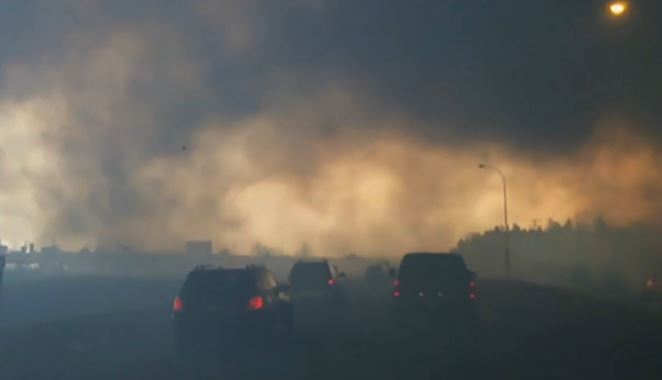
Tar Sands Capitol Evacuated Due to Massive Wildfire
Fort McMurray, the capitol of the Canadian tar sands industry, was under a “mandatory evacuation order” last night as a massive uncontrolled wildfire engulfed the city, forcing some 60,000 residents to flee.
C: CBC
Fort McMurray, the capitol of the Canadian tar sands industry, was under a “mandatory evacuation order” last night as a massive uncontrolled wildfire engulfed the city, forcing some 60,000 residents to flee.
Already the evacuation has become the largest ever caused by a wildfire in Alberta’s history.
The fire, which started on Sunday, has spread rapidly fuelled by high temperatures which rose quickly across Alberta’s boreal forest that was already a tinderbox due to the unseasonably hot dry conditions. Local residents had little time to pack and evacuate.
Later today, when dawn breaks over the ravaged city, fire-fighters expect another challenging day as they fight a rear-guard action to save what is known as the tar sands capital. Strong winds and high temperatures will add to the extremely difficult conditions.
Speaking last night Bernie Schmitte, Wildfire Manager at Alberta Agriculture and Forestry said: “Today has been a devastating day. We have had explosive fire conditions on the landscape brought on by extremely high temperatures.”
Schmitte added: “The fire is still out of control. We have been challenged on many fronts as the fire came through the community. It has entered the community and it has gone through the community.”
Tens of thousands have been forced to flee, leaving most of their possessions behind. Some have already lost everything. Brian Jean, the leader of Alberta’s opposition party, is one of them: “My home of the last 10 years and the home I had for 15 years before that are both destroyed.”
One construction worker, Merv Hansen, told the Edmonton Journal, by the time he arrived home it was too late too. “The house I was in was gone. The smoke was so thick and there were still people going into their homes.”
It is currently unknown how many homes have been destroyed, but images on social media show a hellish scene along highways as people fled for their lives. The fire was so strong it was jumping across roads.
“It became chaotic with vehicles trying to swerve and pull out into the ditch,” said resident Jordan Stuffco. “(With) the heat from the oncoming smoke and the flames, you could see mini-tornadoes forming near the road. It was something out of an apocalyptic movie.”
With so much life and property in danger, luckily so far there have been no reports of injuries.
When the fire is finally under control, people will want answers as to why this happened. Experts are already linking the El Nino effect and climate change to the fire.
Mike Flannigan, a wildlife expert at the University of Alberta says the average amount of land destroyed by wildfires in Alberta has doubled every year since the 1970s. “Every year [an area] half the size of Nova Scotia burns, so it’s a good chunk of real estate,” he says.
The increase in the number of fires he attributes to climate change, fuelled this year by the El Nino. “Because spring came about a month early here, we are already in the middle of our prime fire season for the spring,” he says.
Judith Kulig, Professor in the faculty of Health Sciences at the University of Lethbridge, also believes climate change is driving the increase in wildfires: “The whole aspect of climate change and global warming, which is then interrelated things such as insect infestation, so pine beetle increases because it’s not a cold enough winter.
Kulig adds: “The trees are infested and drier and more prone to fire. In general, we’ve had less rainfall; we didn’t really have a winter this year. And so consequently we have a very dry environment.”
Lets hope everyone escapes unhurt and the fire-fighters control this fire as soon as possible. But the experts are warning that it could be a long fire season this year. And things are going to get worse.