
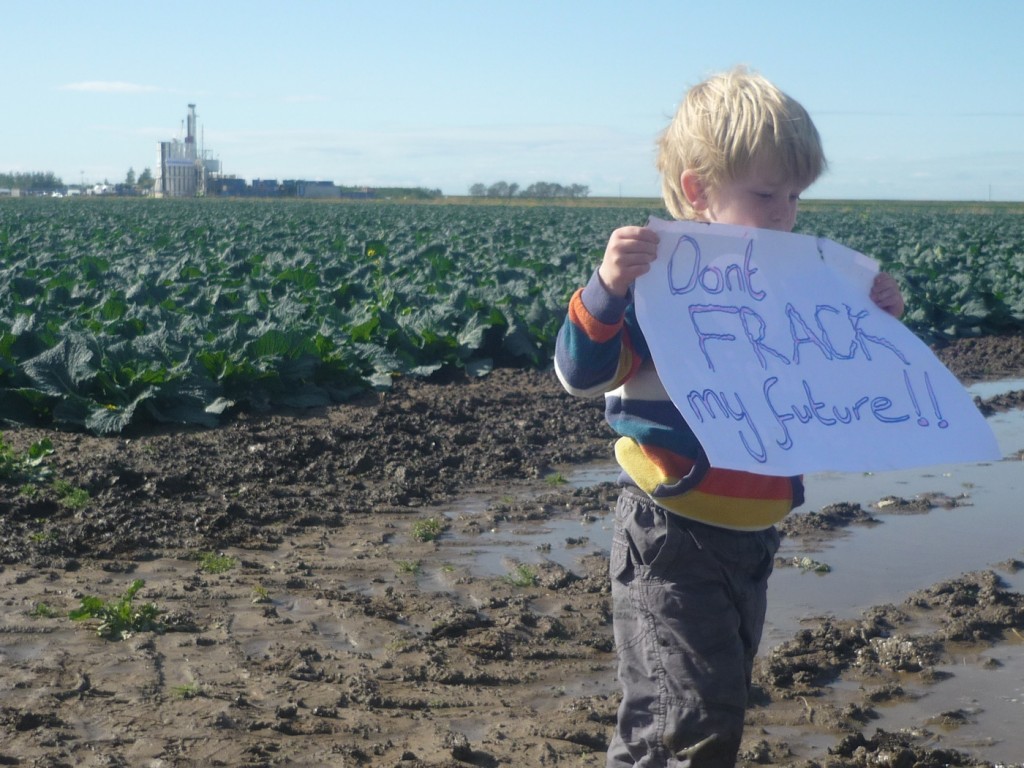
The Downsides of “Extreme Energy”
 So its official: fracking causes earthquakes.
Just minutes ago, a report published by the oil company Cuadrilla as to whether its drilling operations caused two “earthquakes” back in April and May, concluded that fracking was the “highly probable” cause of the small seismic events.
Cuadrilla suspended fracking operations in June, over fears of a link to the two minor earthquakes.
Early this morning the British environmental campaign group Frack Off entered the shale gas rig in near Lancashire. They were protesting against Cuadrilla’s s plans to use fracking. The protest is planned to coincide with the report.
Colin Eastman, one of those who scaled Cuadrilla’s rig said in a statement from the group: “Conventional fossil fuels have begun to run out and the system is moving towards more extreme forms of energy like fracking, tar sands, and deep water drilling.
He continued “The move towards ‘extreme energy’ is literally scraping the bottom of the barrel, sucking the last, most difficult-to-reach fossil fuels from the planet at a time when we should be rapidly reducing our consumption altogether and looking for sustainable alternatives.”
Eastman has a real point here. There is no doubt that fracking and the development of the tar sands is rapidly changing the energy landscape, no more so than in the US.
Yesterday Ed Crookes has a full page article in the Financial Times entitled “Pendulum swings on American oil independence”.
“Over the past couple of years, there has been a great U-turn in US oil supply,” Daniel Yergin of IHS Cera, the research group and author of the Quest told the FT. “Until recently, the question was whether oil imports would flatten out. Now we are seeing a major rebalancing of supplies.”
Such is the boom in fracking that Crookes argued that many analysts expect that in the coming decade the US will leapfrog Saudi Arabia and Russia to become the world’s largest producer of liquid hydrocarbons. This will be achieved via fracking and also gains in horizontal drilling.
Yesterday’s FT article quoted some amazingly brazen production predictions. In 2010, America’s National Petroleum Council (NPC), an adviser to the US government, noted that the US and Canada produced almost 10m barrels a day and consumed about 22.5m b/d.
The NPC now believes that “given the right opportunities and incentives – and the access to closed areas such as America’s east and west coasts for which the oil industry is lobbying – by 2035, the two countries’ production could rise to 22m b/d”.
There is no doubt that this new oil bonanza has the potential to change the energy landscape and be “very seductive” to Americans.
But at what price? It will also seriously pollute our water supplies and cause dangerous climate change, let alone cause small earthquakes.
Let’s not forget that the leading climate scientist Jim Hansen, has called the tar sands “the biggest climate bomb on the planet.”
Are we really going to let that explode?