
Protests Target JBIC Board Chair at CERAWeek Amid Hormuz Crisis
For immediate release
As one of the world’s top LNG importers, Japan faces serious economic risks due to Strait of Hormuz disruption. Its state bank is still signing fossil fuel deals.
Contacts: Weng Cahiles, weng@oilchange.org, +639685399514 (GMT+8, Phillipines)
Rebecca Stoner, [email protected], +019175612607 (GMT-5, USA)
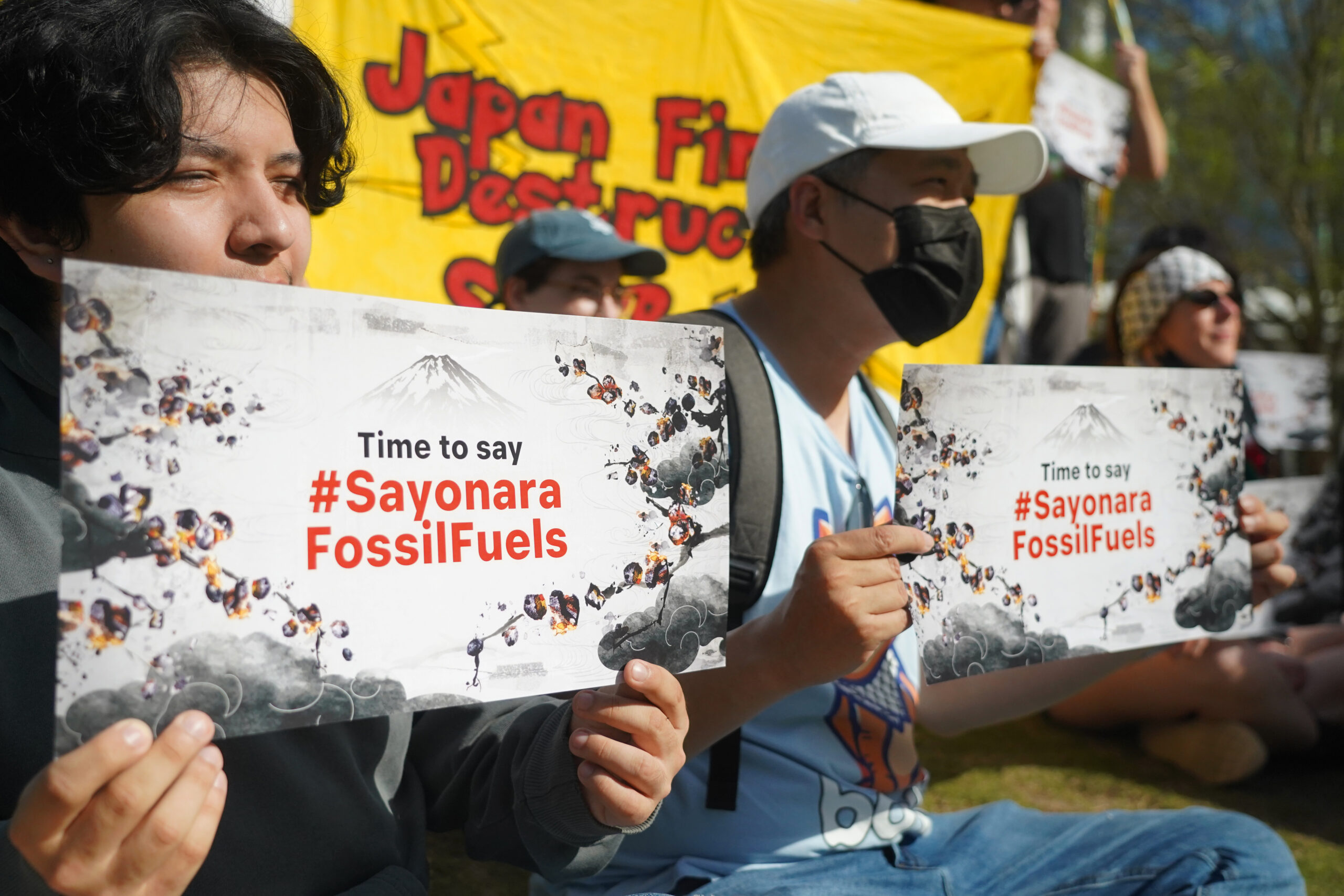
HOUSTON, TX – Protesters wearing Pikachu suits holding signs reading “Sayonara Fossil Fuels” held an action outside the CERAWeek conference on Monday, urging Japan to stop financing LNG projects. Tadashi Maeda, Board Chair of the Japan Bank for International Cooperation (JBIC), spoke at one of the world’s largest oil and gas conferences. JBIC is one of the world’s top public financiers of fossil fuel projects, including nearby liquefied natural gas (LNG) export terminals in Texas and Louisiana.
Despite Japan’s 2022 G7 commitment to end new direct public support for fossil fuels, JBIC has signed approximately USD 3.3 billion in new fossil fuel loans since 2023, including LNG projects across Southeast Asia. JBIC’s financed emissions reached 408 million tons of CO2 equivalent in 2024 — more than France, the UK, and Italy combined.
Community leaders from Texas and Louisiana are urging Japan to stop financing LNG projects, which have caused serious environmental, economic, and health impacts.
In the U.S. Gulf South, JBIC spent $3.7 billion for Freeport LNG in Texas and $4.5 billion for Cameron LNG in Louisiana. Serious safety lapses led to an explosion at the Freeport LNG project. The June 2022 explosion released approximately 3,400 cubic meters of methane, injured multiple people, including children, and forced the terminal to shut down for eight months. Today’s protest in Houston signals that JBIC’s international reputation is coming under increasing scrutiny.
QUOTES:
Melanie Oldham, Director of Better Brazoria:
Japanese leaders, like Tadashi Maeda, must stop sacrificing our communities for short-term profits. Japan poured billions of dollars into LNG projects in the Gulf South, which are poisoning our air and water. They have never acknowledged their role in the Freeport LNG explosion – an event that devastated our community. That ends now. We will exhaust every option available to us until justice is served.
Susanne Wong, Asia Program Manager, Oil Change International:
The war in the Middle East is a wake-up call Japan cannot afford to ignore. LNG is dirty, risky, and volatile. To achieve lasting energy security, Japan must reduce its reliance on imported fossil fuels and stop bankrolling destructive LNG development along the US Gulf South.
Hiroki Osada, Campaigner, Friends of the Earth Japan:
With tankers struggling to pass through Hormuz, JBIC is at CERAWeek, emphasizing the importance of LNG. Japan is doubling down on the very dependency that is right now threatening its economy and energy security. Japanese people are now facing higher energy bills. JBIC should return to its original purpose: to work for the Japanese people, not against them.
Notes:
- High-resolution images and b-roll from the protests are available here.
- Japanese translation of press release available here.
- Analysis from Zero Carbon Analytics shows that of the top countries that import oil and gas via the Strait of Hormuz, Japan faces the most direct risk of disruption, due to its high share of oil and gas trade through the shipping route and its reliance on imported oil and gas.
- JBIC-financed projects have faced global opposition and legal cases for their pattern of environmental destruction, displacement of communities, and violations of Indigenous rights.