Research

Oil Change International publishes upwards of 20 reports and briefings every year focused on supporting the movement for a just phase-out of fossil fuels.

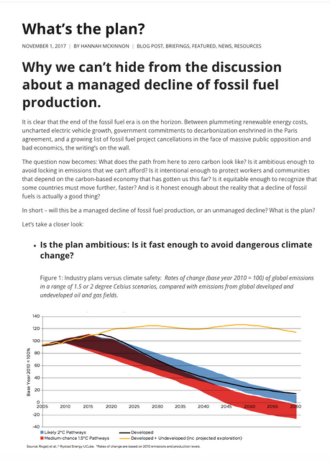
What’s the plan?

The question now becomes: What does the path from here to zero carbon look like? Is it ambitious enough to avoid locking in emissions that we can’t afford? Is it intentional enough to protect workers and communities that depend on the carbon-based economy that has gotten us this far? Is it equitable enough to recognize that some countries must move further, faster? And is it honest enough about the reality that a decline of fossil fuels is actually a good thing?

In the Pipeline: Risks for Funders of Tar Sands Pipelines

A new report exposes the huge financial risks behind three major Canadian tar sands pipeline project proposals: Kinder Morgan’s Trans Mountain Expansion, TransCanada’s Keystone XL and Enbridge’s Line 3 expansion.

Expanding Subsidies for CO2-Enhanced Oil Recovery: A Net Loss for Communities, Taxpayers, and the Climate

This analysis explores the oil production, carbon emissions, and taxpayer cost implications of the proposed changes to Section 45Q in the U.S. tax code in S.1535 and H.R.3761.

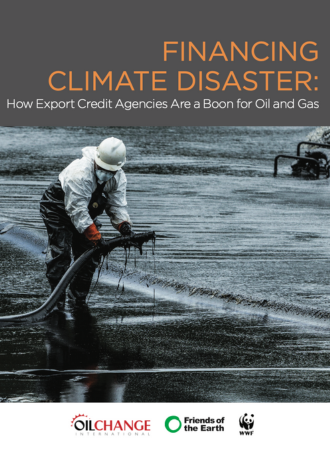
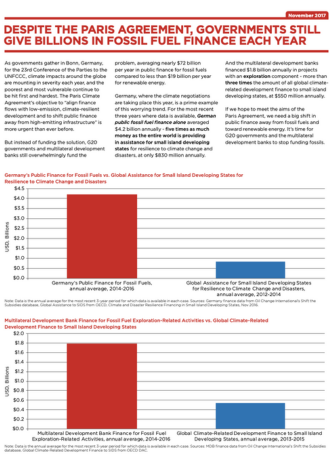
Financing Climate Disaster: How Export Credit Agencies Are a Boon for Oil and Gas

The U.S. Export-Import Bank (USEXIM) is the third-largest supporter of fossil fuels among all G20 countries, according to a new report out today from Oil Change International, Friends of the Earth U.S., and WWF's European Policy Office.

Cross Purposes: After Paris, Multilateral Development Banks Still Funding Billions in Fossil Fuels

A new report shows how multilateral development banks, including the World Bank, gave over $9 billion in funding for fossil fuel projects in 2016, nearly all of it following the Paris Agreement being reached and despite claims that they were acting on climate and adjusting their investment strategies.

Dirty Energy Dominance: Dependent on Denial – How the U.S. Fossil Fuel Industry Depends on Subsidies and Climate Denial

A new report by Oil Change International reveals that U.S. taxpayers continue to foot the bill for more than $20 billion in fossil fuel subsidies each year. Every dollar spent subsidizing this industry takes us further away from achieving internationally agreed emissions goals, and maintaining a stable climate.

Art of the Self-Deal: How Regulatory Failure Lets Gas Pipeline Companies Fabricate Need and Fleece Ratepayers

A new report released by Oil Change International, Public Citizen, and the Sierra Club examines how a new wave of gas pipeline construction threatens to shunt serious risks and costs on to utility ratepayers.

Saudi Aramco’s IPO: A Test of whether Investors Are Serious about Climate

Coming two years after the Paris Agreement, the initial public offering (IPO) of Saudi Aramco will be strongly shaped by climate change. Most analysts believe that Crown Prince Muhammad bin Salman’s US $2 trillion estimate of Aramco’s value was unrealistic, reckoning instead on somewhere in the range $1 to 1.5 trillion. But there has been a gap in commentary, on how moves to decarbonise the energy system will affect the IPO’s valuation.

The Sky’s Limit Norway: Why Norway Should Lead the Way in a Managed Decline of Oil and Gas Extraction

A new study released by Oil Change International, examines the role of Norwegian oil and gas production in a Paris-aligned global carbon budget.

Dirty Distraction: The Energy and Natural Resources Act of 2017 (S.1460)

The Energy and Natural Resources Act of 2017 (S.1460) would pave the way for fossil fuel expansion, locking in decades of dirty energy and undermining the necessary clean energy transition.