Infographic: Who really pays for BP’s arts sponsorship?
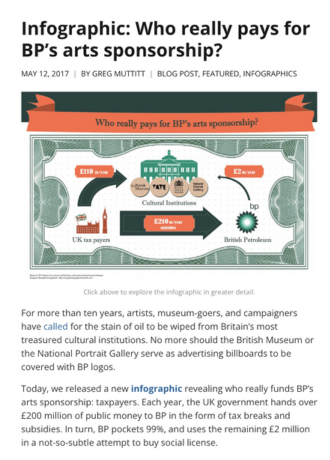
Government handouts to boost BP's private profits massively exceed the firm's sponsorship of the arts – it's time to cut these dirty ties once and for all.
Oil Change International publishes upwards of 20 reports and briefings every year focused on supporting the movement for a just phase-out of fossil fuels.
Government handouts to boost BP's private profits massively exceed the firm's sponsorship of the arts – it's time to cut these dirty ties once and for all.
As part of a series of briefings on proposed Appalachian gas pipelines, Oil Change International's new analysis finds that the PennEast Pipeline would result in the emissions equivalent the 14 coal plants, or 10 million passenger vehicles.
Companies like ExxonMobil, Shell and BP routinely use their in-house energy forecasts to justify investments in multi-decade, high-cost projects, from the Arctic to the tar sands. While the companies present their published forecasts as objective analyses, the forecasts rather reflect the future they want us to believe in.
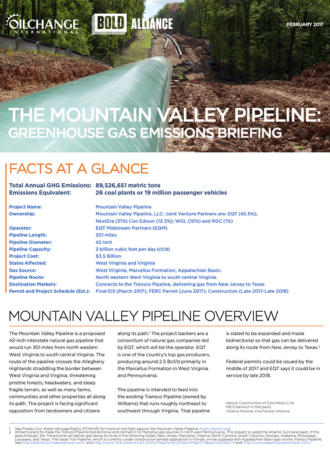
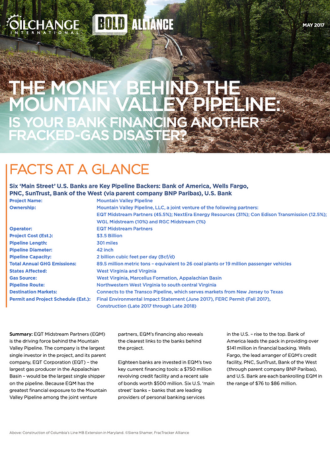
Part of a series of briefings on proposed Appalachian gas pipelines, Oil Change International finds that the Mountain Valley Pipeline would cause the emissions equivalent of 26 coal plants or 19 million passenger vehicles.
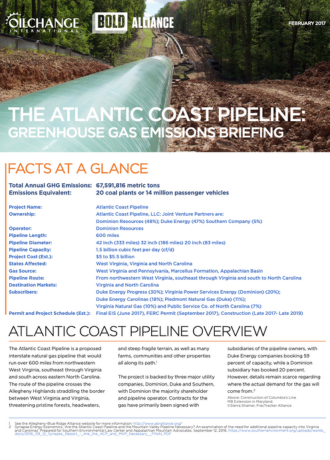
Part of a series of briefings on proposed Appalachian gas pipelines, Oil Change International finds that the Atlantic Coast Pipeline would cause the emissions equivalent of 20 coal plants or 14 million passenger vehicles.
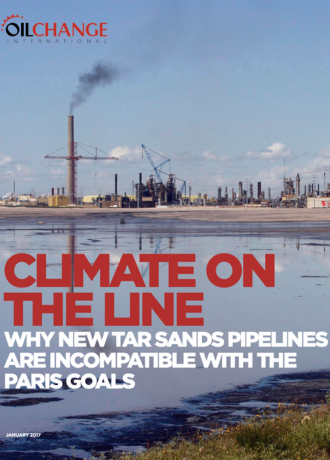
New analysis finds that Canada will be the world’s second highest contributor of new oil production globally over the next twenty years if action isn’t taken to halt new tar sands pipelines and production growth. Once extracted, much of this oil will be burned, pushing global temperature limits over the brink.
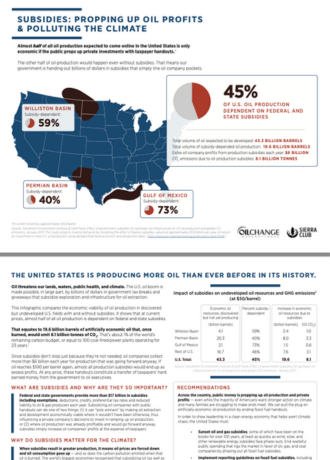
This infographic compares the economic viability of oil production in discovered but undeveloped U.S. fields with and without subsidies. It shows that at current prices, almost half of all oil production is dependent on federal and state subsidies.
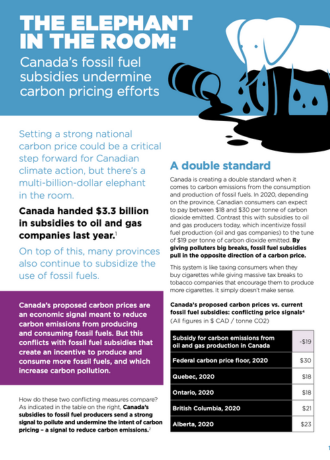
Each year, federal and provincial governments pay billions in hand-outs to Canada’s coal, oil and gas companies, undermining both existing and proposed climate action in Canada.
An update to our previous reports on international coal finance, this report confirms that financing for coal threatens to undermine the Paris Agreement's aims.
A handful of wealthy countries are still funding fossil fuels instead of climate action, giving 3.6 times more public money to prop up fossil fuels than they’re giving to developing countries to address climate change.