Factsheet: The Dirty Energy Money Cycle
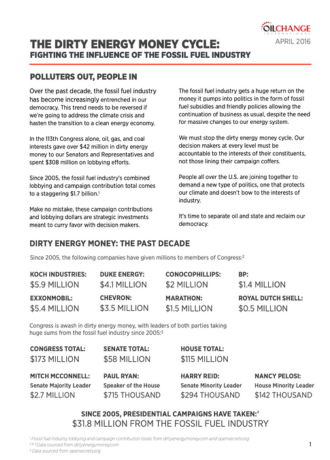
This factsheet shines a light on the millions in campaign contributions made to our elected officials over the past 10 years and the billions in fossil fuel subsidies the industry gets in return.
Oil Change International publishes upwards of 20 reports and briefings every year focused on supporting the movement for a just phase-out of fossil fuels.
This factsheet shines a light on the millions in campaign contributions made to our elected officials over the past 10 years and the billions in fossil fuel subsidies the industry gets in return.
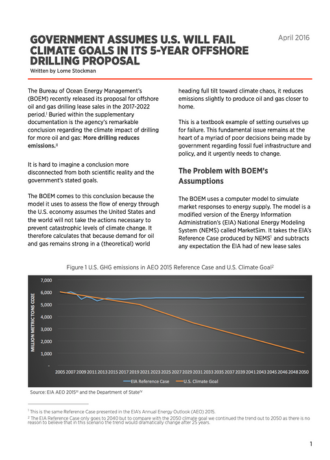
The recently released draft five-year plan for offshore oil and gas drilling is predicated on a failure to act on stated climate policy. To remedy this, the U.S. government should act quickly to implement a climate test in order to evaluate energy decisions on the basis of our national and international climate commitments.
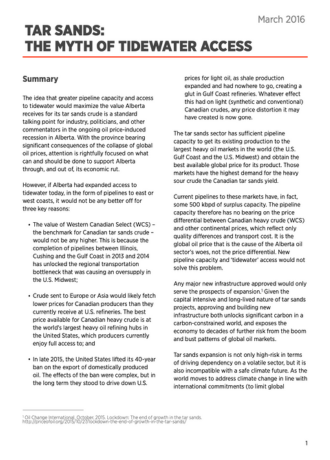
The idea that greater pipeline capacity and access to tidewater would maximize the value Alberta receives for its tar sands crude is a standard talking point for industry, politicians, and other commentators in the ongoing oil price-induced recession in Alberta.
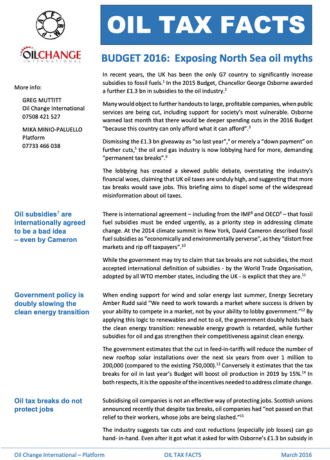
Dispelling myths about North Sea oil taxes, jobs, profits and climate.
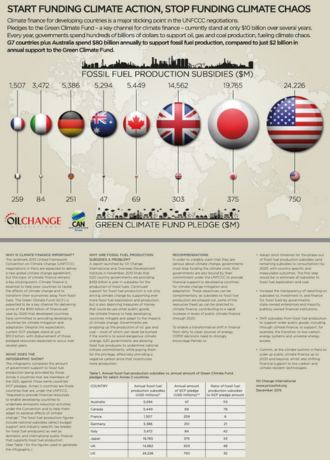
New analysis released today at the COP21 climate negotiations reveals that G7 countries along with Australia spend 40 times more on support for fossil fuel production than they do in contributions to the Green Climate Fund.
G20 country governments are providing $444 billion a year in subsidies for the production of fossil fuels. These governments are propping up the production of oil, gas and coal, most of which can never be used if the world is to avoid dangerous climate change, and undermining national climate commitments.
The states of Washington and Oregon are facing a quadrupling of their crude-by-rail terminal capacity to over a million barrels a day. This report examines the impact that expansion will have on unlocking carbon and thereby exacerbating climate change.
OECD countries support coal-fired power plants abroad by providing preferential financing through institutions called Export Credit Agencies (ECAs). These coal-fired power plants have significant costs, in the form damages to the health of local populations from air pollution, and the cost of climate-change causing emissions. This report finds that support for coal-fired power plants from the ECAs of OECD countries is implicated in tens of billions of dollars in local health impacts and climate change pollution each year.
The pipelines exporting tar sands out of Alberta are almost full, according to new analysis by Oil Change International. Without major expansion-driving pipelines such as Energy East, Kinder Morgan or Keystone XL, there will be no room for further growth in tar sands extraction and tens of billions of metric tonnes of carbon will be kept in the ground.
Oil Change International joins hundreds of organizations worldwide that have written to the Extractive Industries Transparency Initiative (EITI) board calling on global reporting standards for extractive industries to include transparency from fossil fuel companies about the future viability of their oil, coal and gas projects in a warming world.