Research

Oil Change International publishes upwards of 20 reports and briefings every year focused on supporting the movement for a just phase-out of fossil fuels.

Banking on Climate Change: Fossil Fuel Finance Report Card 2018

This ninth annual fossil fuel finance report card grades banks on their policy commitments regarding extreme fossil fuel financing and calculates their financing for these fuels from 2015 to 2017. The report also assesses the shortcomings of the Equator Principles for ensuring banks respect human rights, and Indigenous rights in particular.
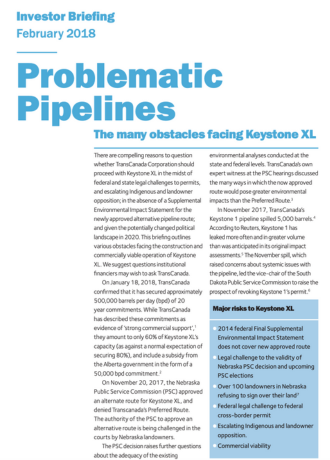
Investor Briefing: The many obstacles facing Keystone XL

This briefing outlines compelling reasons for investors to question whether TransCanada should proceed with Keystone XL given various obstacles facing its construction and commercially viable operation, and suggests questions institutional financiers may wish to ask TransCanada.

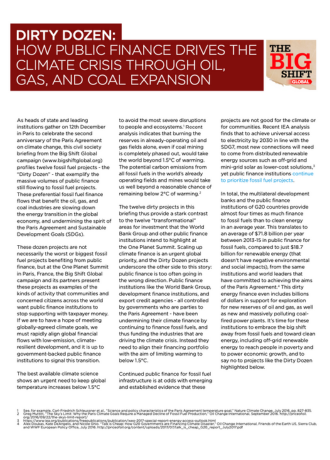
Briefing: Dirty Dozen – How Public Finance Drives the Climate Crisis through Oil, Gas, and Coal Expansion

To have any hope of meeting globally-agreed climate goals, global financial flows must rapidly align with low-emission, climate-resilient development, and government-backed public finance institutions like the World Bank must signal this transition.

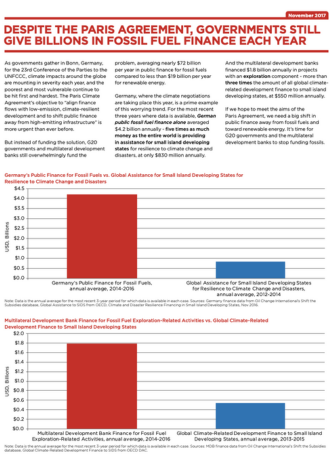
Fact Sheet: Despite Paris Agreement, Governments Still Fund Billions in Fossil Fuel Finance Each Year

Instead of funding clean energy solutions, G20 governments and multilateral development banks still overwhelmingly fund the problem, averaging nearly $72 billion per year in public finance for fossil fuels compared to less than $19 billion per year for renewable energy.

Funding Tar Sands: Private Banks vs. the Paris Climate Agreement

According to a new report released today by Rainforest Action Network, Oil Change International, and 10 organizations from around the world, commercial banks continue to finance the tar sands sector at levels that do not align with the Paris Agreement 1.5° to 2° target – and finance levels are surging in 2017.

In the Pipeline: Risks for Funders of Tar Sands Pipelines

A new report exposes the huge financial risks behind three major Canadian tar sands pipeline project proposals: Kinder Morgan’s Trans Mountain Expansion, TransCanada’s Keystone XL and Enbridge’s Line 3 expansion.

Financing Climate Disaster: How Export Credit Agencies Are a Boon for Oil and Gas

The U.S. Export-Import Bank (USEXIM) is the third-largest supporter of fossil fuels among all G20 countries, according to a new report out today from Oil Change International, Friends of the Earth U.S., and WWF's European Policy Office.

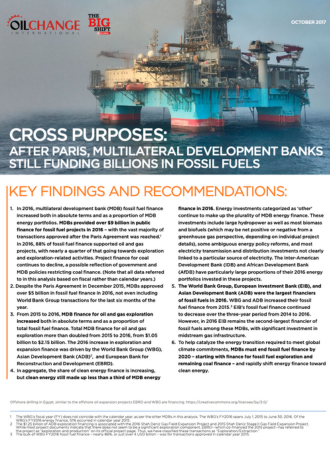
Cross Purposes: After Paris, Multilateral Development Banks Still Funding Billions in Fossil Fuels

A new report shows how multilateral development banks, including the World Bank, gave over $9 billion in funding for fossil fuel projects in 2016, nearly all of it following the Paris Agreement being reached and despite claims that they were acting on climate and adjusting their investment strategies.

Talk is Cheap: How G20 Governments are Financing Climate Disaster

Each year, G20 countries provide nearly four times more public finance to fossil fuels than to clean energy. In total, public fossil fuel financing from G20 countries averaged some $71.8 billion per year, for a total of $215.3 billion in sweetheart deals for oil, gas, and coal over the 2013-2015 timeframe covered by the report. Fifty percent of all G20 public finance for energy supported oil and gas production alone.

Banking on Climate Change: Fossil Fuel Finance Report Card 2017

Big banks’ business as usual is killing the climate. From 2014 to 2016, big banks around the world poured $290 billion into extreme fossil fuel companies and failed to respect human rights.