
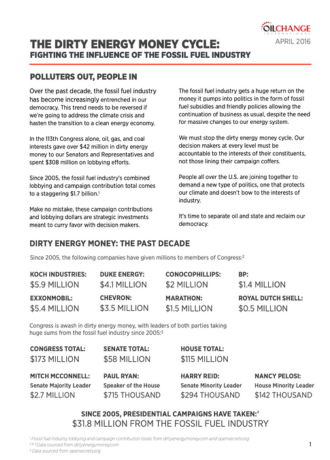
Factsheet: The Dirty Energy Money Cycle
This factsheet shines a light on the millions in campaign contributions made to our elected officials over the past 10 years and the billions in fossil fuel subsidies the industry gets in return.
This factsheet shines a light on the millions in campaign contributions made to our elected officials over the past 10 years and the billions in fossil fuel subsidies the industry gets in return.
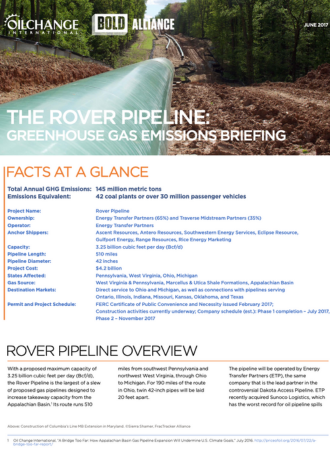
We find that Energy Transfer Partners' Rover Pipeline would lead to annual emissions of nearly 145 million metric tons of carbon dioxide equivalent. This would be the equivalent of adding 42 coal-fired power plants or over 30 million passenger vehicles.
Each year, G20 countries provide nearly four times more public finance to fossil fuels than to clean energy. In total, public fossil fuel financing from G20 countries averaged some $71.8 billion per year, for a total of $215.3 billion in...

A new study released by Oil Change International, examines the role of Norwegian oil and gas production in a Paris-aligned global carbon budget.
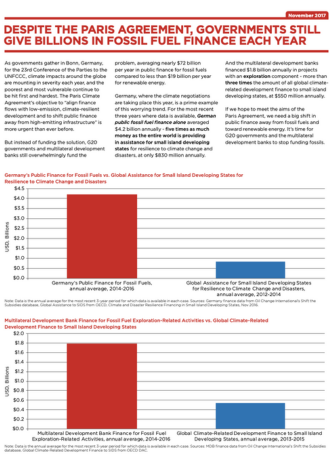
Instead of funding clean energy solutions, G20 governments and multilateral development banks still overwhelmingly fund the problem, averaging nearly $72 billion per year in public finance for fossil fuels compared to less than $19 billion per year for renewable energy.
This report focuses on fossil gas development in the G20 and debunking the myth of fossil gas as a clean transition fuel.

A new analysis of the energy finance provided by the African Development Bank (AfDB) shows that while financing for clean energy access has increased since the bank's landmark New Deal on Energy for Africa, support for off-grid and mini-grid solutions...
At precisely the time in which the world must begin rapidly decarbonizing to avoid runaway climate disaster, the United States is moving further and faster than any other country to expand oil and gas extraction.
The latest climate science and rapidly changing energy markets indicate the need to rapidly shift away from fossil gas, yet the IEA mistakenly presents gas as compatible with a decarbonized future. This policy brief brings together the latest energy market...
As Minnesota decides whether to let the crude oil pipeline cross its cleanest waters, a new report finds that greenhouse gas emissions from Canadian oil company Enbridge's proposed Line 3 expansion would vastly outweigh planned reductions in the state's emissions.