Search results

Select Date Range

2026

2026

Tar Sands: The Myth of Tidewater Access

The idea that greater pipeline capacity and access to tidewater would maximize the value Alberta receives for its tar sands crude is a standard talking point for industry, politicians, and other commentators in the ongoing oil price-induced recession in Alberta.
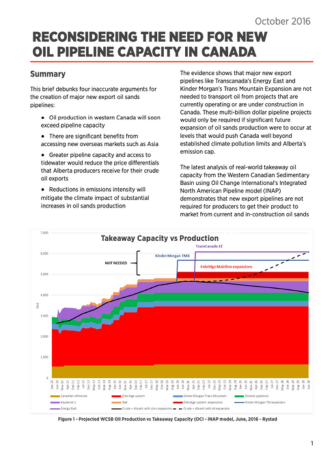
Briefing: Canada Not Running Out of Pipeline Capacity

Canada does not need new pipelines, in spite of repeated misleading claims by the oil industry. That’s the conclusion of a new Oil Change International (OCI) analysis showing that Canada has ample pipeline Capacity to export all existing and under...

Banking on Climate Change: Fossil Fuel Finance Report Card 2018

This ninth annual fossil fuel finance report card grades banks on their policy commitments regarding extreme fossil fuel financing and calculates their financing for these fuels from 2015 to 2017. The report also assesses the shortcomings of the Equator Principles...

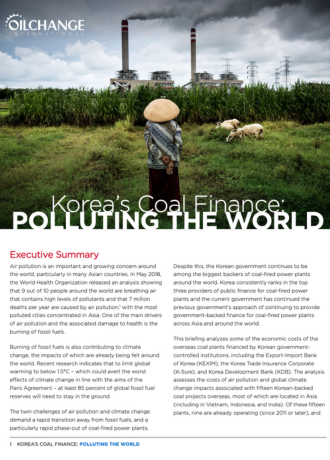
Korea’s Coal Finance: Polluting the World

The twin challenges of air pollution and climate change demand a rapid transition away from fossil fuels, and a particularly rapid phase-out of coal-fired power plants. Despite this, the Korean government continues to be among the biggest backers of coal-fired...

Banking on Climate Change 2019: Fossil Fuel Finance Report Card

This 10th annual "Banking on Climate Change" fossil fuel finance report card reveals that overall bank financing continues to be aligned with climate disaster, and that financing for fossil fuels has increased every year since the Paris Agreement was signed.

Banking on Climate Change 2020: Fossil Fuel Finance Report Card

A new report, Banking on Climate Change 2020, reveals that 35 private-sector banks across Canada, China, Europe, Japan, and the U.S. have financed fossil fuels with USD $2.7 trillion since the Paris Agreement was adopted (2016-2019), with financing on the...