Follow the Oil Money — Key Findings
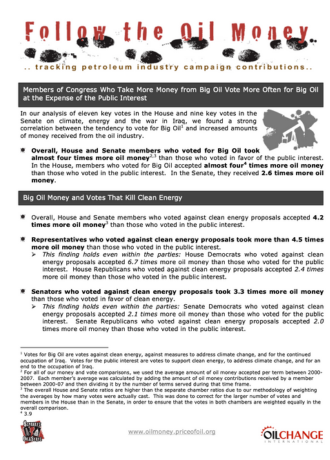
Members of Congress Who Take More Money from Big Oil Vote More Often for Big Oil at the Expense of the Public Interest
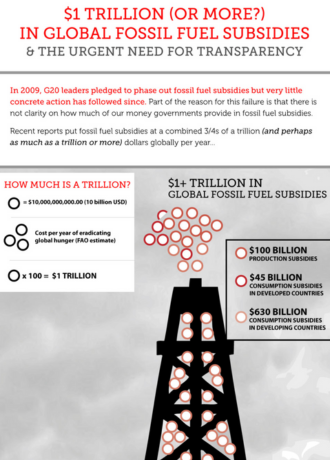
G20 countries are estimated to be spending $88 billion every year subsidising exploration for fossil fuels. This new report documents, for the first time, the scale and structure of fossil fuel exploration subsidies in the G20 countries.
G20 country governments are providing $444 billion a year in subsidies for the production of fossil fuels. These governments are propping up the production of oil, gas and coal, most of which can never be used if the world is...
A new study released by Oil Change International, in partnership with 14 organizations from around the world, scientifically grounds the growing movement to keep carbon in the ground by revealing the need to stop all new fossil fuel infrastructure and...
This infographic compares the economic viability of oil production in discovered but undeveloped U.S. fields with and without subsidies. It shows that at current prices, almost half of all oil production is dependent on federal and state subsidies.
The Alberta tar sands are among the world’s largest oil reserves. While investment and expected growth in the industry have been high for the last decade, new industry data paints a dramatically different picture of the sector moving forward.
To have any hope of meeting globally-agreed climate goals, global financial flows must rapidly align with low-emission, climate-resilient development, and government-backed public finance institutions like the World Bank must signal this transition.
This report reveals the disconnect between Canada’s promises on climate change and the actions of its official export credit agency, Export Development Canada (EDC), in propping up the oil and gas industry.
Canada’s export bank, Export Development Canada (EDC), already provides on average nearly fourteen billion dollars in support to oil and gas companies each year. As a result, Canada ranks second highest among G20 countries in public finance for fossil fuels....
In this six-part series, we explore the ongoing oil, gas, and petrochemical boom in the Permian Basin and Gulf Coast. It is a story of runaway toxic infrastructure, environmental injustice, and climate overshoot.