
Broken Promises, Dirty Deals: Germany’s Fossil Fuel Finance Abroad and Its Destructive Consequences
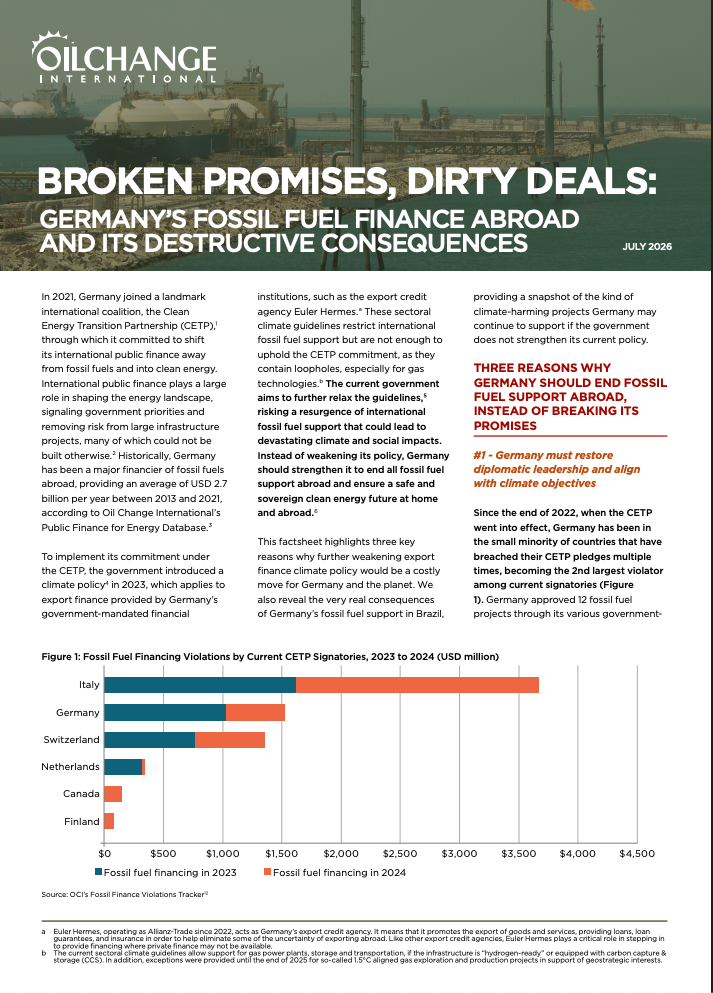
This factsheet highlights three key reasons why further weakening export finance climate policy would be a costly move for Germany and the planet. We also reveal the very real consequences of Germany’s fossil fuel support in Brazil, providing a snapshot of the kind of climate-harming projects Germany may continue to support if the government does not strengthen its current policy.
Download the Factsheet in German
In 2021, Germany joined a landmark international coalition, the Clean Energy Transition Partnership (CETP), through which it committed to shift its international public finance away from fossil fuels and into clean energy. International public finance plays a large role in shaping the energy landscape, signaling government priorities and removing risk from large infrastructure projects, many of which could not be built otherwise. Historically, Germany has been a major financier of fossil fuels abroad, providing an average of USD 2.7 billion per year between 2013 and 2021, according to Oil Change International’s Public Finance for Energy Database.3 To implement its commitment under the CETP, the government introduced a climate policy4 in 2023, which applies to export finance provided by Germany’s government-mandated financial institutions, such as the export credit agency Euler Hermes.a These sectoral climate guidelines restrict international fossil fuel support but are not enough to uphold the CETP commitment, as they contain loopholes, especially for gas technologies.
Read the Press Release