
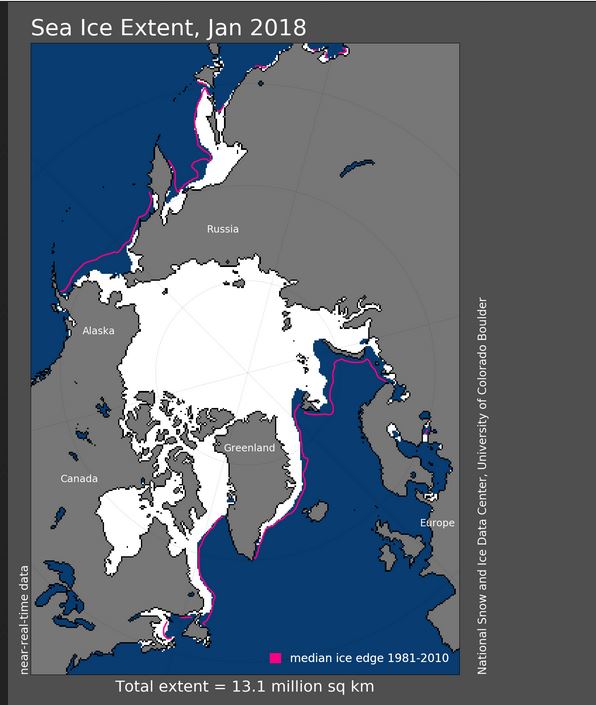
2018 Starts with “record lows in Arctic sea ice extent”
As the Arctic melts due to climate change, which is being driven by our fossil fuel addiction, the fossil fuel industry is now exploiting the increasingly ice-free region.
C: National Snow and Ice Data Centre
And so it goes on. The data does not lie. The Arctic is dying before our eyes.
And as it melts, we enter a vicious circle: the more it melts, so the less heat gets reflected, so the more the planet warms. And that affects us all.
At the end of last year, scientists issued repeated warnings that the region was warming faster than it ever had previously.
The region, they argued, had reached a “new normal’, characterized by “long-term losses in the extent and thickness of the sea ice cover, the extent and duration of the winter snow cover and the mass of ice in the Greenland Ice Sheet and Arctic glaciers, and warming sea surface and permafrost temperature”.
At the time, the meteorologist, Eric Holthaus, said that what the scientists are telling us is that “The Arctic as we once knew it is no more”.
And the bad news keeps on coming. According to the National Snow and Ice Data Centre’s analysis of last month, the region continues to be in trouble. “January of 2018 began and ended with satellite-era record lows in Arctic sea ice extent, resulting in a new record low for the month. Combined with low ice extent in the Antarctic, global sea ice extent is also at a record low.”
The scientists continued: “The monthly average extent of 13.06 million square kilometers (5.04 million square miles) was 1.36 million square kilometers (525,000 square miles) below the 1981 to 2010 average, and 110,000 square kilometers (42,500 square miles) below the previous record low monthly average in 2017.”
One leading Artic ice expert, Ingrid Onarheim, of the University of Bergen and Bjerknes Centre for Climate Research, said: “We are losing sea ice in all seasons now.”
Returning to the theme in recent days, writing on Grist, Eric Holthaus, noted: “Our planet reached another miserable milestone earlier this week: Sea ice fell to its lowest level since human civilization began more than 12,000 years ago.”
Everywhere there are alarms bells from both the Arctic and Antarctic. Eric Holthaus adds: “The past 30 days have averaged more than 21 degrees Fahrenheit warmer than normal in Svalbard, Norway — the northernmost permanently inhabited place in the world. Down south in the Antarctic, sea ice is all but gone for the third straight year as summer winds to a close.”
And with it comes an irony that is nearly too much to comprehend. As the Arctic melts due to climate change, which is being driven by our fossil fuel addiction, the fossil fuel industry is now exploiting the increasingly ice-free region.
As the Independent reported in the last few days: “A ship has made a winter crossing of the Arctic without an icebreaker for the first time as global warming causes the region’s ice sheets to melt.”
The tanker contained liquefied natural gas and was the first to make a crossing from South Korea to northern Russia in the winter months.
Sarah North, senior oil strategist for Greenpeace International told the Independent, because of climate change and the melting Arctic “ironically, we can deliver fossil fuels more quickly. It’s like a heavy smoker using his tracheotomy to smoke two cigarettes at once.”