
BP: Boldness and Blunders with no Hand on the Brake
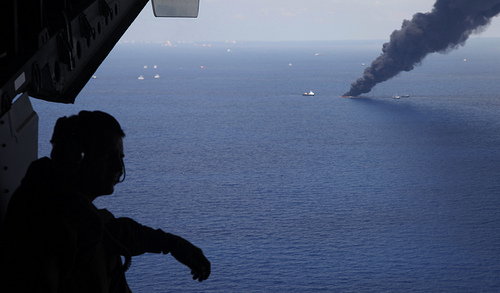 Uncertainty still surrounds the success of the replacement cap on the BP well today, with the company expressing cautious optimism that this second, tighter cap has worked.
BP will now attempt a “well integrity test” and this means it will find out how damaged the well is below the cap and how intact the casing is.
If the company losses pressure, it will know that it has a real problem on its hands, as this means the casing is leaking.
The company will know that then the only permanent solution is when the relief wells are drilled. If and when (and there is still a big if) these are successful BP will be wanting to say there is a definitive line under the crisis.
But the more BP wants to move on, the more questions that remain unanswered. Also the more the American media and press seem to be uncomfortable with BP as their largest oil producer.
What is interesting about this is that nearly three months into this disaster, BP’s safety record is still making front page news in the US. And the more the press scrutinises BP’s safety record, the more worried they become.
Yesterday CNN lamented “How we got stuck with BP” and criticised the company’s poor safety record.
The piece quotes an analysis of Occupational Safety and Health Administration records by the Center for Public Integrity that showed that since June 2007 97% of the most serious safety violations at refineries went to BP.
It ends up by stating: just how did this company with so many black marks become the biggest oil producer in the United States?
Today’s NYT runs with the headline “In BP’s Record, a History of Boldness and Costly Blunders”
Once again the company’s safety record comes under fire. “Despite a catalog of crises and near misses in recent years, BP has been chronically unable or unwilling to learn from its mistakes, an examination of its record shows,” writes the paper damningly.
The paper concludes: “Time and again, BP has insisted that it has learned how to balance risk and safety, efficiency and profit. Yet the evidence suggests that fundamental change has been elusive.”
“They were very arrogant and proud and in denial,” Steve Arendt, a safety specialist who assisted the panel appointed by BP to investigate the company’s refineries after a deadly 2005 explosion at its Texas City, facility tells the paper. “It is possible they were fooled by their success.”
The paper talks about the run up to the Texas City fire disaster in 2005. “We have never seen a site where the notion ‘I could die today’ was so real,” the Telos Group, a consulting firm hired to examine conditions at the plant, said in a report two months before the accident.
When inspectors revisited Texas City last year, they found more than 700 safety violations and proposed a record fine of $87.4 million.
The paper also talks about the cracks in pipes and the underwater manifold that were discovered after the Thunder Horse near-disaster.
“Had the well been active, the damaged pipes would have caused a major oil spill. As it was, the company had to remotely rip out, retrieve and fix dozens of complex and heavy pieces of equipment lying on the sea floor, some weighing more than 400 tons”, says the Times.
Already the evidence coming out of the official Obama Commission is not looking too good – and that is only after day one.
“There is natural friction between safety and caution and meeting schedules,” said Larry Dickerson, who is the chief executive of Diamond Offshore Drilling, the main rival to BP’s contractor Transocean’s. “Our customers push us.”
Dickerson said that Transocean – should have exercised its power to shut down BP’s well operation before the blowout. “The drill company is sitting there with its hands on the brake,” he said. “They have the responsibility to do that.”
So another question to be answered is who took the hands of the break? All the evidence points to one company alone and that is BP..