
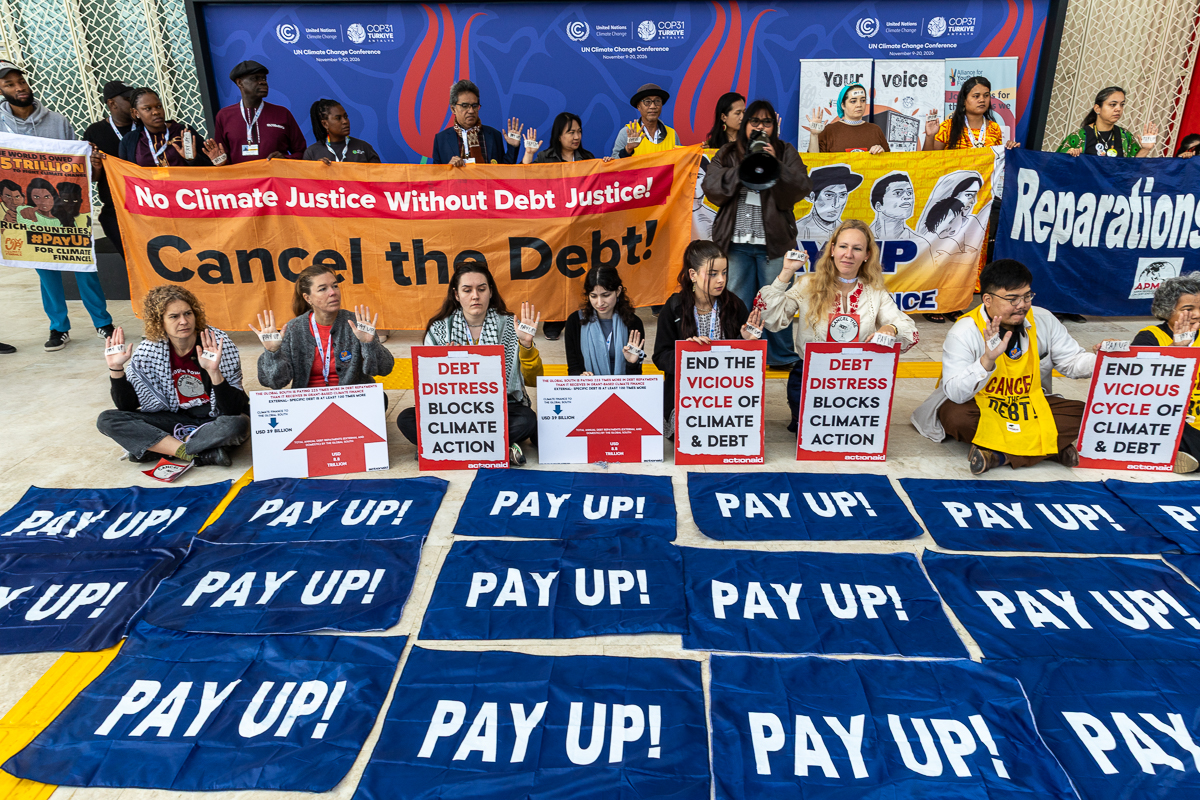
COP31’s real blockers are the countries failing to pay up for just transition
With global heating set to breach 1.5°C, we need to urgently transition away from fossil fuels. Positively, building out a renewable economy has a dramatically lower price tag than continued fossil fuel dependence. But this transition requires public planning and spending that will remain out of reach for most if wealthy countries continue to cut their climate finance, block COP31 finance negotiations, and obstruct changes to unfair global economic rules.
As COP31 enters its final days, headlines — in the New York Times and the Guardian — are dominated by the debt crisis in the Global South, emphasizing how this constrains governments’ options to respond to climate disasters and fossil-fuelled inflation. But inside the COP31 conference hall in Antalya, many rich countries are trying to sideline this reality, blocking key finance negotiations. They are prioritizing new commitments on fossil fuel phaseout and electrification but refuse to come to the table with the public climate finance needed to make it happen, let alone in an equitable way.
It’s simple: without public climate finance, there can be no adaptation, no recovery from climate disasters, no electrification, and no just transition away from fossil fuels.
With global heating set to breach 1.5°C, we need to urgently transition away from fossil fuels. Positively, building out a renewable economy has a dramatically lower price tag than continued fossil fuel dependence. But this transition requires public planning and spending that will remain out of reach for most if wealthy countries continue to cut their climate finance, block COP31 finance negotiations, and obstruct changes to unfair global economic rules.
The transition away from fossil fuels, electrification, and adaptation are not separate negotiating issues. They are deeply interconnected, and none can succeed without public finance provided at a level that meets needs.
Rich countries are blocking an unprecedented opportunity
At COP31, we have an unprecedented opportunity to establish a Climate Finance Work Programme to hold rich countries accountable for meeting their legal obligation under Article 9.1 of the Paris Agreement to provide climate finance to assist developing countries with climate action. They have this obligation because of their outsized historic responsibility for the climate crisis and them being better resourced to respond. The Climate Finance Work Programme can decide to create a concrete action plan to ensure developed countries increase public climate finance to meet evolving needs, assess actual finance needs, and support an implementation pathway for tripling adaptation finance.
But rich countries like the EU, Norway, and Switzerland are blocking progress.
They have been pushing for a “no-text” option that could effectively kill this opportunity. Instead of a concrete plan for delivery and accountability, they want to avoid an outcome that would hold them to their obligations.
Claiming global climate leadership while casting others as the blockers has become a favorite UN climate summit tactic for major wealthy fossil fuel producers like the EU, the UK, Canada, Australia, and Norway in particular. They’re calling for fossil fuel phaseout language, but blocking finance progress so that the group of countries able to confidently back increased ambition is too small and quiet to succeed. All while continuing to expand fossil fuels at home.
Private finance promises won’t fill the gap
These same Global North countries say we need to trust them on their word that they remain committed to providing public climate finance. Yet, the numbers show that climate finance is being cut, and new climate finance pledges have dropped by 70%, even as the costs of the climate crisis continue to escalate.
Instead of fulfilling their obligations under the Paris Agreement, wealthy countries come here launching one shiny private finance mobilization initiative after another, promising that private investment will fill the gap. Yet these initiatives have consistently underdelivered, while saddling Global South countries with even more debt.
Case in point: so far at COP31, rich countries made announcements promising a total of $12 billion in climate finance related to energy transition — but only 2% of this ($273 million) is public money. The rest is projections of private finance that they say will flow from these investments, even though 20 years of this approach has not delivered anything close to the promised figures. And of the $273 million in public money, the vast majority are guarantees or loans that rich countries themselves stand to profit from, and risk creating new Global South debt.
Countries already struggling with debt should not be forced to borrow more money to protect their communities from a crisis they did the least to cause.
We need public climate finance, provided through grants, not loans. We need predictable finance and accountability, not another round of promises and initiatives that fail to deliver.
The Climate Finance Work Programme must focus on rich countries’ public finance obligations under Article 9.1, not be diluted into another discussion about private finance mobilization or broadening the contributor base.
The money is there. It’s a question of political will.
Rich countries claim they cannot afford to provide the climate finance they owe. But at the same time, they are increasing military spending, subsidizing fossil fuels, and protecting the record-breaking profits of the oil and gas industry.
G7 countries alone spend $25.7 billion every year on fossil fuels overseas. That’s more than 30 times the $822 million pledged to the Loss and Damage Fund.
In other words, wealthy governments are spending vastly more public money worsening the very climate impacts that their meager contributions to the Loss and Damage Fund are supposed to help address.
Meanwhile, oil and gas companies are making enormous profits on the back of bloody wars and energy price shocks, while ordinary people struggle with unaffordable energy bills and the cost-of-living crisis.
The money to protect communities from the climate crisis exists. The problem is that many rich countries choose to spend it on the very fossil fuels driving the destruction.
Through our We Can Pay for It work, we have shown that by ending fossil fuel subsidies, making big polluters pay, and changing unfair financial rules, rich countries could unlock over $6 trillion in public funds every year.
They could meet the needs of their own people at home, who are increasingly taking to the streets to protest public spending cuts, and fulfill their international climate finance obligations.
We know progress is possible. At COP26 in Glasgow, 38 countries and institutions committed to end international public finance for fossil fuels. Since then, their fossil fuel financing has fallen by up to 80%. Now they must match that progress with a major increase in public finance for clean energy and others must follow.
Without finance, there is no just transition
As negotiations enter their final days, the Australian and Turkish COP31 presidencies, ministers, and delegations, but also the media covering these talks, must stay focused on what can actually unlock the transition.
A cover decision full of ambitious language will go nowhere if it isn’t backed by negotiated outcomes that deliver concrete plans for implementation and accountability. Shiny private finance initiatives cannot substitute for wealthy countries meeting their obligations.
COP31 must deliver a strong Climate Finance Work Programme that holds wealthy countries accountable for providing public climate finance, establishes an action plan to increase that finance in line with actual needs, and supports an implementation pathway for tripling adaptation finance.
Wealthy countries must stop dodging their responsibilities. They must end fossil fuel subsidies, make polluters pay, change unfair financial rules, and put the public money on the table to fund a fair and just transition away from fossil fuels.
Whether those with the greatest historic responsibility and resources start to provide the means for climate action is not just the key moral question here in Antalya. It is the single move that can unlock political progress across the board.