
Don’t Look Now! With clean energy disruption looming, pipeline developers are rushing to dupe consumers
As clean energy accelerates, it’s time regulators stepped up to protect ratepayers from rip-off gas pipelines.
 Clean energy disruption, or the changes in how we produce and use energy being driven by new technologies, is a hot topic in the energy sector today. It was the subject of a conference in Australia just last week, and of numerous blogs, articles, books and presentations.
But it’s not just an academic issue. It’s happening in real time, right now. It can be seen in the U.S. Department of Energy announcement that its SunShot program achieved its goal to trim utility-scale solar costs to $0.06/kWh three years early and that it would now aim to halve that cost. Meanwhile in Dubai, solar is already achieving $0.03/kWh.
It can also be seen in the way battery storage is being deployed today to address crises, primarily created by fossil fuels and poor planning, in California and Australia in ways that were not thought possible just a year or so ago. And in the fact that the U.S. economy is growing even as energy demand is flat.
So you would think that with so much change happening so fast, our nation’s top energy regulators — the Federal Energy Regulatory Commission (FERC) — would take a hard look at industry claims before permitting a new wave of multi-billion-dollar gas pipelines designed to lock in the burning of more fossil fuels for 40 years or more.
You would think that FERC would undertake a thorough review of the “public convenience and necessity” of these projects given their economic viability depends on decades of rising gas demand, and given ratepayers could end up shouldering their costs. Not to mention that pipeline companies get to use eminent domain to take land from people who don’t want to live with a gas pipeline when FERC determines that the project is in the public interest.
Well think again.
In a report we release today, we show how in an era of profound technological change that is increasingly disrupting energy markets, FERC conducts no meaningful analysis of market need for new gas pipelines. Instead, FERC is allowing companies to sew up contracts between affiliated subsidiaries in order to manufacture demand for additional pipeline capacity and cash in on lavish returns. The comparatively high rates of return authorized by FERC also lure new companies into the pipeline business, incentivizing the construction of new projects over the efficient use of existing pipelines or cost competitive clean alternatives.
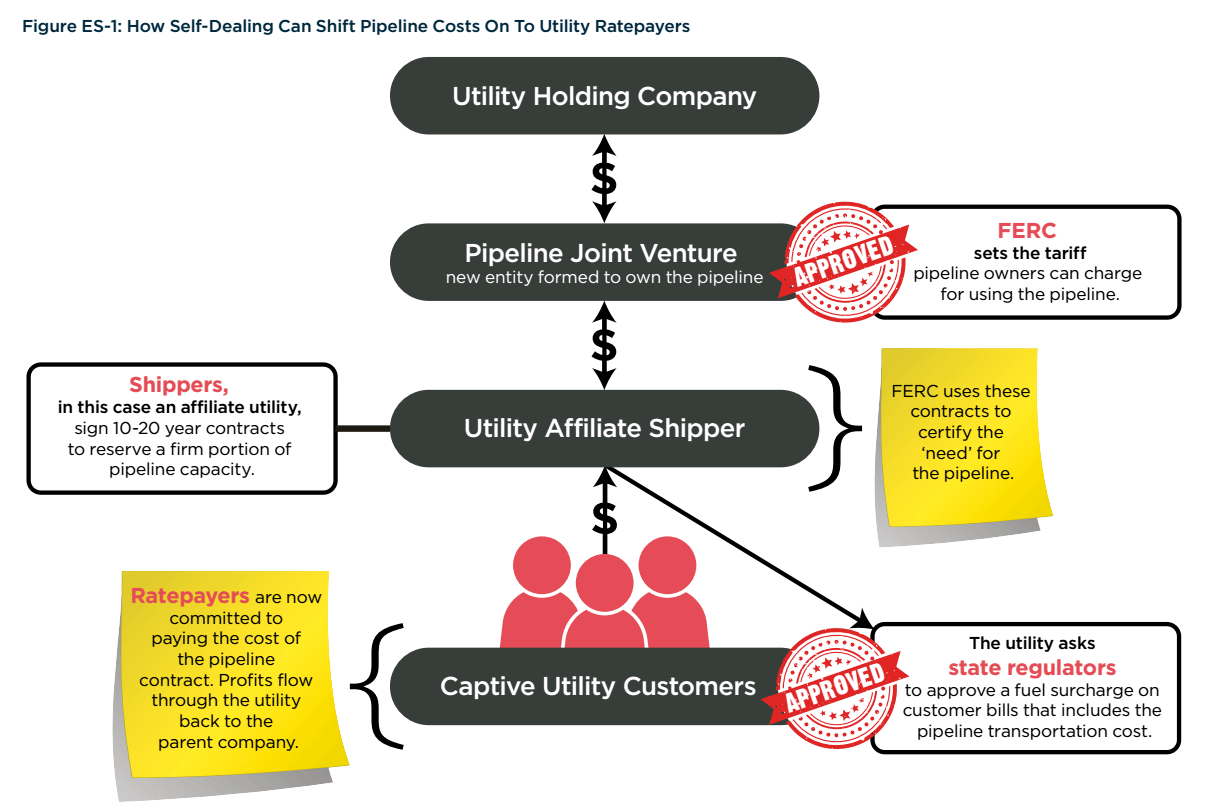
The problem is reaching a critical juncture as FERC commissioners prepare to make permit decisions on a slew of new greenfield gas pipelines in the coming weeks. Many of these projects have a high degree of affiliation between the companies developing them and the companies that have signed contracts to ship gas in them. Increasingly, those affiliated companies are regulated utilities that are looking to pass on the cost of those contracts onto ratepayers. This type of ‘self-dealing’ arrangement shifts the risks of pipeline investment from shareholders to ratepayers: customers are committed to pay for pipeline capacity while guaranteed profits flow back to the utility’s parent company.
The report looks at four pipelines that are yet to begin construction, three of which are yet to be permitted by FERC: the Atlantic Coast, Mountain Valley, PennEast, and NEXUS projects. Each of these projects has affiliated utility partners that have signed contracts for pipeline capacity.
The Atlantic Coast pipeline has the highest degree of utility affiliation, being wholly owned by utility holding companies (Dominion, Duke and Southern), the three of which have contracted nearly 90% of the pipeline’s capacity for a period of 20 years. But those contracts are 28% more expensive for Virginians than the cost of transporting gas on existing infrastructure.
The flowchart below illustrates how this works. Utility holding companies form a pipeline company to develop a gas pipeline. They sign precedent agreements with their utility affiliate to reserve capacity on the pipeline. This is called self-dealing. They present these agreements to FERC, which typically uses them as the sole criteria to certify market ‘need’ for the pipeline.
With a Certificate of Public Convenience and Necessity from FERC in hand, the utility affiliate of the pipeline company can then go to the state public service commission (PSC) and ask the PSC to include the pipeline contract in fuel surcharges charged to ratepayers. If the PSC complies, which they generally do, ratepayers are paying for the utility’s pipeline contract. This is passing money from the ratepayer, through the utility, to the utility holding company. At the high rates of return authorized by FERC (14% based on return on equity or 15% or more total pre-tax return), this is one of the most profitable activities a utility holding company can hope to engage in.
While it may have made sense in the past to allow utilities to pass on to ratepayers the cost of long-term pipeline capacity contracts, as well as that of multi-billion-dollar power plants, the reasoning for this kind of regulated cost recovery is becoming increasingly weak.
It used to be that as population and GDP grew, so did energy demand, and we needed utilities to invest in more power generation to meet our growing needs. Cost recovery was a way for PSCs to support utility investment in meeting those needs.
But today, economic growth and energy demand have decoupled. The U.S. economy is growing while energy demand is stagnant and likely in decline. Investment in efficiency is reducing our energy use per unit of GDP, which has fallen 26 percent since 2000.
Nonetheless, billions of dollars will be invested in new power generation capacity. But, as the overall demand for power declines, all of it will be built to replace retiring, inefficient and polluting plants. And therein lies the rub.
With energy demand in decline and an increasing array of choices for meeting that demand coming on line in the form of renewable energy, storage and demand response, not to mention technological innovations that could enter the market in the coming years, it would be prudent for regulators to study and verify potential future gas demand before permitting utilities to land ratepayers with the cost of long lived gas infrastructure. But that’s not what’s happening.
This has to stop. We know that we must get off fossil fuels by midcentury. We know that, because of leaking methane, the climate changing emissions from gas are as bad if not worse than coal. Why would we want to be locked in to paying for gas infrastructure for decades to come? It doesn’t make sense for our pocketbooks and it doesn’t make sense for our climate.
We need to tell FERC as well as state PSCs that we don’t want to pay for gas pipelines. We want a real clean energy future and we want it now.