
Gasland Ain’t So Green After All
 Finally people are waking up to the concept that the fossil fuel industry’s supposedly wonder transition fuel – gas – may not be so green after all.
It’s a subject I have covered on this blog before, notably questioning just how green shale gas is, but now the idea is getting some serious traction.
The FT has pointed to a preliminary paper by Robert Howarth, a professor of ecology and environmental biology at Cornell University, that raises huge questions about how clean natural gas is when total emissions are considered.
Howarth argues that: “Natural gas is being widely advertised and promoted as a clean burning fuel that produces less greenhouse gas emissions than coal when burned. While it is true that less carbon dioxide is emitted from burning natural gas than from burning coal per unit of energy generated, the combustion emissions are only part of story and the comparison is quite misleading.”
He concludes that: “A complete consideration of all emissions from using natural gas seems likely to make natural gas far less attractive than other fossil fuels in terms of the consequences for global warming.”
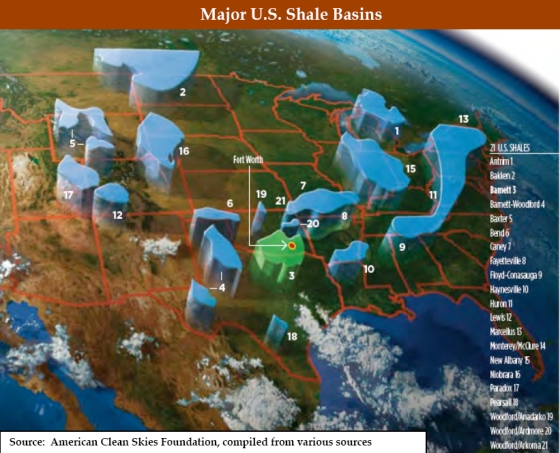
His paper centres on “shale gas” – the latest craze sweeping North America, that uses a process called fracturing – where chemicals, sand and water are used to separate the gas from rocks.
Unbelievably Howarth points out, there has been no independent analysis looking at the greenhouse emissions given off during this process.
He says: “There is an urgent need for a comprehensive assessment of the full range of emission of greenhouse gases from using natural gas obtained by high-volume, slick water hydraulic fracturing. I am aware of no such analysis that is publicly available.”
A first attempt by Howarth to emissions of greenhouse gas emissions from fracturing suggests that they are 2.4- fold greater than are the emissions just from the combustion of the natural gas.
Whilst this estimate is highly uncertain, is likely to be conservative, with true emissions being even greater.
Whilst the emissions from transportation are important – of greater worry is the leakage of methane:
“The leakage of methane gas during production, transport, processing, and use of natural gas is probably a far more important consideration” he argues. “Methane is by the far the major component of natural gas, and it is a powerful greenhouse gas.”
Howarth comes to the staggering conclusion that “When the total emissions of greenhouse gases are considered, fracturing-obtained natural gas and coal from mountain-top removal probably have similar releases, and in fact the natural gas may be worse in terms of consequences on global warming.”
Howarth argues that greenhouse gas emissions from gas from fracturing are estimated to be 60% more than for diesel fuel and gasoline.
Although Howarth points out these numbers should be treated with caution “until better estimates are generated and rigorously reviewed, society should be wary of claims that natural gas is a desirable fuel in terms of the consequences on global warming.”
He argues that “Far better would be to rapidly move towards an economy based on renewable fuels.”