
Texas Community Leaders Deliver First-of-Its-Kind Complaints to Hold Japanese LNG Financiers Accountable
For immediate release
For the first time, a community harmed by a Japanese-funded LNG project has filed a series of coordinated complaints against the whole chain of project financiers.
As Prime Minister Takaichi doubles down on US fossil fuel deals, Freeport, Texas community files historic complaints highlighting risks and human rights violations with U.S. LNG
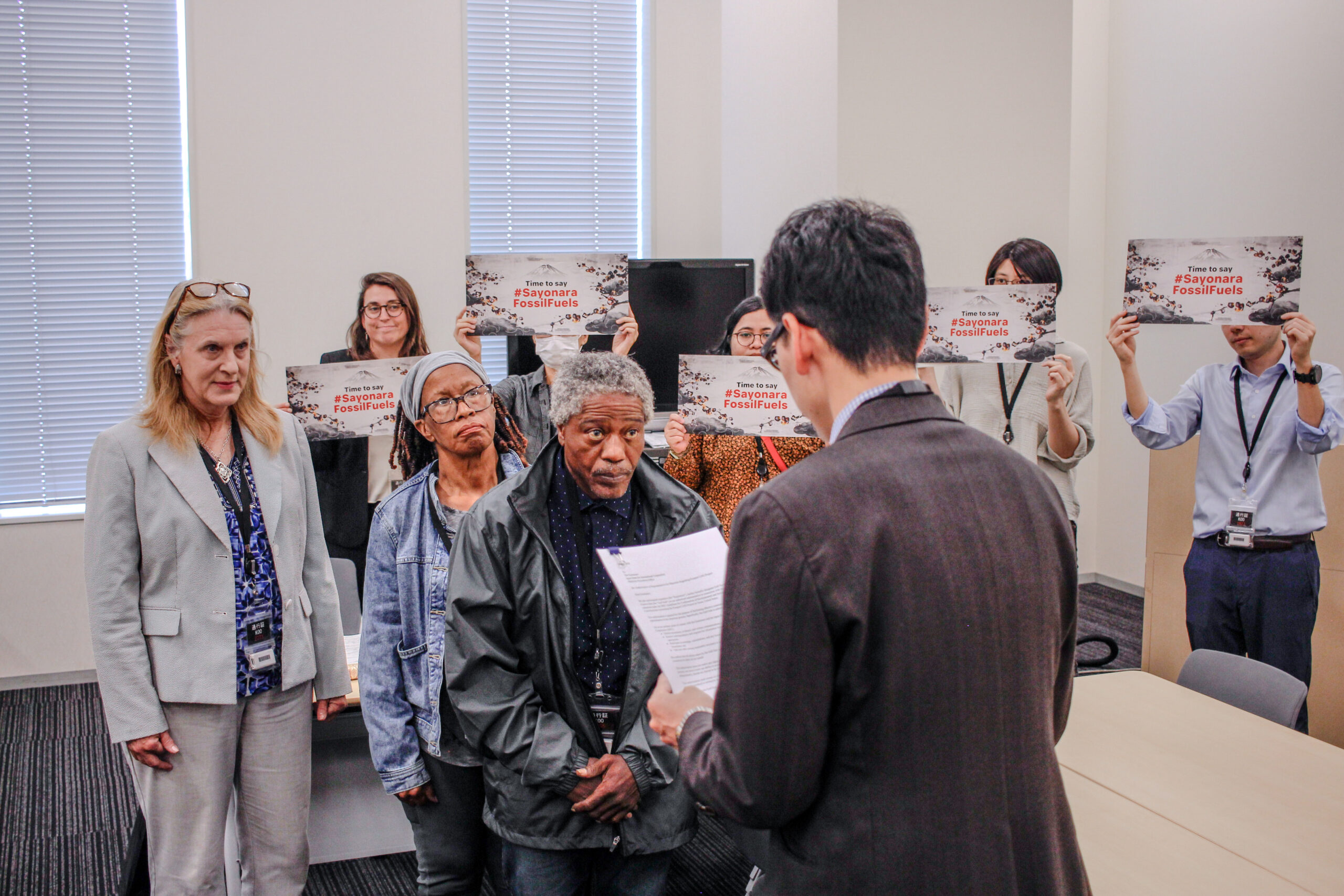
TOKYO, Japan—Community leaders from Texas travelled to Tokyo today to file a landmark series of complaints and meet directly with the Japanese financiers of the Freeport LNG (Liquefied Natural Gas) project. This is the first time a community harmed by a Japanese-funded LNG project has filed a series of coordinated complaints against the whole chain of project financiers —targeting both Japanese public institutions JBIC and NEXI, private megabanks MUFG, Mizuho, and SMBC, and the Japanese power company JERA.
The complaints come as Japan faces mounting scrutiny of its fossil fuel dependency, with the soaring oil and gas prices due to the Hormuz crisis exposing the vulnerability of Japan’s long-term LNG strategy. In October 2025, Prime Minister Sanae Takaichi signed a $550 billion US investment commitment in a desperate attempt to mitigate tariffs and appease President Trump. Prime Minister Takaichi announced the first tranche with a $36 billion commitment to US oil and gas investments.
The socio-economic risks of US oil and gas investments are visible in Freeport, Texas. In 2022, a major explosion sent a fireball 450 feet into the sky, injuring those nearby and releasing almost 120,000 cubic feet of LNG. Freeport LNG has been fined for violating air pollution emissions rules, releasing carbon monoxide, nitrogen oxides, and other highly dangerous chemicals in excess of allowed levels. Ongoing LNG operations have generated pollution associated with respiratory illness, cardiovascular disease, and toxic air hazards. Dredging and vessel traffic also threaten marine ecosystems, bringing risks to fisheries and communities that rely on them. The project was offline for 8 months following the explosion, causing significant losses for companies contracted to the project, and it has struggled with operational problems.
MUFG, Mizuho, and SMBC are the three largest financiers of LNG projects in the U.S., having committed $14.8 billion, $12.8 billion, and $10.1 billion, respectively. Japanese government institutions JBIC and NEXI amplify this exposure further, providing loans, equity, and guarantees that lower risk for private Japanese banks and trading houses, enabling them to pour billions more into Gulf Coast terminals. Specifically, JBIC and NEXI provided $3.8 billion in financing for the Freeport LNG terminal in Texas.
The complaints mark the first step in a broader process to hold Japanese financiers accountable. Freeport leaders will continue to pursue every available avenue to hold Japanese financiers accountable for the harm caused by their investments.
Notes to Editor:
- Japanese translation of the press release is available here.
- The press conference hosted by the Foreign Correspondents’ Club of Japan will be livestreamed here on May 19, 10:30 AM JST. For those who cannot watch live, the recorded video will be available immediately on FFCJ’s YouTube page.
- For more information on the complaint filed, refer to this background document.
- The complaint filers are available for interviews.
- There is a pattern of harm and destruction in JBIC-financed gas projects, and communities have conveyed to the bank that it is violating its own “Guidelines for Confirmation of Environmental and Social Considerations.” The report, “Faces of Impact: JBIC and Japan’s LNG Financing Harms Communities and the Planet,” and accompanying website documents case studies from Australia, Bangladesh, Canada, Indonesia, Mozambique, the Philippines, Thailand, the United States, and Vietnam, exposing a pattern of environmental destruction, displacement of communities, and violations of Indigenous rights.
- Photos from the in-person handover of the complaint to the representative of Japan Bank of International Cooperation are available here.
QUOTES:
Gwendolyn Jones, Founder, Climate Conversation Brazoria County
“I’ll never forget the day the Freeport LNG project exploded. It changed the way I look at that facility and the way I feel about the safety of my family and my community. No one should have to live with that fear. Japanese financiers need to know that Freeport LNG is full of risk – for our communities, for our environment, and for financiers. We came to Tokyo to make sure they can no longer look away.”
Manning Rollerson, Founder and Director, Freeport Haven Project
“The Freeport LNG project is poisoning people in my community. These projects put our health and safety at risk. I’ve lost 17 members of my family to cancer, young and old. I’m in Tokyo to tell Japanese financiers that investing in U.S. LNG is like making a deal with the devil— it’s volatile, risky and undependable. Japanese financiers must listen to those harmed by the projects they fund and stop treating our communities like sacrifice zones.”
Melanie Oldham, Founder and Executive Director, Better Brazoria: Clean Air and Water
“Since it began exporting LNG in 2019, Freeport LNG has had 70 air quality violations. When it exploded in 2022, it was because management had ignored days of warnings and understaffed the facility, so employees were unable to operate the plant safely. The explosion, Freeport LNG’s air quality violations, and just its regular operations contaminate our air and water with cancer-causing chemicals. I was a healthcare professional for 41 years. Working with the Texas Department of Health, I found that in Southern Brazoria County, where Freeport LNG is located, we have six types of cancer at higher-than-expected rates. My community has received no benefits from Freeport LNG being in our community, and all of the harms.”
Allie Rosenbluth, U.S. Campaign Manager, Oil Change International
“Japan’s continued funding of U.S. fossil fuel projects like Freeport LNG is a reckless economic gamble. The recent US-Israel war against Iran has sent oil and gas prices soaring, exposing the extreme volatility of fossil fuel markets and the inherent risk of reliance on imported fossil fuels. The future of U.S. LNG supplies are uncertain because of strong community opposition to LNG projects, legal challenges, and the difficulties of securing financing and buyers for the gas. To achieve lasting energy security, Japan must double down on affordable renewable energy, energy efficiency, and electrification, and stop wasting money on gas and LNG.”
Hiroki Osada, Campaigner, FoE Japan
Japan is now committing to pour even more public money into U.S. fossil fuel infrastructure under and beyond the US-Japan investment deal. But Freeport LNG shows exactly what that money buys: explosions, methane leaks, polluted air, and significant health impact. Expanding this investment without confronting its human cost must not be a negotiation tool to appease Trump.
Rachel Ho, Asia Energy Finance Campaigner, Market Forces
“By investing in Freeport LNG, Japan’s biggest banks are supporting harrowing harms and escalating hazards being inflicted on local communities, the climate and the Texas Gulf Coast environment, in violation of their policies and standards. Evidence shows demand for gas will be destroyed globally as the shift to clean energy accelerates, so Freeport LNG exemplifies that the US-Japan investment deal strikes a costly burden in dollars, lives and livelihoods.”
Bios of the Texas community leaders:
Gwendolyn Jones: Gwendolyn Jones is the founder of Climate Conversations Brazoria County. She grew up in Freeport’s East End, now surrounded by over a dozen fossil fuel facilities. She works tirelessly to educate the community about the hazards that these facilities pose, while holding the corporations accountable. Today, death and health issues for all ages are very real in Brazoria County. This work is personal to Gwendolyn, and she feels an obligation to God and to all the people of Freeport and Brazoria County to fight for justice and educate the next generation. She believes love and people will triumph over money.
Melanie Oldham: Melanie Oldham is the founder and executive director of Better Brazoria: Clean Air and Water. Melanie has been a frontline community leader for decades, fighting for clean air and water in Freeport, Texas, and the surrounding areas. Her 40-year career as a healthcare professional prepared her for 20 years and counting as a public health advocate and activist. She has volunteered with the Sierra Club Houston and Sierra Club Lone Star Chapter, serving on the Executive Committee of both chapters for 10 years. She has spoken in opposition to proposed US oil and gas/LNG export projects, petrochemical industry expansion, industry tax abatements, and CCUS (carbon capture, utilization, and storage) projects at events around the world.
Manning Rollerson Jr. III: Manning Rollerson Jr III is a Freeport resident and an advocate for his community. A deacon and grandfather of 27, Manning was a resident of the displaced East End community of Freeport and has been active in the fight for justice for the community whose rights were violated. He is the founder of the Freeport Haven project, a non-profit focused on housing and environmental justice. He is an outspoken activist fighting against local corruption and industrial pollution along the Gulf Coast, where people’s health and safety are severely impacted by the fossil fuel industry.