
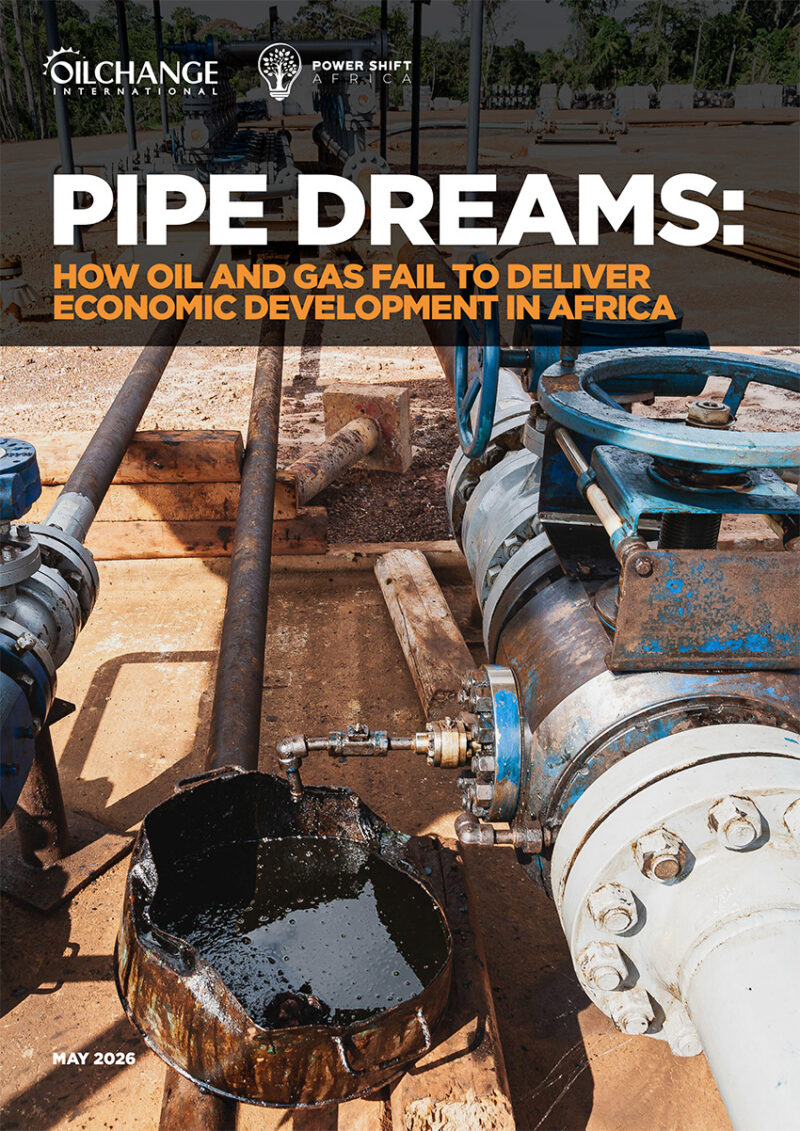
Pipe Dreams: How Oil and Gas Fail to Deliver Economic Development in Africa
As global energy markets are rocked by conflict and geopolitical instability, this new report finds that oil and gas production has failed to deliver economic development in Africa’s producing countries and is instead deepening vulnerability, inequality, and dependence.
Pipe Dreams: How Oil and Gas Fail to Deliver Economic Development in Africa, draws on evidence from 13 producing countries in Africa and finds that decades of extraction have failed to reduce poverty or drive economic growth, and instead are lining the pockets of an elite few.
Pipe Dreams: How Oil and Gas Fail to Deliver Economic Development in Africa
Africa is in a fossil fuel crisis. Global energy prices have surged in the wake of the American-Israeli war on Iran, leaving many African governments struggling to keep energy accessible and affordable. In turn, high energy prices are also driving up food prices. The combined crisis is also leading to reduced currency values, increased inflation, and constrained growth.
Across Africa’s oil-producing countries, evidence shows that fossil fuels have enriched the wealthy few, undermined economic development, and left economies exposed to external shocks. The benefits have flowed to multinational corporations and elites, while communities bear the costs of pollution, lost livelihoods, and economic instability.
Download the Report Read the Press Release
Key Findings
This report assesses the experience of 13 African oil and gas producers, based on peer-reviewed literature, official data,
and independent reports. It identifies five common features across these cases:
- The oil and gas economy is extractive.
- Oil and gas extraction occurs in enclaves.
- Oil and gas extraction weakens other economic sectors.
- Oil and gas lead to corruption.
- The oil and gas economy is vulnerable to external forces.
African countries are confronted by harms caused by failed fossil fuel-led development, while high debt burdens and unequal global economic structures shape how these countries’ resources are controlled and exploited. As global energy markets shift, continuing to expand oil and gas production risks deepening these harms. The promise that fossil fuels will deliver development has not and will not be realized; only a just transition to renewable energy can achieve that goal.
A renewable-led pathway could create millions of jobs across Africa by 2030 and beyond, far exceeding fossil fuel alternatives. These jobs are more geographically distributed and more accessible to women and young people. The International Renewable Energy Agency (IRENA) estimates that renewables create two to three times more jobs per dollar than fossil fuels. Clean energy could create an estimated 14 million jobs in Africa by 2030.
By prioritizing people‑centered, renewable‑powered development, African countries can expand energy access, create jobs, strengthen institutions, reduce vulnerability, and advance their economic security using an energy system that is less vulnerable to colonization.