
BAAJA Fails to Stop Skyrocketing Energy Prices
BAAJA does not address affordability or the climate crisis. This is not a deal for the American people, but a massive gift to the Trump administration, Big Oil, and Big Tech.
Proponents of the Bipartisan American Affordability and Jobs Act (BAAJA) cite a Rhodium Group study that assesses aspects of the bill. The analysis found that the bill could reduce the average annual U.S. electricity bill in 2040 by between $50 and $78. So at best, the bill might save you the cost of one tall latte a month 14 years from now.
These cost savings must be viewed in the context of the expected trajectory of electricity costs in the coming years. BAAJA might help reduce electricity prices incrementally from what they would otherwise be, but where are prices heading?
Rhodium analysts kindly shared some of the data behind their analysis so we could answer this question. What follows is our interpretation of the data they shared.
According to the data Rhodium shared, electricity prices are projected to be higher with or without BAAJA. So, while BAAJA may reduce prices, saving households at best the cost of a tall latte every month, households will still be paying more for electricity.
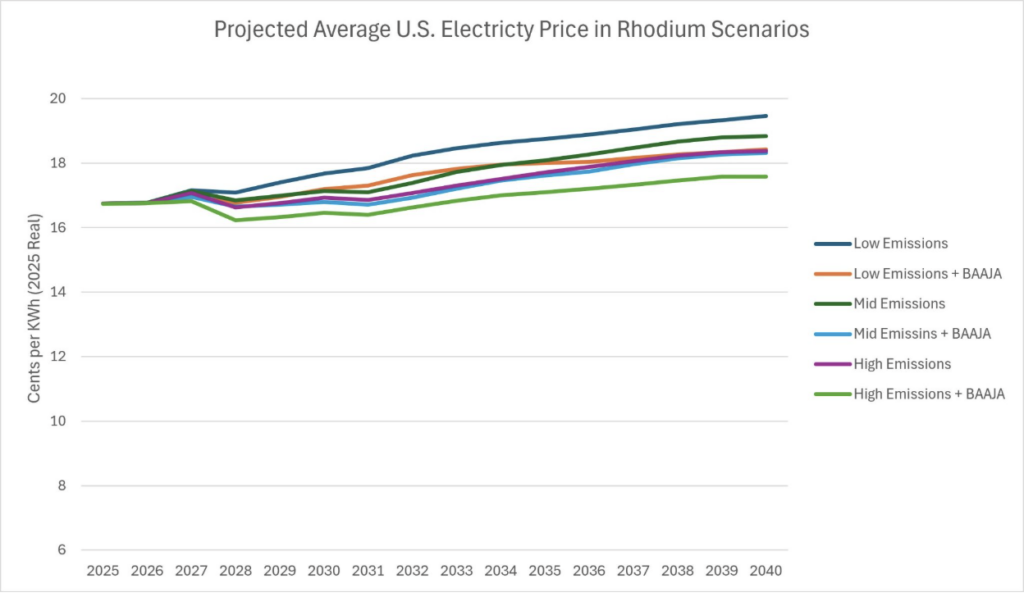
Source: Rhodium Group (data shared via email)
The analysis adjusts for inflation and presents values in 2025 dollars. Averaging across the three scenarios that include BAAJA, electricity prices could be 5% to 10% higher in 2040 than in 2025, with an average increase of 8.2%. This is a small improvement over the modeling result without BAAJA, which averages a 12.8% increase.
In our analysis, the bill’s savings are overshadowed by the increases. For example, according to Rhodium, in the Mid Emissions Scenario with BAAJA, the bill is seen to shave $50 off the average annual bill, or just over $4 a month. But our calculation shows the average annual bill in 2040 would still be over $157 higher than in 2025, or over $13 a month. Households that are already struggling to afford to keep their electricity on today will not see relief from rising energy bills under BAAJA.
This finding exposes the bill’s fundamental weakness in addressing the energy affordability crisis that is making life increasingly difficult for millions of people in the U.S. today. A poll released in April 2025 found that 73 percent of Americans were concerned about rising electric and gas utility bills. An accompanying analysis of 2024 U.S. Census Bureau data estimates that 80 million Americans, around a quarter of the population, are struggling to pay their utility bills. Those bills are projected to keep increasing, and BAAJA will barely make a dent.
We need fundamental change that stops energy prices from rising all together and this bill barely scratches the surface. Rising electricity demand from data centers, extreme climate events spiking energy costs in winter, wildfires and storms repeatedly destroying infrastructure that needs to be rebuilt, excessive utility profits, and overdependence on increasingly expensive fossil gas – none of this is adequately addressed in the bill.
Meanwhile, civil society groups defending Indigenous rights, the climate, and communities on the fencelines of the oil and gas industry widely described the bill as disastrous. Al Gore, former EPA administrator Gina McCarthy, and 17 Democratic attorneys general have joined them in raising the alarm.
BAAJA does not address affordability or the climate crisis. This is not a deal for the American people, but a massive gift to the Trump administration, Big Oil, and Big Tech. Congress must reject this bill now.