Implications for LNG importers
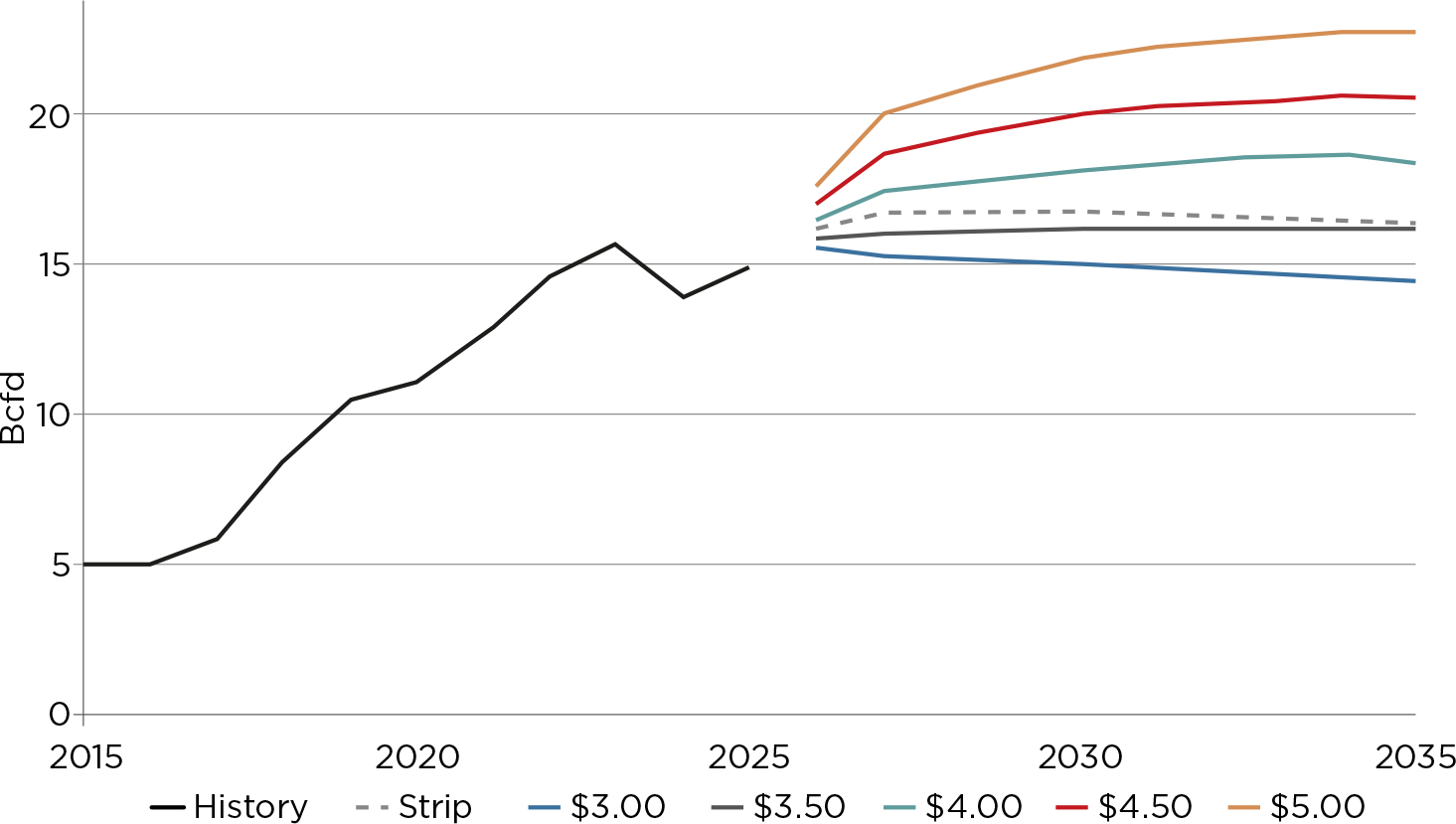
The U.S. became the world’s leading LNG exporter in 2023 and is on track to double its exports based on 2025 levels by the early 2030s. U.S. LNG exports regularly flow to Europe, Asia, and Latin America. In 2025, U.S. LNG exports went to 45 countries; the top five were the Netherlands, France, Egypt, Spain, and the United Kingdom.105 As pressure on U.S. gas supply increases, the evidence above suggests that the average cost of U.S. LNG exports could rise by 80 percent over the coming decade.
Contracted LNG is primarily linked to rising Henry Hub prices
Most U.S. LNG export projects contract between 80 and 90 percent of their capacity via long-term Sale Purchase Agreements prior to gaining finance for building the project.106 The main exception to this is the Woodside Louisiana project in which Australian oil and gas giant Woodside sold equity stakes in the project, financing the rest itself and seeking to contract only around 50 percent of capacity.107
Most of these contracts use a pricing formula based on the Henry Hub price, plus a set liquefaction fee. The liquefaction fee is set per MMBtuOne thousand cubic feet of gas is 1.037 MMBtu. of gas and is typically a fixed cost in the contract, regardless of how much gas is bought. So, if a contract specifies one million tons of LNG per year, the contractor is committed to pay the liquefaction fee for that quantity of gas every year of the contract’s duration, even if they purchase less than one million tons in a given year. This is considered a fixed cost for LNG traders and is a significant factor in a trader’s decision to continue to lift cargoes when profit margins are squeezed.108
The price paid for the gas that is shipped with each cargo is generally indexed to the Henry Hub price at 115 percent.109 The 15 percent premium covers the cost of gas consumed by the LNG plant during liquefaction. This means that the cost of each cargo varies with the prevailing gas price at the time of purchase. If Henry Hub prices rise, so too will the cost of the gas to be liquefied. Together with liquefaction fees, these are the two cost components of an LNG cargo loaded at a U.S. LNG plant terminal. Traders and buyers also have to factor in shipping and regasification costs at the destination to arrive at the final cost of landing LNG and regasifying it for sale in the destination market.
Liquefaction fees are also rising
While the price of gas entering an LNG plant is expected to rise for the reasons discussed above, cost inflation is also expected to raise liquefaction costs at LNG terminals currently under construction. In March 2025, Reuters reported that several U.S. LNG producers were negotiating higher liquefaction fees for projects under construction or in the planning stage.110 Labor and materials cost inflation mean that the cost of constructing LNG plants today is significantly higher than in the past. High interest rates for financing were also cited. While some projects built before 2020 were contracted at liquefaction fees below $2/MMBtu, projects under construction today are locking in buyers at above $2.40/MMBtu, with some reports of prices as high as $2.90/MMBtu.111 In 2025, Venture Global reported selling cargoes on the spot market with liquefaction fees as high as $7.09/MMBtu.112
The demand on limited labor markets from the booming construction of data centers and oil and gas infrastructure is affecting the industry across the board, from drilling to pipeline and LNG plant construction. In March 2025, NextEra Energy’s CEO, John Ketchum, told a CERAWeek panel that “we have a real shortage of labor supply in this country,” referring to competition among data centers, LNG terminals, chemical companies, refineries, and the utility industry.113 The CEO of Chiyoda Corp, a Japanese construction company, cited a labor shortage on the U.S. Gulf Coast as a reason it was stepping away from contracts to build LNG terminals.114
Steel and aluminum prices are also a major factor in cost inflation for LNG terminals and other oil and gas infrastructure. Sergio Chapa, Senior LNG analyst at Poten and Partners, linked tariffs on steel and aluminum to liquefaction fees rising above $2.50, explaining that tariffs drive up the price of inputs. “Steel, aluminum turbines, compressors. Even though some of this equipment is made by American companies, they’re made overseas, and their imports and tariffs are due at the time of importation.”115
How will higher U.S. LNG costs impact global LNG markets?
The surge in U.S. LNG construction has led to expectations of a near-term oversupply in the global LNG market. Many market analysts and gas companies have expected this looming “glut” to lower LNG prices in importing regions. The March 2026 bombing of the world’s largest LNG plant in Qatar has likely delayed the expected glut and reduced the overall extent of any oversupply, as repairs are slated to take up to five years and planned expansions are also delayed.116 However, there remains the expectation that new LNG supply will keep prices low.117
U.S. gas and LNG executives have dismissed concerns about the impact of glut-driven low prices on their profitability, arguing that low prices will stimulate demand and therefore may not persist.118 The lesson for LNG importers is clear. Low prices will be temporary if demand catches up with supply. If the response to glut-driven low LNG prices is to greenlight new gas power plants or other long-term structural gas-demand infrastructure, the supply and demand balance will tighten, and prices will rise. In other words, rising costs being passed onto consumers in LNG-importing countries depends on one thing: locking in rising demand for gas.
The analysts at Rystad Energy, BloombergNEF, and the EIA, whose projections and analysis are covered in this report, currently expect that the vast surge in U.S. LNG export capacity currently under construction will be heavily utilized, based on the existing policy and market environment. This is likely based on data indicating that more than 80 percent of the capacity is contracted.119
While rising prices may help trigger policy responses to reduce LNG demand, there is a certain amount of lock-in as a result of capital invested in infrastructure and long-term contracts. The billions of dollars currently going into expanding LNG export and import capacity and building additional LNG tankers and gas plants to burn that gas120 suggest that market players expect these investments to pay off, and that consumers will bear the cost of increasing reliance on gas and LNG imports.
On the export side, it is generally not the LNG export plant owners or the gas producers that bear the financial risk; it is primarily the companies that contracted to buy the LNG, including traders (or middle men) and utilities in importing countries. These buyers will choose either to sell their cargoes at a loss or to bear the cost of breaking the contract, which essentially means paying for gas they do not load onto ships and sell into the market. On the import side, it is the capital invested in gas plants and import infrastructure by utility companies and others, both private and state-owned, that risks locking in demand for an increasingly costly commodity.
The findings of this report suggest that if importers increase LNG demand in line with expanding U.S. export capacity, they risk locking in high LNG prices due to rising U.S. gas production costs. This may impact the LNG market more broadly, given the increasing proportion of contracted LNG indexed to Henry Hub prices in the global market.
Henry Hub indexed contracts are set to dominate
The rising dominance of contracted U.S. LNG volumes in the market suggests that U.S. prices could become increasingly influential on global LNG pricing, even if other suppliers may be able to offer LNG at lower prices. LNG contracts linked to U.S. Henry Hub prices are set to become the majority of contracts in the market by the 2030s (See Figure 23). When large-scale U.S. LNG exports started in 2016, only 16 percent of global contracts were tied to Henry Hub prices. By 2025, this had risen to 35 percent. This will surpass 50 percent by 2033 and reach nearly 60 percent by 2035 (See Figure 23).
This essentially means that U.S. LNG will account for the largest share of contracted LNG supplies and will be the marginal supplier in the market, so for LNG demand to grow, it will need to be profitable for traders to trade U.S. supply. This implies a shift in where prices are set, from regional supply-and-demand fundamentals in destination markets such as Asia and Europe to the price of contracted U.S. LNG supply. Analysts from Rystad Energy highlighted this before war broke out in the Persian Gulf, when they wrote about what they termed “Henry Hub upside risks:”
As the U.S. becomes the marginal global LNG producer – potentially accounting for 35 percent of global LNG production by 2030 – the increase in Henry Hub index contracts mean that the price of TTF and JKM become more closely tied to, not only regional supply-demand fundamentals, but to the price of U.S. LNG contracts. Therefore, the cost of marginal LNG supply is bound to fluctuate with the price of Henry Hub, implying that a rise in Henry Hub will also lead to a rise in global LNG prices, as we’ve seen so far in 2026.121
Wood Mackenzie analysts came to the same conclusion, writing, “Internationally, as U.S. LNG is the marginal cost fuel, higher Henry Hub prices inevitably mean higher global LNG prices.”122