
How the BAAJA Could Unlock a Massive Expansion of Data Center-Linked Gas Infrastructure
As communities across the country challenge the enormous burden data centers and gas infrastructure threaten to place on land, clean water and air, public health and safety, energy access, and the cost of living, BAAJA will take away their ability to demand accountability and protection.
In short:
- The Bipartisan American Affordability and Jobs Act (BAAJA) strips communities of critical protections against the impacts of data centers and gas infrastructure on land, clean water and air, public health and safety, energy access, and the cost of living.
- A massive gas buildout is underway: 370 GW of gas power capacity is in development, with over 180 GW directly linked to data centers, while over 10,000 miles of gas pipeline is also planned or already under construction.
- Oil Change International has compiled a list of gas infrastructure in development – hundreds of pipelines and power plants – to show how BAAJA could accelerate fossil fuel expansion. We also highlight five fossil gas projects (STAK Data Center, Project Jupiter, Ports-Pike Data Center, Desert Southwest Pipeline, Mountain Valley Pipeline Boost, and the Rockies Columbia Connector) from this list to illustrate their impact on frontline communities and the climate, and highlight what is at stake.
The Bipartisan American Affordability and Jobs Act (BAAJA) is chock full of provisions that will streamline permitting for gas infrastructure in the U.S., just as a massive, unprecedented buildout of gas power plants and pipelines is being planned to fuel Big Tech’s data center boom, increase LNG exports, and secure the domination of gas on the nation’s grids. This imminent gas boom is a key reason BAAJA would fail to trigger a clean energy revolution, as the bill will boost it rather than impede it.
As communities across the country challenge the enormous burden data centers and gas infrastructure threaten to place on land, clean water and air, public health and safety, energy access, and the cost of living, BAAJA will take away their ability to demand accountability and protection. Growth in U.S. gas production will exacerbate the suffering of communities on the frontlines of this fossil fuel expansion, which is disproportionately borne by Black, Brown, Indigenous, and poor communities in Appalachia, the Gulf of Mexico, and the Permian Basin of Texas and New Mexico. The expansion of data centers and associated gas infrastructure unlocked by BAAJA further sacrifices these communities.
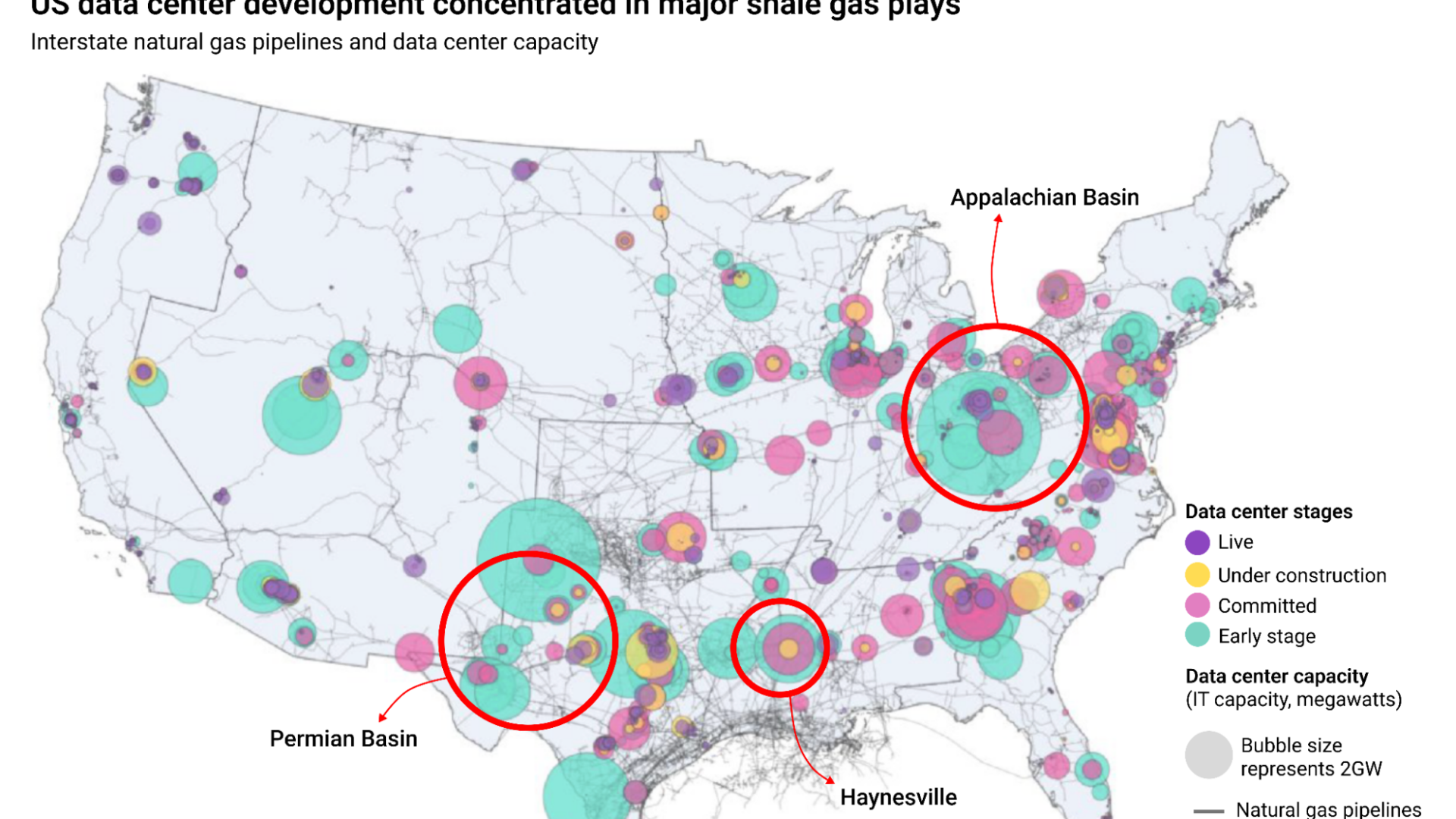
The map shows a clear relationship between data centers and gas infrastructure, as many proposed data centers, especially those from massive hyperscalers, are planned in key gas-producing basins and along pipeline corridors.
Project Lists Show an Imminent Unprecedented Gas Buildout
Oil Change International has compiled a list of gas infrastructure in development – pipelines and power plants – that could be facilitated by the passage of BAAJA. This list may not be fully comprehensive and could include some projects that would not require federal permits relevant to BAAJA. However, it serves to illustrate the unprecedented scale of the imminent fossil gas construction boom in our midst, its relationship to the data center boom, and the prospect that BAAJA could do more to lock in gas than its proponents admit, undermining the case that the bill would be a boon for clean energy and the climate. We also present brief details of six gas projects clearly facilitated by BAAJA, along with their potential community and climate impacts.
An Unprecedented Gas Power Boom is Underway
Gas already supplies around 40% of U.S. electricity generation. In 2025, gas power capacity exceeded 578 GW. The EIA currently tracks over 50 GW of new gas power plant capacity with regulatory approval in process. Another almost 20 GW is either under construction or about to be. But this 70 GW of additional gas capacity may be the tip of the iceberg.
Global Energy Monitor is tracking over 370 GW of gas power plant capacity currently either under construction, in pre-construction, defined as “actively moving forward in seeking governmental approvals, land rights, or financing,” or announced. Of these, around 50% is identified as directly related to data centers, many of which are off-grid, behind-the-fence proposals. Data centers are also constructing or planning more than 8 GW of diesel backup generation capacity.
The list includes 406 gas plants comprising 707 individual generating units. 149 plants and 277 units are identified as data center “captive.” Many of the data center linked proposals are of enormous scale, vying to be the largest gas power installations in the world. Most of them have stated start-up dates before 2035. If most of these go ahead, the buildout will easily surpass the 2000-2010 “dash for gas,” when the U.S. built 237 GW of gas capacity in a decade. This is happening as the world faces an intensifying climate crisis fueled by burning fossil fuels. Most of these plants add fossil fuel capacity rather than replacing retiring capacity.
Projects in Focus
We feature three data center captive gas plants that would benefit from BAAJA provisions that shorten permit timelines and limit public consultation and legal recourse. Each of these massive plants threatens communities’ air, water, and climate, and some could also impact Tribal cultural resources and historic places.
| Project Name | Company | Location | Power Capacity (GW) | Gas Demand (Million Cubic Feet per Day) | Estimated Annual CO2 Emissions (Metric tons) | CO2 Emissions Equivalency (Million Additional Gasoline Vehicles) |
|---|---|---|---|---|---|---|
| Portsmouth Powered Land Project/PORTS-Pike Technology Campus | Consortium of Japanese Banks and Various Shareholders | Piketon, Ohio | 9.2 | 1200 | 16-19 million | 3.7-4.4 |
The Ports-Pike Technology Campus would become the world’s largest data center and, at 9.2 GW, the $33 billion Portsmouth Powered Land Project would surpass the Jebel Ali Plant in the UAE to become the largest gas plant operating in the world today. It would supply power equivalent to New York City’s peak summer demand and would become the country’s largest source of power-sector pollution. The site hosting the data center, power plant, and associated infrastructure covers 3,700 acres near Piketon, Ohio. Part of the site was previously a Department of Energy uranium enrichment plant that closed in the early 2000s, where unresolved radioactive and toxic pollution has led to devastating health consequences. The cancer mortality rate in Pike County for the years 2018 to 2022 was 44% above the national rate, while life expectancy at birth in Pike County is nearly eight years below the national rate.
Permitting is currently in process for the gas plant and associated transmission and gas pipeline infrastructure, including possible Clean Water Act, Endangered Species Act, and Clean Air Act permits that BAAJA would fast-track.
| Project Name | Company | Location | Power Capacity (GW) | Gas Demand (Million Cubic Feet per Day) | Annual CO2 Emissions (Metric tons) |
|---|---|---|---|---|---|
| STAK Energy Campus | STAK Energy Corporation | North Slope, Alaska | 3 | 350-500 | Unknown (project has not specified turbine technology to be used) |
The STAK Energy Campus is a data center planned on a 715-acre site, about 26 miles south of Deadhorse on the Alaskan North Slope. Gas would be piped in via a 90-mile pipeline. The project would convert a large area of Arctic tundra and wetlands vital for Alaska Native communities into an industrial campus, including a data center and a 3 GW gas power plant, and would operate continuously, threatening local wildlife and the community with round-the-clock noise, light, and pollution. Its major environmental and cultural resource issues include habitat conversion, hydrology changes, permafrost risk, air emissions, greenhouse gas emissions, caribou and migratory bird impacts, subsistence concerns, noise, lighting, and cumulative industrialization. The gas power plant would consume more than twice the gas currently used by all of urban Alaska. While a 50-year land lease has been granted, all permits are still pending.
The STAK project would require Clean Water Act permits, and a National Environmental Policy Act (NEPA) review, both laws significantly weakened by BAAJA, as well as state air permits. This project could also trigger the Endangered Species Act, as species in the area, including Polar Bears, Steller’s Eider, Spectacled Eider, and Eskimo Curley, are threatened. BAAJA would also fast-track the 90-mile gas pipeline associated with this project.
| Project Name | Company | Location | Power Capacity (GW) | Gas Demand (Million Cubic Feet per Day) | Annual CO2 Emissions (Metric tons) | CO2 Emissions Equivalency (Million Additional Gasoline Vehicles) |
|---|---|---|---|---|---|---|
| Project Jupiter | Oracle | Doña Ana County, New Mexico | 2.45 | 400 | 10.1 | 2.4 |
Project Jupiter is sited on a 1400-acre site outside the small rural communities of Santa Teresa and Sunland Park, New Mexico, about a dozen miles from El Paso, Texas. The data center project has begun construction but still lacks permits for the gas plant and pipeline. The company claims it will minimize water use in the heavily water-stressed state, but residents fear it could still use millions of gallons per day. According to the 2025 U.S. Census, over 90% of residents in Sunland Park, New Mexico, and over 80% of El Paso County, Texas, identify as Hispanic. The region already faces some of the worst particulate matter and ozone pollution in the country. The proposed 18 miles of new gas pipeline will trigger an NEPA review of the project’s environmental impacts, which BAAJA would fast-track and limit in scope.
These power plant projects are just three examples of the hundreds planned today. They require federal permits and processes that give communities and interested parties some recourse to challenge the projects’ plans and address community concerns. BAAJA would take this away and ensure that these projects surge ahead without public scrutiny.
Gas Pipelines
The surge in gas power can only happen with an expansion of gas pipelines across the country. Hundreds of projects are currently in the permitting process or have been proposed. This follows over 38,000 miles of gas transmission projects built between 2005, when the fracking boom first got going, and 2022.
The Environmental Integrity Project (EIP) has raised the alarm that the Trump administration has weakened pipeline safety standards ahead of yet another surge in proposed pipeline construction. EIP estimates that 193 pipeline projects are currently underway or proposed that could add 17,000 miles of pipeline. 151 of these are gas pipelines across 42 states, covering 10,000 miles. At least 2,500 miles and 24 billion cubic feet per day of pipeline capacity are flagged as associated with data centers. We derived our list of gas pipeline projects from EIP’s database.
Pipeline Projects in Focus
The Desert Southwest pipeline is a $5 billion, 520-mile, 48-inch gas pipeline proposed to run from Texas through New Mexico to Arizona, where several large data centers are planned. The project is meeting resistance along its route. This bill would take away communities’ ability to participate in the permitting process, including the crucial Clean Water Act 401 permit that states use to protect their water resources, a vital issue in the arid Southwest, and to challenge the project in court. It will all but ensure that another 2.3 billion cubic feet per day of gas, an amount similar to the entire gas consumption of the Netherlands
MVP Boost is an expansion of the Mountain Valley Pipeline mainline. The proposal would expand capacity at three existing compression stations and construct one new compression station in Montgomery County, Virginia. The MVP mainline faced years of delays as communities and environmental advocates used the courts to repeatedly show that the project could not be constructed legally. It was eventually greenlit by legislation slipped into Congress’s debt-ceiling negotiations in 2023.
The expansion proposal would increase the MVP mainline system’s capacity by over 30%. A 2025 Virginia Tech study of residents near the proposed compressor station found that 41% of residents are vulnerable to environmental harm due to age; 43% of households include at least one resident with a chronic illness or disability, including 41% with a lung or heart condition, making them more susceptible to harm from air pollution.
FERC issued an Environmental Assessment for MVP Boost on August 7, followed by a 30-day comment period that garnered over 100 comments from impacted community members and advocacy organizations; Virginia Senators Tim Kaine and Mark Warner requested an extension on the comment deadline, and the Virginia Environmental Justice Council filed a recommendation to Governor Spanberger calling for the project’s “termination.” MVP has also filed an application for a Minor New Source Review Permit with the Virginia Department of Environmental Quality; however, the agency has suspended the processing of this permit, and the project is on hold. MVP Boost is included on an American Petroleum Institute list of gas pipelines BAAJA would support.
Rockies Columbia Connector is part of a planned expansion of a Williams gas pipeline network across Wyoming, Idaho, Oregon, and Washington through a series of pipeline capacity expansions and hundreds of miles of new pipeline. The Columbia Connector is a 158-mile 24” new pipeline following the iconic Columbia River Gorge in Washington. Constructing new pipeline along the Columbia River Gorge would harm water quality and impact highly sensitive ecosystems and Tribal resources. Columbia Riverkeeper has identified over 100 data center campuses at various stages of development and operation in 12 Washington and Oregon counties bordering the Columbia River.
Another proposal connected to this network, called the “Valley Trail Project,” includes 137 miles of new pipeline in Grant County, WA, that would also fuel new data center gas demand. In August 2025, the Grant County Public Utility District claimed that 79 pending requests for utility service would consume roughly twice the energy the city of Seattle uses. Grant County Public Utility District announced plans to explore the feasibility of constructing new gas-fired power plants, citing the nearby pipeline expansion.
Both pipelines would require a NEPA review and likely 401 Clean Water Act certificates from State governments. These proposals could threaten the cultural resources of many Tribal nations, triggering government-to-government consultation through the National Historic Preservation Act. BAAJA threatens to erode and weaken these critical laws, while also creating “categorical exclusions” for gas pipeline expansions that industry could argue apply to this network.
BAAJA Fast-Tracks Data Centers’ Use of Dirty Technology
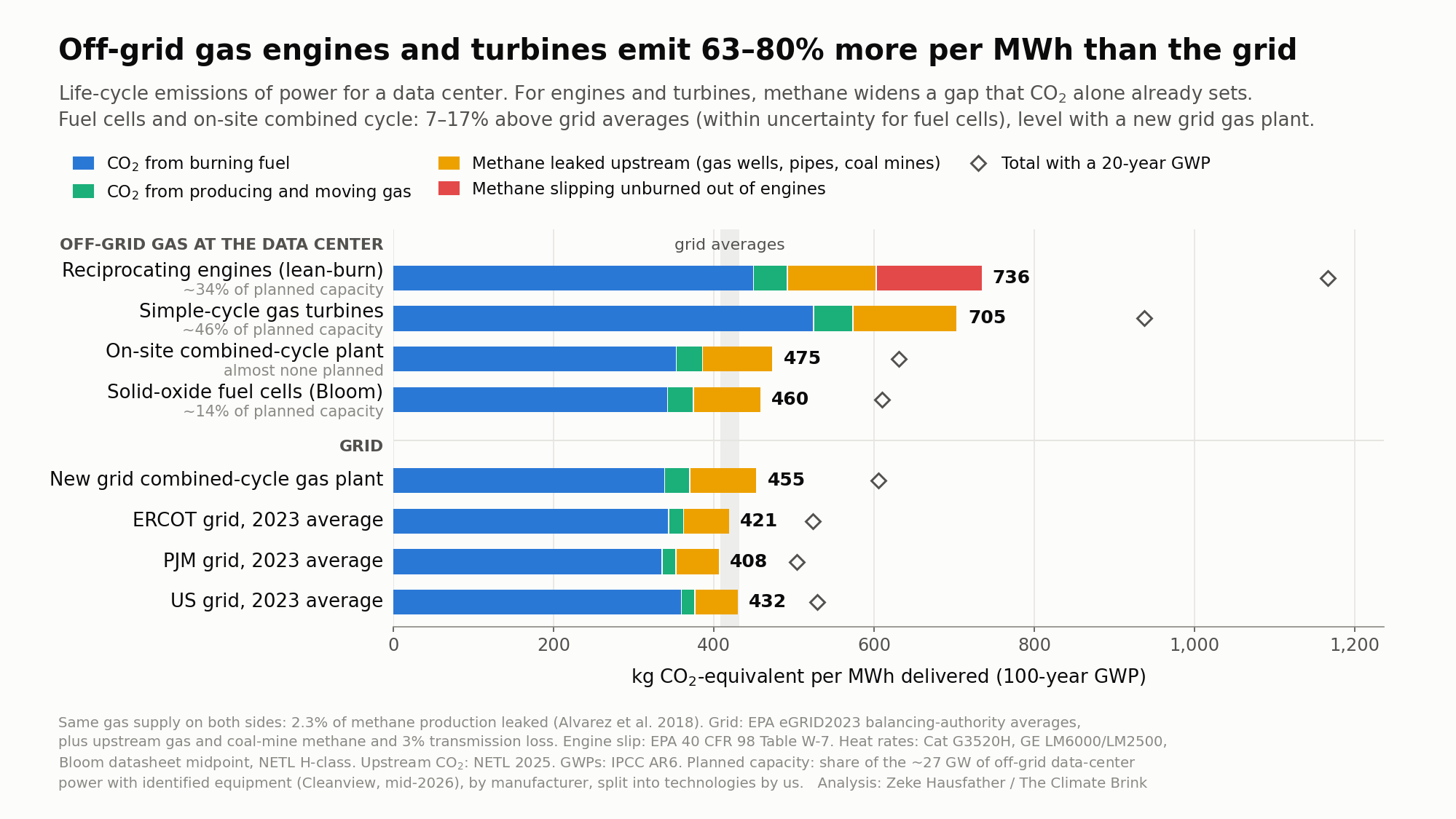
Rolling back environmental review and short-circuiting the right to legal challenges will only encourage data centers to choose dirtier gas generation technologies. Long wait times for new heavy-duty combined-cycle gas turbines, the most efficient, are now five to seven years. Many data centers planning on-site gas power are opting for single-cycle, or simple-cycle, aeroderivative (adapted jet engines) or reciprocating engines that can be delivered within one to two years but have much lower fuel efficiency, leak more methane, and therefore emit more greenhouse gases.
An analysis by Zeke Hausfather at Climate Brink found that emissions at off-grid data centers could be 60-80% higher per unit of energy produced (MWh) because of the choice to install this less efficient equipment. Taking away communities’ and environmental advocates’ ability to challenge these reckless plans will lock in these bad choices.
 Source: Climate Brink
Will BAAJA Shift Data Centers Toward the Grid and Therefore Less Gas?
Supporters of the bill argue that faster grid connections will bring more data centers onto the grid, reducing on-site gas use and the proliferation of these inefficient turbines. However, this is far from certain. Ratepayer provisions in the bill would require data centers to pay the full cost of transmission line extensions, upgrades, and grid connections. This may further incentivize data centers to remain off-grid. The Rhodium Group estimates that these provisions could double electricity costs for data centers, resulting in a 10% increase in total annual operating costs.
The map above shows that many of the largest data centers have already chosen sites in the country’s key gas-producing regions and along its gas transmission network. Many of them already have gas turbine equipment on order. Because the bill’s ratepayer protection provisions could raise the cost of grid connections, additional policy mechanisms would be needed to force data centers to abandon plans for on-site gas and connect to the grid. Instead, the bill will provide a tailwind for their current plans by reducing public input and permitting timelines, potentially sealing the deal for a massive surge in inefficient, dirty on-site gas generation.
Conclusion
The Bipartisan American Affordability and Jobs Act would streamline and accelerate a massive surge in gas power plants and pipelines. While transmission lines and grid connections are sorely needed for the clean energy transition, the bill’s provisions undermine clean energy and climate progress by making it easier and faster to build out gas infrastructure.
The list of planned gas pipelines and power plants makes it clear that we need to stop an imminent surge in gas infrastructure, not boost it. We need clean energy legislation that forces data centers and utilities to move to renewable energy while protecting clean air and water, rather than forcing massive gas plants and endless pipeline expansion through our communities. Senators should vote no on this bill.