
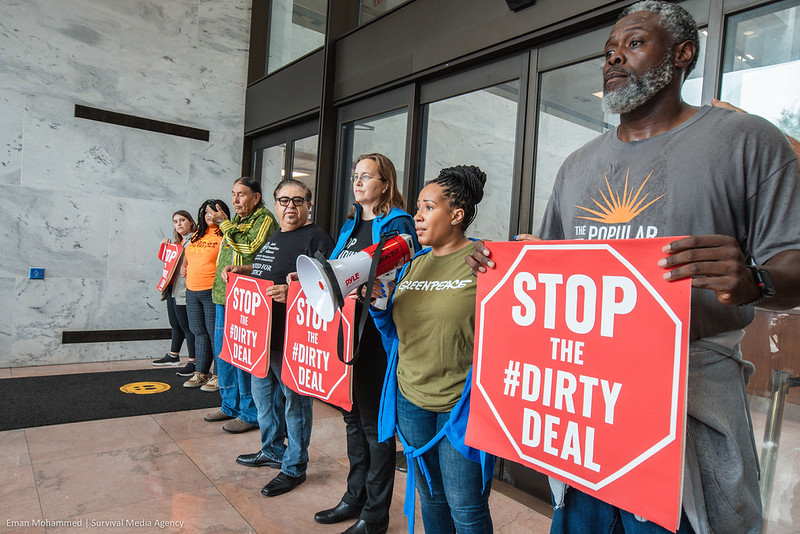
The Permitting Bill Is The Fossil Fuel Industry’s Climate Action Kill Switch
Proponents’ models only expose how little would be gained from this epic giveaway.
In short:
- Some provisions within BAAJA are designed to prevent future administrations from reinstating emissions limits and could serve as a kill switch for future climate action—a major gift to the fossil fuel industry.
- Modeling touted by the bill’s proponents shows best-case emissions reductions that fall 2.3 billion tons short of climate goals in 2040.
- Touted cost savings are misleading. U.S. overreliance on gas will raise energy bills, and the proponents’ models only reinforce this.
- The data center boom’s hunger for gas likely isn’t adequately factored into models, suggesting gas could be the bill’s main beneficiary.
The U.S. Senate aims to pass an energy infrastructure permitting bill, known as the Bipartisan American Affordability and Jobs Act (BAAJA), soon after returning from the midterm election recess. Civil society groups defending Indigenous rights, the climate, and communities on the fencelines of an oil and gas industry that has become the world’s biggest producer and exporter of oil and gas have widely described the draft bill as disastrous.
Senate Democrats are championing the bill as a way to push back against the Trump administration’s war on wind and solar, as it seeks to reduce bureaucratic red tape that slows the development of electricity transmission lines and grid connections. This may sound good in principle, but the package includes dismantling federal statutes, including Tribal sovereignty protections, the Clean Water Act, the National Environmental Policy Act, the Endangered Species Act, and the National Historic Preservation Act. This could not only support continued expansion of oil and gas infrastructure, countering gains for clean energy, but would also drastically curtail the ability of communities, states, and Tribes to protect themselves from harmful energy projects.
Whether curtailing environmental laws will boost renewable energy more than it will boost fossil fuels is highly contested. Supporters of the bill argue that “unleashing” renewable energy will let the market reduce fossil fuel use, since renewable energy is the cheapest source of energy on the market. They believe that removing the “red tape” holding back renewables is the key to vanquishing fossil fuels. To them, destroying communities’ rights to protect their air, land, water, and cultural heritage is a price worth paying to achieve this goal.
Unfortunately, this drastically underestimates the power of the U.S. fossil fuel industry, evidenced by the provisions it inserted into this over 400-page bill that will ensure fossil fuels dominate U.S. energy production and consumption indefinitely. BAAJA proponents’ modeling of its potential emissions and cost savings shows how little even a rosy analysis of the bill would deliver, while ignoring what’s at stake.
You Will Never Regulate Us Again
The provisions, labeled Sections 1401 and 1402 in the draft bill, could undermine the power of any future administration to set climate or clean energy goals, effectively protecting the fossil fuel industry from any future efforts to reinstate, for example, EPA powers to control methane, CO2, mercury, or any other pollutant emitted by fossil fuel infrastructure that the Trump administration has unwound in the past two years, or possibly even set Nationally Determined Contributions (NDCs) under the Paris Agreement on Climate Change. Essentially, these provisions give corporations the power to sue federal agencies for any action that would affect the utilization rate of their federally permitted project, and that threat alone could chill any effort to do so. This doesn’t just apply to projects permitted after the bill passes, but to all projects with any kind of federal permit. This means no fossil fuel phaseout, ever.
So, having gutted the bedrock environmental laws that give communities the power to push back against projects that threaten their health, safety, and cultural heritage, they also plan to protect those projects from any future administration taking action to protect those communities or the climate. Essentially, this gives the fossil fuel industry the get-out-of-jail-free card it has long sought in order to never have to face a federal permit denial, or ever wind down its colossal pollution, whether to mitigate the climate crisis or protect community health.
This is so obviously an atrocious trade-off that you have to assume massive concessions are being offered to offset this nightmare scenario. Surely the provisions supporting renewable projects are so large and powerful that the invisible hand of the market will bring about the massive reductions in fossil fuel use needed to save us from catastrophic climate impacts that, at this point, are not far around the corner. We won’t need government regulation of fossil fuels anymore because we’re giving renewable energy such a massive leg up that it won’t be necessary. You would think.
Pro-Permitting Reform Models Only Serve to Expose the BAAJA’s Epic Weakness on Emissions and Cost Savings
Proponents argue the bill will reduce CO2 emissions by speeding up grid connections and electricity transmission line development, which could support faster, more extensive development of solar and wind generation as well as battery storage. They aim to prevent the Trump administration from denying permits for renewable energy projects and reinstate the wind farms that Trump has illegally canceled. They’re convinced the cost advantage of renewable energy is so great that, if bureaucratic red tape and administrative interference are removed, renewables will win the day and fossil fuel emissions will plummet.
So you would think they must have some really robust modeling to back it up. They do have some numbers. But what they have suggests that bill proponents are giving away the entire climate battle for so little that it will barely register. And that assumes you take their numbers at face value. What has been offered so far does not enable a full scrutiny of the models, so we will have to do exactly that.
The American Petroleum Institute Touts the Bill’s 0.6% Emissions Cut
Perhaps the clearest sign that the bill would be a gift to the U.S. oil and gas industry is the American Petroleum Institute’s (API) support. In late September, the API issued a press release urging senators to bring the legislation to the floor, pointing to an analysis of the draft bill it commissioned.
This analysis is revealing. It claims that the bill would reduce emissions and energy costs while increasing fossil gas consumption and exports compared to business as usual. However, the emissions reductions in their model would barely register, and the price reductions are incremental amid rising energy costs in an affordability crisis driven largely by overreliance on the same energy source the analysis shows the bill would boost: fossil gas.
API’s study, conducted by ICF, finds that the bill would shave 2.4% off U.S. power sector emissions through 2035. The figure presented is 33 million metric tons of CO2 per year below an annual average total of 1.37 billion. This is purportedly because the bill would enable more gas and renewables to displace coal on the U.S. grid.
In this analysis, the U.S. power sector would still emit 1.34 billion metric tons of CO2 in 2035. This is remarkable for several reasons, not least because it is higher than the Department of Energy’s Annual Energy Outlook forecasts in all scenarios, including the one with the highest oil and gas supply.
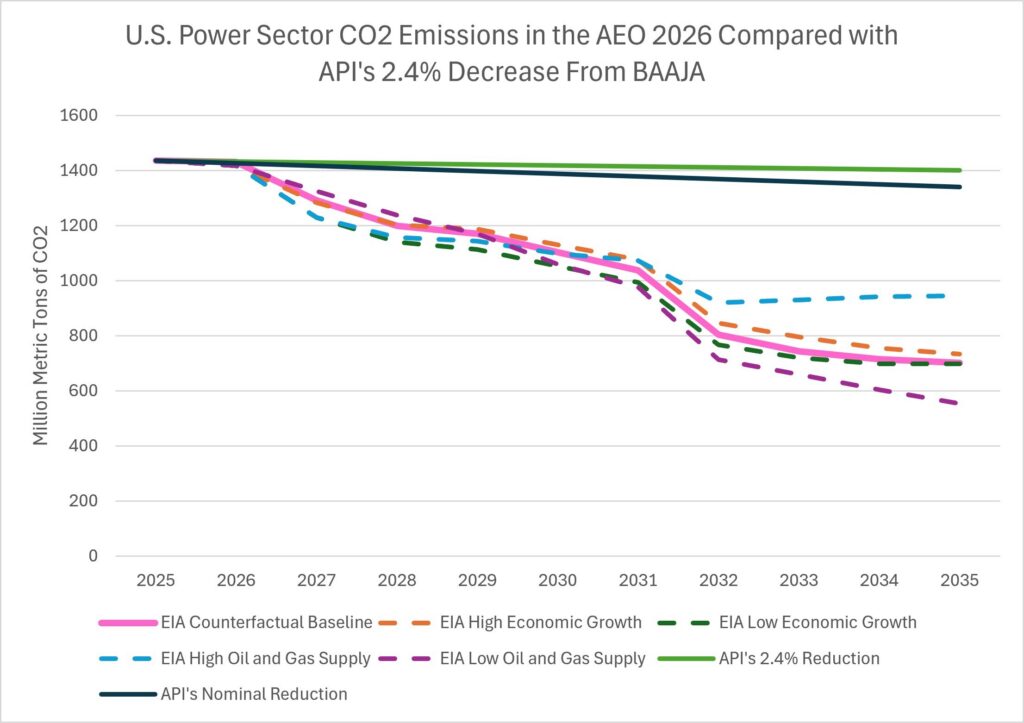
Source: EIA, AEO 2026 and American Petroleum Institute. Note: the API’s starting point, or Reference Case, is lower than the EIA’s, with emissions averaging 1,373 million metric tons over the period. Therefore, we have produced two trajectories. One tracks the API’s 2.4% decline projection, starting with the EIA’s 2025 figure (2.4% Reduction). The other uses API’s Policy Case (impact of BAAJA) figure of 1,340 mmt as the end point (Nominal Reduction), also starting with the EIA’s 2025 figure. Both result in substantially more emissions than the AEO 2026 scenarios.
The API’s 2.4% decrease is based solely on power sector emissions; the study does not discuss how emissions in sectors other than power generation would be affected. Taken at face value, the bill would therefore lead to an insignificant decrease in power sector emissions, equivalent to 0.6% of total U.S. emissions in 2025. [1] Given the dramatic reductions needed to give the world a chance of meeting the Paris Agreement’s emissions targets (see below), this is a change without a difference. If the U.S. power sector is still emitting over 1.3 billion metric tons of CO2 in 2035, we are likely facing the severest climate change.
What We Know About the Senators’ Own Analysis
While the API is no doubt swarming the Hill with lobbyists armed with their study, the Senators pushing the bill have their own analysis, apparently conducted by the Rhodium Group. They have not made it publicly available, but we have gained some insight from the Center for Energy & Environmental Analysis, published earlier this week. This shows a range of modeling results from nine different sources, only two of which actually assess the bill itself. The others project U.S. emissions in a range of scenarios to provide context.
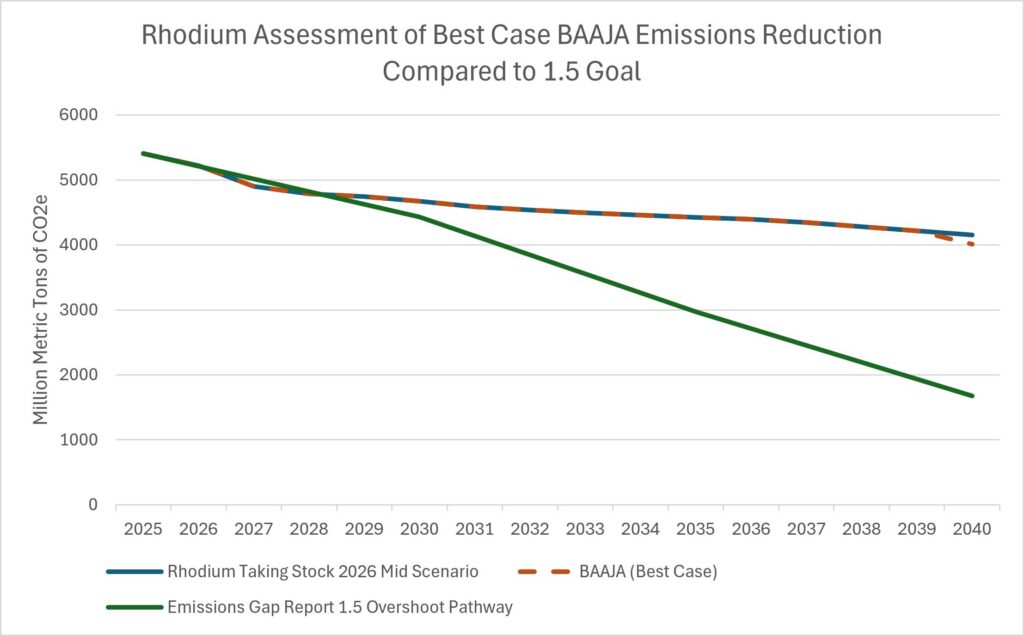
The two that assess the bill show emissions outcomes ranging from a 32 million metric ton per year (MMT/A) increase to a 144 MMT/A decrease in 2040. So the best-case scenario, according to these models, is a 144 MMT/A emissions decrease by 2040, which is a little under 2.7% of total U.S. emissions in 2025.
This comes from the Rhodium analysis reportedly touted by the Senators introducing the bill, which is not yet public, so we don’t have context for whether this is a reduction from a 2025 starting point, from a reference case that already saw emissions declining, or a case that projected increases. However, we think the baseline is likely Rhodium’s Taking Stock 2026 Report published in July.
2.3 Billion Tons Short
We have created the chart below using the “Mid” scenario in Rhodium’s Taking Stock report as the baseline. We only have the 2040 figure from the BAAJA analysis, so the BAAJA scenario’s trajectory will likely look different, perhaps tracking slightly below the Rhodium Mid Case. But what is clear is that the BAAJA, in this best-case scenario, is shaving incremental points off the U.S. emissions trajectory rather than course-correcting toward where we need to be. It’s also worth noting that Rhodium also found that the bill could lead to a 32 million-ton emissions increase in 2040.
We compare the outcome with the global emissions decline rate in UNEP’s “lowest possible” 1.5°C overshoot pathway in the 2026 Emissions Gap report. The BAAJA case results in 2040 emissions more than 2.3 billion tons higher than where we need to be, without accounting for the U.S.’s fair share of effort. The Emissions Gap trajectory does not account for equitable cuts based on historic responsibility for emissions, for which the U.S. has the greatest responsibility. It also leads to temperatures peaking as high as 1.7- 1.8 °C mid-century, which would cause severe, irreversible harms. It is not a radically ambitious scenario.
The Data Center Boom’s Gas Preference Suggests Gas Will Win Over Renewables
The data center boom and its clear preference for gas-fired power raise the specter that gas power will benefit most from the bill’s provisions. It is unclear how much the bill’s analysis, or whichever reference case it used, considered this. The rate of new data center announcements in recent months is such that analysts at BloombergNEF increased their forecast for U.S. data center power demand by 83% between December 2025 and July 2026. Most of that power is expected to come from new gas power plants, threatening a major reversal in the power sector’s emissions trajectory over the coming decade. Global Energy Monitor announced in August that “U.S. gas power proposals tied to data centers nearly double(d) in six months.”
If this massive surge in gas power has not been factored into the analysis of the bill, which seems likely given how new many of the announcements are, it is likely that emissions reductions have been overestimated.
The EIA currently tracks over 50 GW of gas power plant capacity with regulatory approval pending or preparing to file. Another almost 20 GW is either under construction or about to be. But this 70GW of additional gas capacity may be the tip of the iceberg.
Global Energy Monitor is tracking 283 GW of gas power plant capacity currently either in pre-construction, defined as “actively moving forward in seeking governmental approvals, land rights, or financing,” or announced. Of these, 56% (158 GW) is identified as directly related to data centers.
Wood Mackenzie published a white paper in July estimating that gas demand for the U.S. power sector could rise 50% by the mid-2030s primarily due to data center growth. This aligns with BNEF’s analysis published in September. These analyses did not factor in the BAAJA, but they do show that gas currently dominates the investment plans of data center and utility companies planning for the expected boom in power generation triggered by AI.
Given the bill’s all-of-the-above approach to energy sources, the fact that its provisions will both enable and accelerate gas infrastructure as well as renewables, and given that the sheer scale of the U.S. data center boom favors large-scale, on-site, dispatchable power, we should be greatly concerned that the bill will do little to raise renewable energy above gas, and may in fact boost gas further.
The Cost of More Gas
Both the Wood Mackenzie and BNEF analyses point to the risk of rising fossil gas prices as demand grows from both data centers and LNG exports, the latter set to double in the next five years due to the massive increase in capacity currently under construction. Oil Change International (OCI) published a report in July showing that analysts across the industry expect wholesale U.S. gas prices to rise 80% over the coming decade, well ahead of the Fed’s inflation target of 2%.
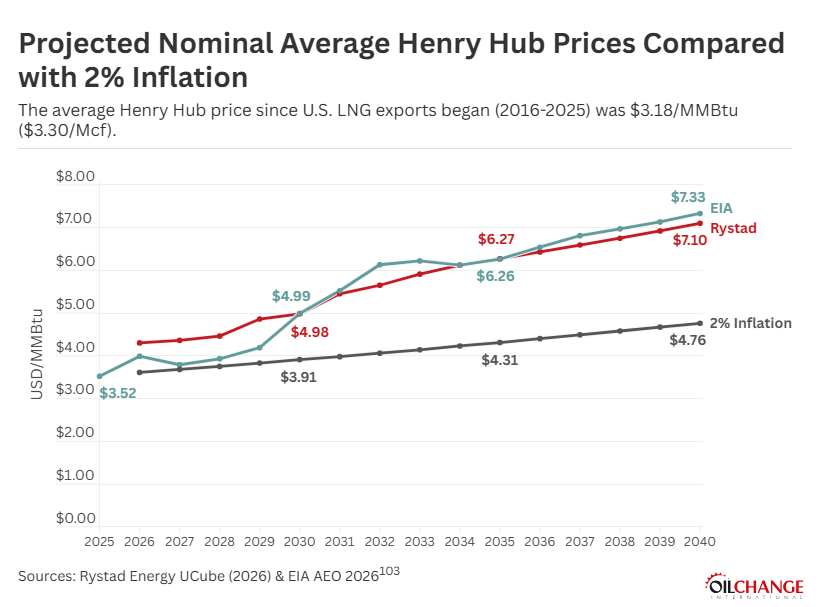
In this context, claims about the bill’s potential cost savings must also be put in perspective. API’s study emphasizes economic benefits, touting job creation that primarily derives from lower energy bills for households and businesses. But the context exposes the hollowness of these supposed gains.
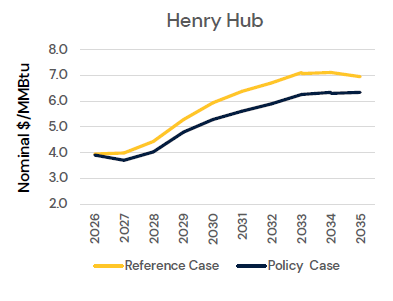
The study points to lower wholesale fossil gas prices, with the main U.S. gas price benchmark, Henry Hub, averaging 10% lower than in API’s reference case. Prices in the reference case closely align with OCI’s report’s findings. Therefore, the savings API is touting are not a reduction in energy costs, but simply the possibility that prices may not rise as high as they otherwise would. It still leaves U.S. households and businesses paying far more for energy than before. Hardly a solution to the cost-of-living crisis.
Henry Hub Prices in the API’s BAAJA Study
Source: American Petroleum Institute
The Bill Must be Stopped
The bill threatens to force energy projects onto communities across the country, leaving them and their state governments no recourse to protect their air, land, and water. It could set in stone the Trump-era rollbacks of EPA powers, and prevent future administrations from setting climate or energy goals that can in any way constrain fossil fuels.
This permitting bill comes at a time when our federal environmental protections are already greatly diminished, and our climate goals are slipping out of sight, while the gas industry, tech giants, and utilities plan the biggest expansion of gas power ever seen.
The analysis provided by the bill’s proponents brings us no hope that what they are proposing will fix this situation. The changes proponents tout make no real difference to the issues they claim to address. Slightly lower emissions in a world that needs to rapidly push emissions down to zero does nothing to end the climate crisis. If the bill shaves a few percentage points from relentlessly rising energy prices, it only fails to address the affordability crisis caused by overreliance on fossil fuels.
We need reforms, for sure. But we need reforms that definitively support clean energy: wind, solar, energy storage, energy efficiency, and electrification, without concessions to fossil fuels that will only serve to entrench them further and undermine subsequent action to rein them in. If this cannot be done at this time because of the Republican Party’s destructive refusal to see climate change as anything other than another culture war opportunity, then this is not the time for Congress to act.
[1] Net 2025 emissions of 5,409 million metric tons from Rhodium Group, Taking Stock 2026