
Our Pain, Their Gain: Tax Big Oil’s $65 Billion War Windfall
Now is the time to tax oil and gas profits and use the revenue to alleviate energy poverty and support an equitable transition away from fossil fuels.
Our Pain, Their Gain
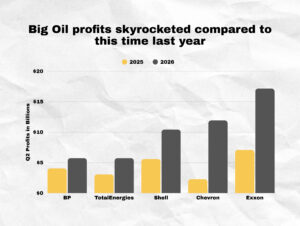
The world’s five largest international oil companies (IOCs) and five largest U.S. independent refiners made over US$65 billion in profits in the second quarter of 2026 as conflicts in the Persian Gulf and Ukraine spiked oil prices and caused refined fuel supply constraints.
As thousands die in the relentless bombardments of drones and ballistic missiles, the oil and gas industry reaps windfall profits in a year that was looking to be a loser before the bombs started falling.
Around the world, refined fuel, especially diesel and jet fuel, is in short supply as stores deplete, and around 8-10% of global refining capacity is offline due to the two conflicts. This disruption has spiked profits from refining crude into fuel.
In a repeat of 2022, when Putin launched his war on Ukraine, there is a massive transfer of wealth occurring as billions around the world struggle with high energy prices while an elite few reap the windfall. And while wildfires, drought and floods destroy lives and livelihoods, the companies that have profited from the climate crisis are getting to keep their windfall as governments fail to take action.
Trump’s war against Iran, coupled with his policies such as AI and data center promotion, have led to skyrocketing energy prices in the US and globally. As conflict disrupts global oil and gas markets, people around the world pay more for basic needs while oil companies reap billions in windfall profits. Fossil fuel dependence makes economies more volatile, puts communities in danger, and helps the wealthy few profit from wars. Accelerating an equitable transition towards renewable energy is essential to a more stable and peaceful future.
International Oil Companies Profits Up 131%
The five major international oil companies (IOCs) recorded massive jumps in profits in Q2 2026 compared to the same quarter of 2025. Their total adjusted net income amounted to $51 billion for the 3 months – that’s nearly $400,000 per minute. Meanwhile, people around the world are paying around 30% more for gasoline and diesel, with some countries, particularly in Southeast Asia, seeing increases of 80% or more.
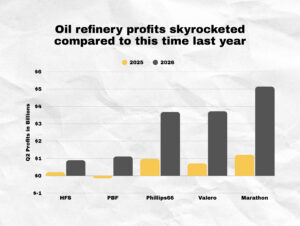
Refining driving profits – up by 391% in the U.S.
Much of this profit has been derived from refining rather than producing and trading oil and gas. Refineries in Saudi Arabia, Kuwait, Bahrain, and the UAE have been struck by Iranian missiles and drones and face shipping issues going through the Strait of Hormuz. Elsewhere, Ukraine has repeatedly struck Russian refineries, causing fuel shortages and restrictions on refined product exports from Russia.
Globally, refineries are producing about 8-10% less, or around 6.5 million barrels a day, compared to a year ago, with global exports of diesel down around 35%. Goldman Sachs warned that global refining activity is at its lowest since 2020, when the COVID pandemic led to lockdowns and plummeting demand for fuel.
While US refiners have increased their production and exports, this has only made up for about a third of the shortage, leading to record profits for US independent refiners. Valero, one of the largest independent refining companies in the world, recorded its most profitable quarter on record. The five US independent refiners made over $14.5 billion in Q2 2026, up from $2.9 billion in Q2 2025, a 391% increase.
A Very Different Outlook at the Beginning of 2026
In January 2026, the oil industry was facing a year of oversupply, low prices, and plummeting profits. The International Energy Agency expected oil and gas markets to be in surplus for 2026 and on into 2027. Oil prices were expected to stay around $60 per barrel compared with the $80 to $100 per barrel range since Israel and the US started bombing Iran. Despite Ukraine’s escalating attacks on Russian refineries, fuel markets were expected to stay well supplied and refining margins tight. Many companies announced reductions in dividends and share buybacks in order to preserve cash for difficult times to come. Now they are reaping record profits and paying down debt to support future distributions to shareholders.
Taxing the Windfall Makes Sense
We know that when oil and gas companies make windfall profits, the world’s richest elites reap the lion’s share. An analysis of the distribution of profits from 2022 among publicly listed oil and gas companies found that U.S.-based firms pocketed the largest share, and the richest Americans overwhelmingly benefited from this windfall: 50% of U.S. firms’ profits went to the wealthiest 1% of individuals.
There are growing calls from around the world for windfall taxes. In the United States, civil society organizations have called on Congress to stop Big Oil’s war profiteering by implementing a windfall profits tax. Senator Sheldon Whitehouse told the Associated Press, “It’s fair to put a windfall profits tax on inordinate windfall profits rather than cut off children’s food programs.” Whitehouse introduced a bill back in March that would impose a windfall profits excise tax on crude oil and rebate the tax collected back to taxpayers. So far, Congress has not acted.
French campaigners called for a permanent windfall tax on fossil fuel profits back in April. Even before these latest results, the French National Assembly had summoned TotalEnergies’ CEO, Patrick Pouyanné to answer questions about high profits.
In late July, Portugal’s government approved a 33% windfall tax on extraordinary profits earned by oil and refining companies due to the Iran War. The Portuguese Finance Ministry said, “It is therefore fair and necessary to create a solidarity mechanism by taxing part of these exceptional profits to help finance measures to offset the impact of higher fuel prices on households and the most vulnerable businesses.”
In the UK, Green Party leader Zack Polanski has called for oil and gas companies that have made bumper profits during the war to be taxed at a higher rate to help fund climate mitigation measures and wildfire protection.
There is a predictable pushback from Big Oil. Darren Woods from Exxon told investors: “We canceled investments that we had planned for Europe based on the last time they passed a windfall profits tax. In fact, we’re suing the EU because we don’t think that’s a legal taking for the industry.”
Portugal has it right, and others should follow suit. People around the world are suffering the consequences of fossil fuel dependence. The climate crisis is here, and its impacts are destroying lives and livelihoods every day. As if this wasn’t enough, oil and gas dependence is exacerbating the cost-of-living crisis, even as we have the technologies and solutions to address both issues. Now is the time to tax oil and gas profits and use the revenue to alleviate energy poverty in the short term by issuing rebates for low-income families and in the long term by supporting a just transition away from fossil fuels.