
Fact Sheet • Global Public Finance, Asia, United States

Pay, Baby, Pay: Trump’s AI and energy dominance agenda means costlier LNG for Europe

Oil Change International

This fact sheet summarizes the Pay, Baby, Pay report in the context of Europe’s increasing dependence on U.S. LNG imports.

Introduction

The European Union (EU) is becoming increasingly reliant on U.S. liquefied natural gas (LNG) as U.S. fossil gas gets more expensive. The Trump administration’s push to expand LNG exports and artificial intelligence at the same time is set to spike demand for U.S. gas. Analysis shows that meeting this demand will require more expensive gas production, potentially increasing prices for U.S. LNG importers, including Europe.

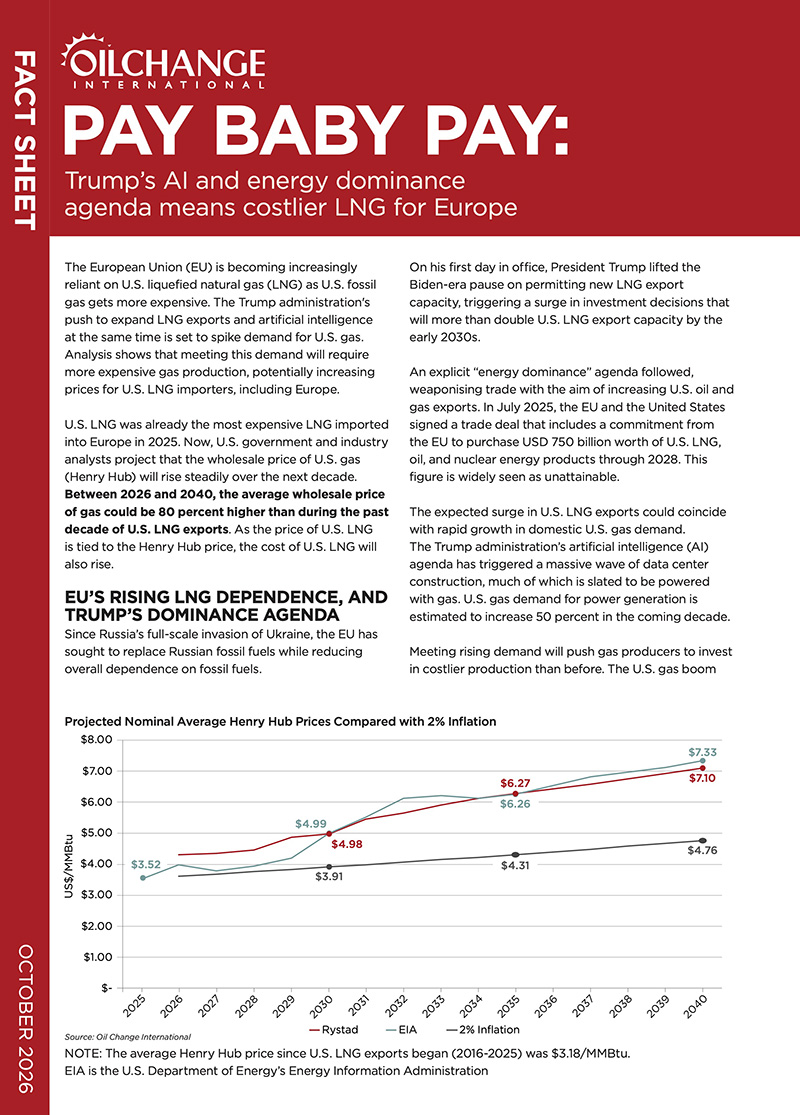
U.S. LNG was already the most expensive LNG imported into Europe in 2025. Now, U.S. government and industry analysts project that the wholesale price of U.S. gas (Henry Hub) will rise steadily over the next decade. Between 2026 and 2040, the average wholesale price of gas could be 80 percent higher than during the past decade of U.S. LNG exports. As the price of U.S. LNG is tied to the Henry Hub price, the cost of U.S. LNG will also rise.

EU’s rising LNG dependence, and Trump’s Dominance Agenda

Since Russia’s full-scale invasion of Ukraine, the EU has sought to replace Russian fossil fuels while reducing overall dependence on fossil fuels.

On his first day in office, President Trump lifted the Biden-era pause on permitting new LNG export capacity, triggering a surge in investment decisions that will more than double U.S. LNG export capacity by the early 2030s.

An explicit “energy dominance” agenda followed, weaponising trade with the aim of increasing U.S. oil and gas exports. In July 2025, the EU and the United States signed an agreement that includes a commitment from the EU to purchase USD 750 billion worth of U.S. LNG, oil, and nuclear energy products through 2028. This figure is widely seen as unattainable.

The expected surge in U.S. LNG exports could coincide with rapid growth in domestic U.S. gas demand. The Trump administration’s artificial intelligence (AI) agenda has triggered a massive wave of data center construction, much of which is slated to be powered with gas. U.S. gas demand for power generation is estimated to increase 50 percent in the coming decade.

Meeting rising demand will push gas producers to invest in costlier production than before. The U.S. gas boom is entering its third decade, and the regions that have met most gas demand to date will not be able to meet the coming surge on their own. To raise gas production to expected levels, drilling will need to increase in the Haynesville region, where gas lies deeper and in more technically challenging geology. Higher drilling costs mean higher gas prices.

The EU Methane Regulation: an opportunity to protect Europe’s energy resilience and affordability

Adopted in August 2024, the EU Methane Regulation (EUMR) aims to curb methane emissions from fossil fuels, covering both domestic production and imports. This legislation matters because voluntary initiatives have not reduced methane emissions.

The EUMR has been repeatedly attacked by the fossil fuel industry and exporting states like the United States and Qatar.

In June 2026, the EU caved to pressure and recommended that member states suspend the regulation’s penalty regime for three years. In September, the bloc’s energy Commissioner proposed to delay the Regulation by a year.

Rapid, full implementation of the EUMR would allow the bloc to set a standard for the gas it imports. While the EU explicitly strives to end fossil fuel dependency, it falls short of its climate commitments. Its imports should decline rapidly, and far enough that compromises on crucial policies become unnecessary.

Conclusion & Recommendations

The ongoing energy crisis (the second one Europe has faced in four years) caused by Israeli and U.S. attacks on Iran has finally triggered explicit debate about the need to end EU fossil fuel dependency. On a continent where one in four households and many businesses struggle with energy poverty, the potential for U.S. LNG, which has become the source of two-thirds of EU gas supply, to increase in price is alarming.

EU decision-makers must deliver on gas demand-reduction measures, support the most vulnerable in the short term, and focus on a just transition away from fossil fuels by increasing electrification, replacing imported fossil fuels with locally produced renewable energy, and improving energy efficiency in the long term.

The EU also has a major historical responsibility for the climate crisis. Wealthy governments like the EU and its member states must swiftly adopt meaningful fossil fuel transition roadmaps with phase-out dates for coal, oil and gas that are aligned with the 1.5°C limit and equity, end their public finance for fossil fuel projects, and deliver their fair share of debt-free international public finance for a just energy transition.

This resource was written by Oil Change International (OCI). Please reach out to [email protected] for any questions or comments.

Oil Change International is a research, communications, and advocacy organization focused on exposing the true costs of fossil fuels and facilitating the coming transition towards clean energy.

Cite this work

“Pay, Baby, Pay: Trump’s AI and energy dominance agenda means costlier LNG for Europe.” Oil Change International, October 7, 2026, https://oilchange.org/publications/pay-baby-pay-trumps-ai-and-energy-dominance-agenda-means-costlier-lng-for-europe/.