
BAAJA’s Epic Climate Fail
Slightly lower emissions in a world that needs to rapidly push emissions down to zero does nothing to end the climate crisis.
This article updates earlier BAAJA modeling analysis following the publication of Rhodium Group’s analysis of the bill.
Last week, we published an analysis of the available emissions modeling of the Bipartisan American Affordability and Jobs Act (BAAJA), highlighting its epic failure to bring U.S. emissions anywhere near where they need to be for a livable climate. Our analysis of the modeling the bill’s sponsors used to promote it relied on headline numbers only because the analysis was unpublished. Speculation that the Rhodium Group provided this unpublished modeling was confirmed when they reached out to us to publish a disclaimer that the numbers came from a preliminary, unpublished analysis, which we did.
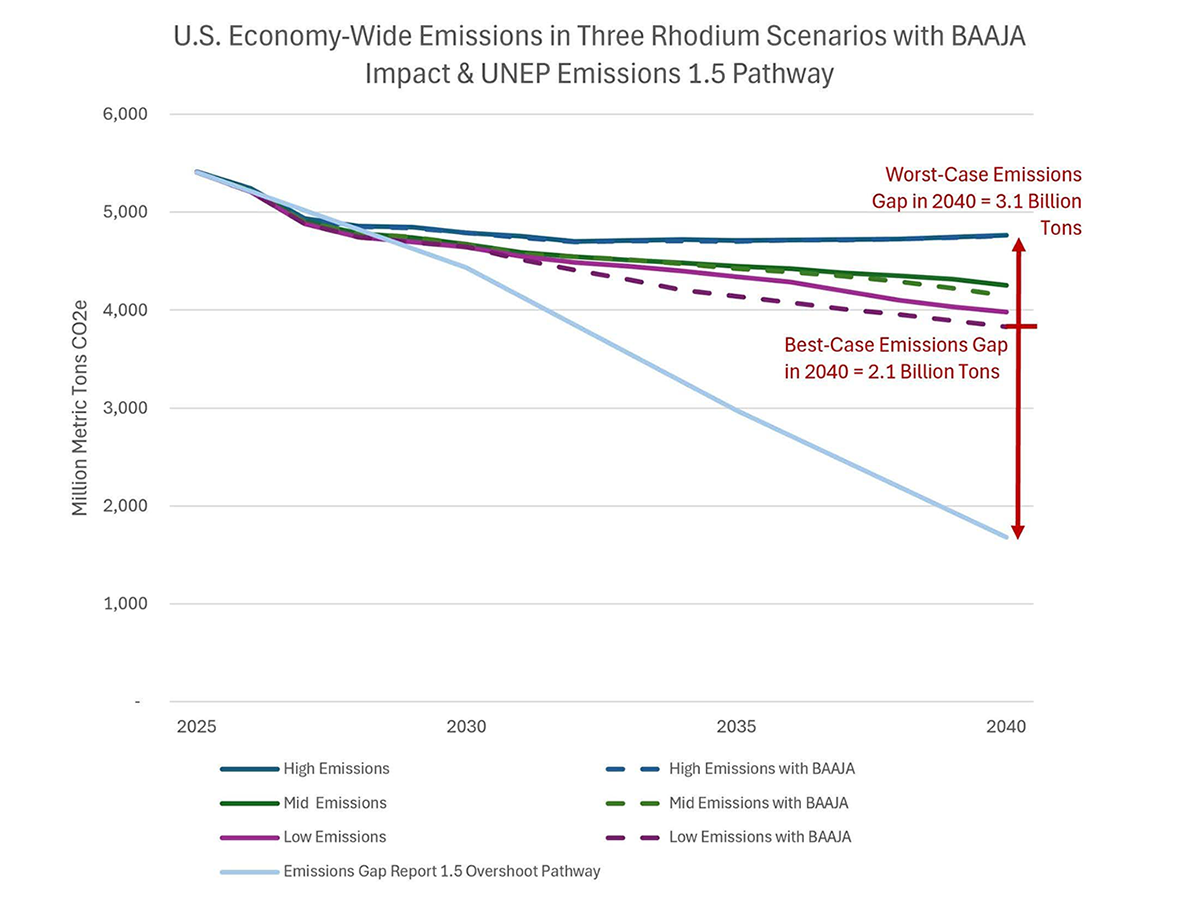
On Monday, the Rhodium Group published its final analysis and expressed support for the bill. We now have a more complete picture of the emissions analysis. However, the picture is not dramatically different. The best-case scenario, which in the chart below is the Low Emissions with BAAJA case, falls over 2.1 billion tons short in 2040 of where U.S. emissions need to be. In the worst case, the shortfall is 3.1 billion tons.
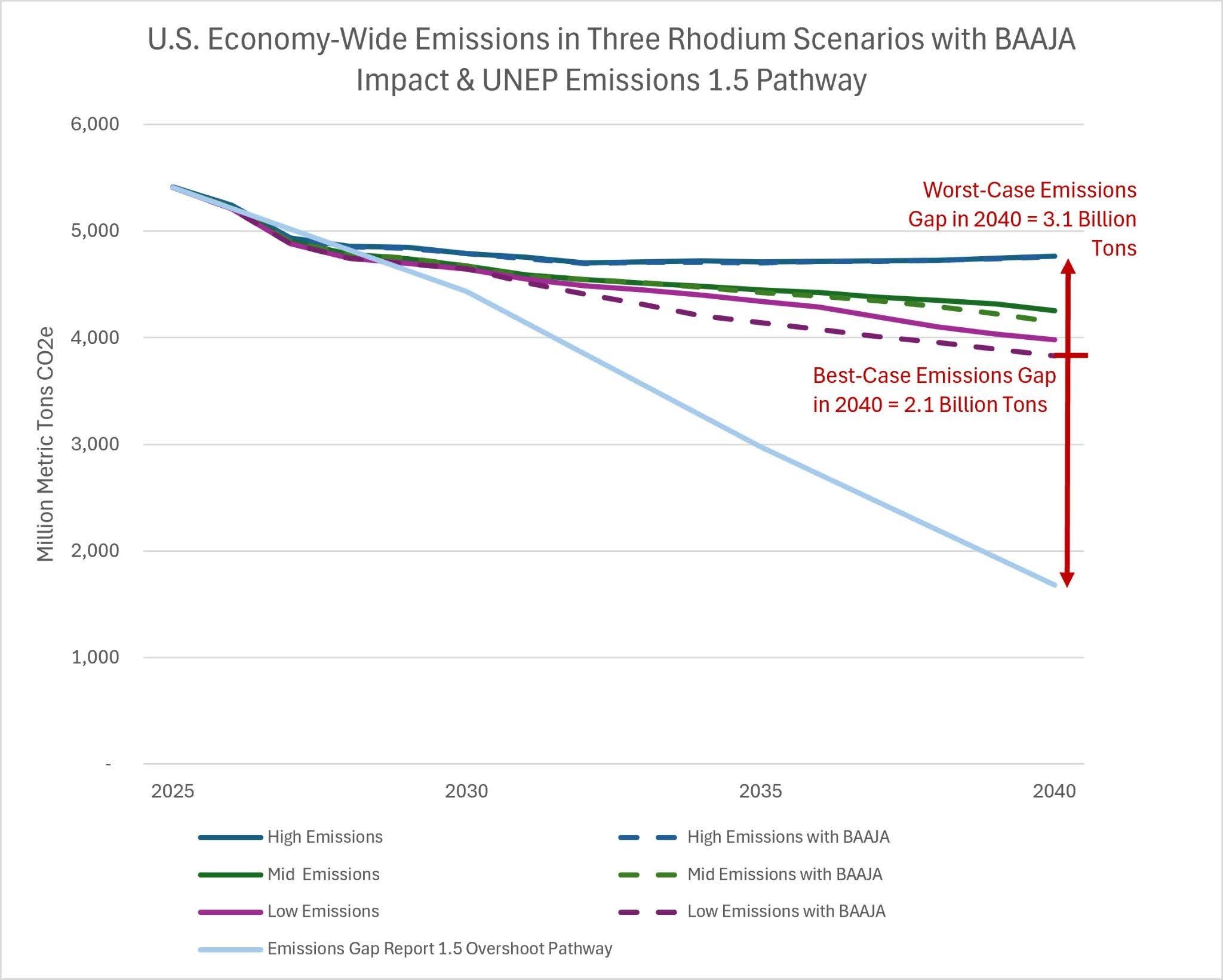
Source: Oil Change International using Rhodium & UNEP
The best-case emissions reduction is 3.8% in 2040, or only 2.4% from 2027 to 2040. This is the difference between the Low Emissions scenario and Low Emissions with BAAJA over that period. In the worst case (High Emissions), there is essentially no difference.
That emissions could be incrementally lower is not a victory if the U.S. is still billions of tons away from the goal. Emissions are still accumulating in the atmosphere at an alarming rate. If that rate is slightly less alarming, it is still alarming.
This analysis also left out much that points to the potential for emissions to actually rise. For example, the analysis of data center growth assumed modest growth with all data centers connected to the grid. In reality, data center growth and its reliance on on-site, off-grid gas generation threaten to surge U.S. power sector emissions, and BAAJA only reinforces and accelerates this reckless buildout.
We compared the modeling with the global emissions decline rate in UNEP’s “lowest possible” 1.5°C overshoot pathway in the 2026 Emissions Gap report. The Emissions Gap trajectory does not account for equitable cuts based on historic responsibility for emissions, for which the U.S. has the greatest responsibility. It also leads to temperatures peaking as high as 1.7- 1.8 °C mid-century, which would cause severe, irreversible harm. It is not a radically ambitious scenario.
The Bill Must be Stopped
The bill threatens to force energy projects onto communities across the country, leaving them and their state governments little recourse to protect their air, land, and water. It could set in stone the Trump-era rollbacks of EPA powers, and prevent future administrations from setting climate or energy goals that can in any way constrain fossil fuels.
This permitting bill comes at a time when our federal environmental protections are already greatly diminished, and our climate goals are slipping out of sight, while the gas industry, tech giants, and utilities plan the biggest expansion of gas power ever seen.
The bill’s potential emissions reductions offer no hope of fixing this situation. Slightly lower emissions in a world that needs to rapidly push emissions down to zero does nothing to end the climate crisis.
We need reforms, for sure. But we need reforms that definitively support clean energy: wind, solar, energy storage, energy efficiency, and electrification, without concessions to fossil fuels that will only serve to entrench them further and undermine subsequent action to rein them in. This week, Congress received a clear mandate to rein in data center construction, Big Tech, and Big Oil. This bill fails on all counts.