
Deal or no deal, Trump’s war on Iran is making billionaires more billions
Author: Camilo Rodriguez, Oil Change International Research Analyst
Top findings:
- Despite the agreement signed between Iran and the United States, the price of crude oil will remain elevated until the end of 2026. If the price averages $100 per barrel this year, oil producers in the United States would be making $143,000 per minute on average in extra profit, which is double the average annual U.S. salary.
- Our estimate suggests that oil companies in the United States could obtain approximately $38 billion in additional revenues from crude oil exports alone this year.
- More than $6 billion of these $38 billion are expected to originate from countries in the Global South, with India representing one of the largest individual sources with close to $3 billion. This $6 billion wealth transfer from the Global South to U.S. oil companies represents the same amount of money needed to prevent 32 million people from falling into poverty as a result of this crisis.
Beyond the devastating human toll, including deaths, displacement, and destruction, Trump’s illegal war on Iran has triggered a sharp increase in global energy prices worldwide. Brent crude oil prices, which serve as a global price benchmark, have averaged over $100 per barrel since the war began, a 50% jump from February. Fossil gas markets have also experienced severe volatility, with prices in Europe and Asia peaking at double the February level, resulting in millions of families struggling to cook their meals. While the newly announced U.S.-Iran agreement, if it leads to a swift opening of the Strait of Hormuz, is likely to settle prices below that mark in the second half of 2026, there is no doubt that oil prices will stay inflated compared to pre-war levels of around $60 per barrel.
Rising energy prices generate windfall profits for fossil fuel companies—and misery for everyone else. Analysts at Rystad Energy estimated that, if benchmark US oil prices average $100 per barrel through the end of the year, U.S. companies could make a windfall of $63 billion in extra profit from U.S. crude oil production sold at war-inflated prices. If U.S. oil producers realize the full $63 billion windfall, that means they would be making $143,000 per minute on average in extra profit while you’re reading this blog (which is double the average annual U.S. salary).
We estimate the excess revenues that U.S. companies will get just from exporting crude oil to the rest of the world – representing a transfer of wealth from importing countries as they pay higher prices for the same amount of oil. Our estimates indicate that companies exporting crude oil from the United States will earn an extraordinary windfall of $38 billion this year alone. This estimate is based on more recent market expectations of prices averaging just over $90 per barrel from February through December. More than $6 billion of U.S. oil companies’ excess revenues are expected to originate from countries in the Global South, with India representing one of the largest individual sources with close to $3 billion. This $6 billion wealth transfer from the Global South to U.S. oil companies represents the same amount of money needed to prevent 32 million people from falling into poverty as a result of this crisis, according to estimates of the United Nations Development Programme.
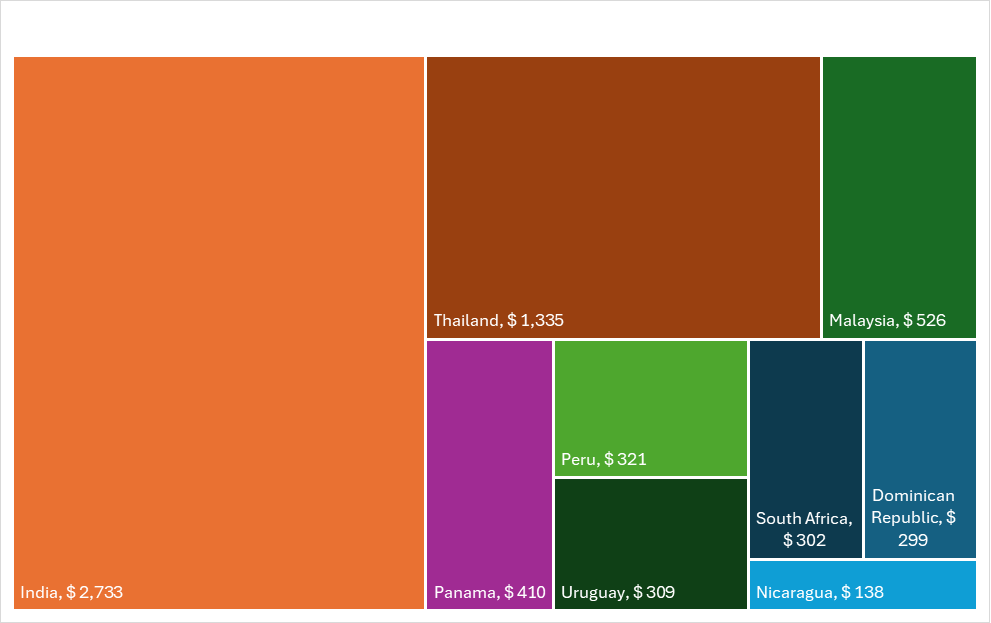
Figure. Estimated extraction of wealth from the Global South to U.S. oil companies through windfall revenue from crude oil exports in 2026, in million USD
Source: Own calculations using data from U.S. Energy Information Administration and Bloomberg (see Methodology)
While oil and gas companies profit, ordinary people bear the costs of Trump and Netanyahu’s war. In Iran and Lebanon, thousands have been killed or had their homes and livelihoods destroyed. In communities across the world, people struggle to heat their homes, cook their meals, and put gas in their cars as energy prices skyrocket due to the closure of the Strait of Hormuz, through which around 20% of the world’s petroleum and liquefied natural gas (LNG) flowed in 2025.
Trump’s war also pushes up the prices of petrochemicals and fertilizers, generating cascading effects throughout global food systems and industrial supply chains. As a consequence, households around the world are facing higher costs for food and other necessities. If the fuel price spikes from Trump’s war on Iran persists through the end of the year, even U.S. families —who are relatively insulated from the war’s economic impacts—are expected to pay an extra $1,258 in household costs. High energy prices are not only affecting the Global South; they are also hitting lower-income households in the United States. As of June 1, gasoline prices in the United States had increased by 41% per gallon, while diesel prices had risen by 37% since the beginning of March. This has led to higher prices across the country and a decline in the real value of wages for people living in the United States.
The most severe effects, however, are concentrated among low-income households in countries that rely on energy imported from the Persian Gulf, particularly in Africa and Asia. Some of these economies were already trapped in unjust debt associated with fossil-fuel dependence, leaving them highly exposed to external energy shocks.
India is one of the countries most affected by the crisis, given the country’s heavy reliance on imported energy. Households account for about 85–90% of the liquefied petroleum gas (LPG) used for cooking, making households particularly sensitive to supply disruptions and price volatility. 60% of this LPG is imported, and 90% of that comes from the Persian Gulf. The shortage of LPG has increased its price by 7% and forced the government to ration it for commercial users. At the macroeconomic level, rising energy import costs are placing additional pressure on India’s external accounts and foreign exchange reserves, contributing to financial uncertainty and capital outflows, which could increase unemployment and prices.
In Indian cities, long lines have formed at gas stations, while women bear the brunt of the crisis at home. Many are returning to firewood, biomass, and coal for cooking, exposing themselves to harmful indoor air pollution. While they are suffering, the oil exports from the U.S. to India increased by 29% between February and March. We estimate India had to pay around $271 million more for U.S. crude in March than if prices were at pre-war levels – a windfall in the pockets of U.S. producers. Over the year, we estimate that U.S. oil producers will get close to $3 billion in excess revenue from selling crude oil to India at war-inflated prices.
In April, reports indicated that 65 supertankers returned empty to the United States to load crude oil—more than double the average observed during the previous year. As we have written before, the U.S.’s role as the world’s top oil and gas producer and exporter likely played a role in the Trump administration’s reckless decision to wage its illegal war. They believed the U.S. would be relatively insulated from the risks, while U.S. oil and gas companies and their CEOs – including key Trump donors – could profit.
In fact, a comparable dynamic emerged in 2022 following Russia’s invasion of Ukraine, when spikes in oil and gas prices generated a substantial transfer of wealth from energy-importing countries to the wealthiest 1% of individuals in the United States. Similar patterns are expected to persist through 2026.
U.S. gas companies also profit from Trump’s war, with the potential to rake in billions by exporting liquified natural gas (LNG) and petrochemicals at elevated prices. In March, Iranian airstrikes shut down Qatar’s Ras Lafflan gas field, which supplies 17% of the country’s LNG exports, creating a gap in the market for U.S. LNG companies to exploit. In April, 13 LNG supertankers that were travelling from the United States to Europe were rerouted to Asia, probably looking to make more profits by selling the LNG at a higher price.
Big oil and gas companies’ profiteering from Trump’s war on Iran is hardly limited to U.S. oil companies. Global Witness estimates that the world’s top 100 oil and gas producers got more than $30 million every hour in excess profit in March alone due to the higher oil prices. In the first quarter, Shell, TotalEnergies, and BP reported profits of $15.5 billion, 39% higher than the same period last year.
These extraordinary gains are, in some cases, being padded by financial speculation by oil traders, including the trading divisions of big oil companies. Analysts estimate that trading accounted for between 48% and 69% of Shell, BP, and Total Energies’ increase in first quarter profits of 2026, compared to the final quarter of 2025.
In addition, the BBC found “a consistent pattern” of unusual trading activities in the oil sector minutes before Donald Trump made major announcements related to his illegal attacks on Iran. These transactions may have generated staggering profits for certain traders and raised serious concerns regarding the misuse of confidential information and potential violations of U.S. financial and securities laws.
As long as the global energy system relies on volatile fossil fuel markets, conflicts will continue to drive instability, economic shocks, and corporate profiteering. Fossil fuel companies can rake in profits from this volatility, while households are left with higher bills. The only real path to energy security is a just transition to affordable renewable energy.
Methodology
The analysis estimating a $38 billion extraction of wealth by United States oil producers from countries importing U.S. crude at war-inflated prices is based on U.S. Energy Information Administration (EIA) data on monthly net crude oil export volumes from the United States and Bloomberg price forecasts. Net import volumes of U.S. crude oil by country are compiled on a month-by-month basis from February (when oil prices began rising due to the risk of war) to December and then multiplied by price estimates. For February and March, we used actual import data; from April to December, we estimated volumes based on countries’ average monthly imports over the past three years. We multiplied the monthly import data by Bloomberg’s projected WTI Midland futures prices for each corresponding month in 2026 to estimate total export revenues under pre-war versus current market expectations. The excess, or windfall, revenue is defined as the difference between two price scenarios: the WTI futures curve projected in January 2026 (which averaged $57/bbl from Feb. to Dec.) and the revised WTI futures curve reflecting war-driven increases (which averages $91/bbl from Feb. to Dec.). Actual WTI prices are used for February to April, while for remaining months we use the forecast as of May 2026. This differential captures the additional revenue attributable to the upward revision in crude oil price expectations over the period.